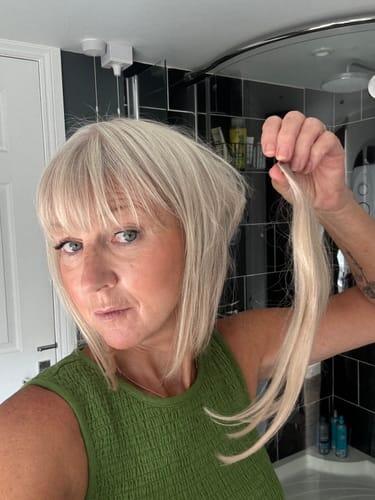
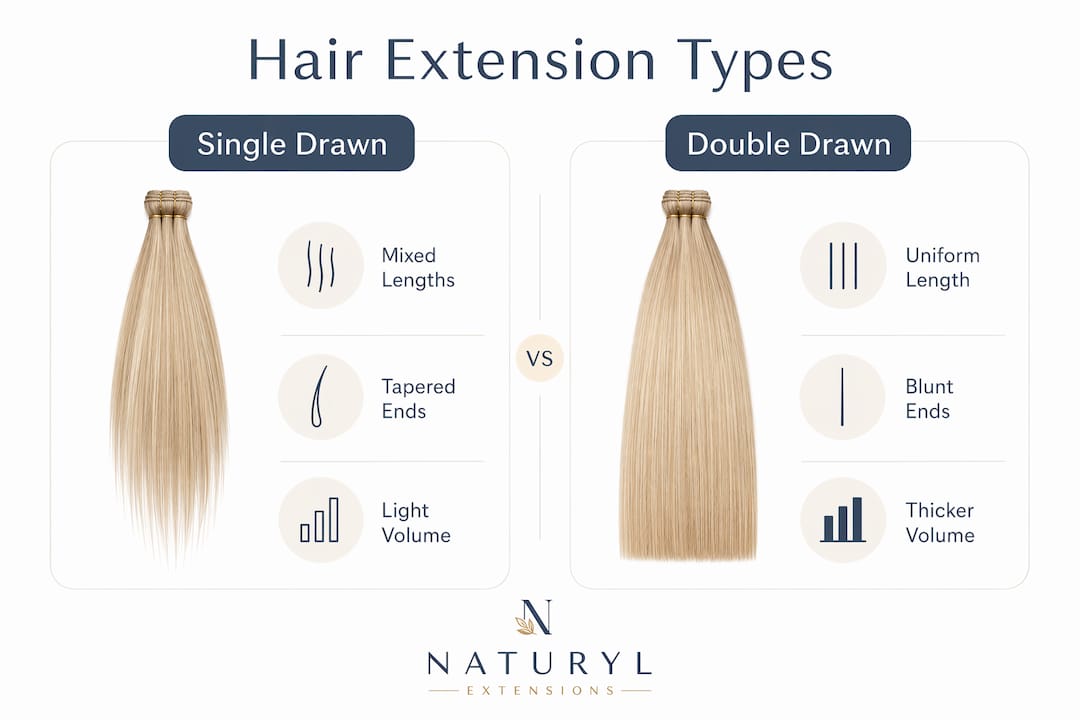
Double drawn hair is an extension bundle in which the majority of strands have been sorted to the same full length, producing uniform thickness from root to tip and a blunt, dense finish. If you want a high-volume, polished look, it is the construction to reach for. For everyday wear, where a natural, tapered fall matters more, single drawn hair is usually the better fit. Premium double drawn bundles, such as those made from Remy human hair, typically contain 70–80% full-length strands, and super double drawn grades declare 80–95%. Naturylextensions uses ethically sourced Remy human hair precisely because cuticle alignment and strand quality are what separate a genuine double drawn result from a disappointing one.
Table of Contents
- What does double drawn hair actually look like?
- How double drawn hair is made — and why it costs more
- Single drawn vs double drawn: a side-by-side comparison
- How to identify double drawn hair when buying
- Pros and cons of double drawn hair
- Who should choose double drawn hair?
- Maintenance and care for double drawn extensions
- How to choose between single drawn and double drawn
- Expert insight: tangling, humidity, and long lengths
- Key takeaways
- Why the “double drawn” label alone is not enough
- Naturylextensions Remy hair extensions: what to expect
- Further reading and sources
- FAQ
What does double drawn hair actually look like?
Hold a double drawn bundle at arm’s length and the difference from single drawn is immediate. The weft looks thick and even all the way down, with blunt, blocky ends rather than the gradual taper you see in a natural ponytail. When worn, it falls in a dense, sculpted curtain that photographs beautifully and holds a blunt cut without thinning out.
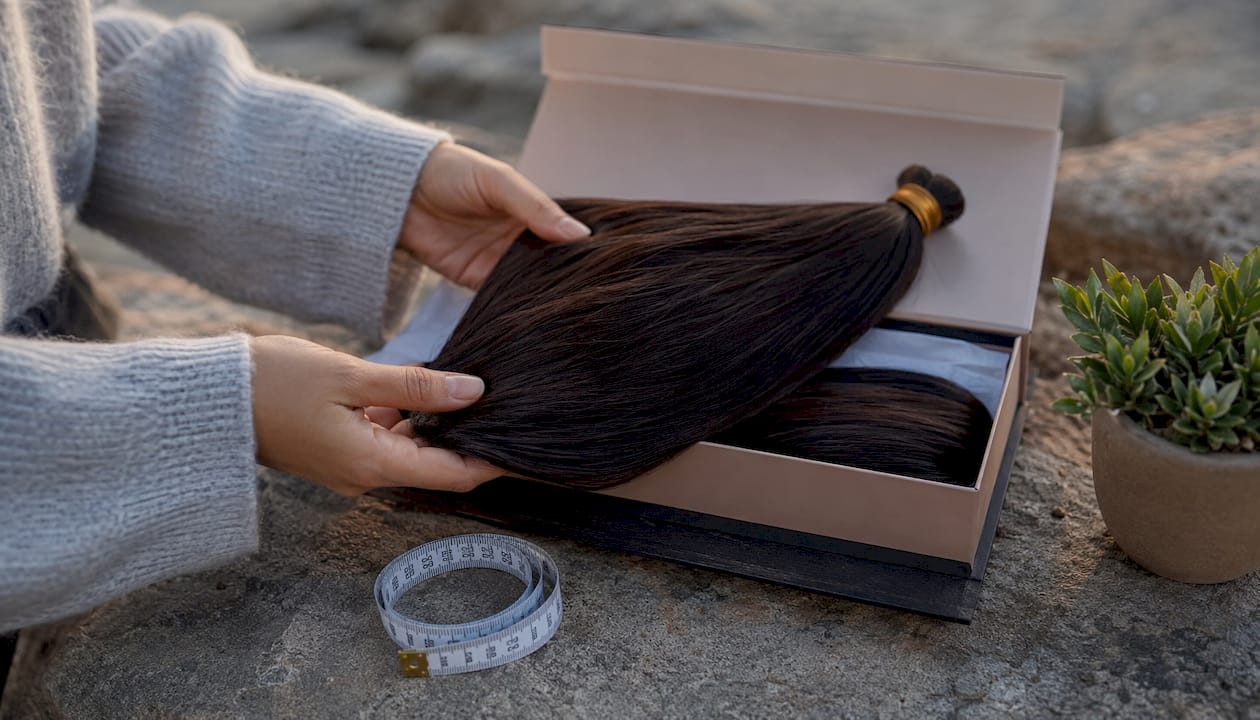
The term “double drawn” has no industry-wide standard, which matters when you are shopping. Some sellers use “super double drawn,” “triple drawn,” or proprietary grade names to suggest higher quality, but without a declared longest-hair percentage those labels mean very little. A reputable supplier will state the ratio; a vague grade name without a number is a red flag worth noting.
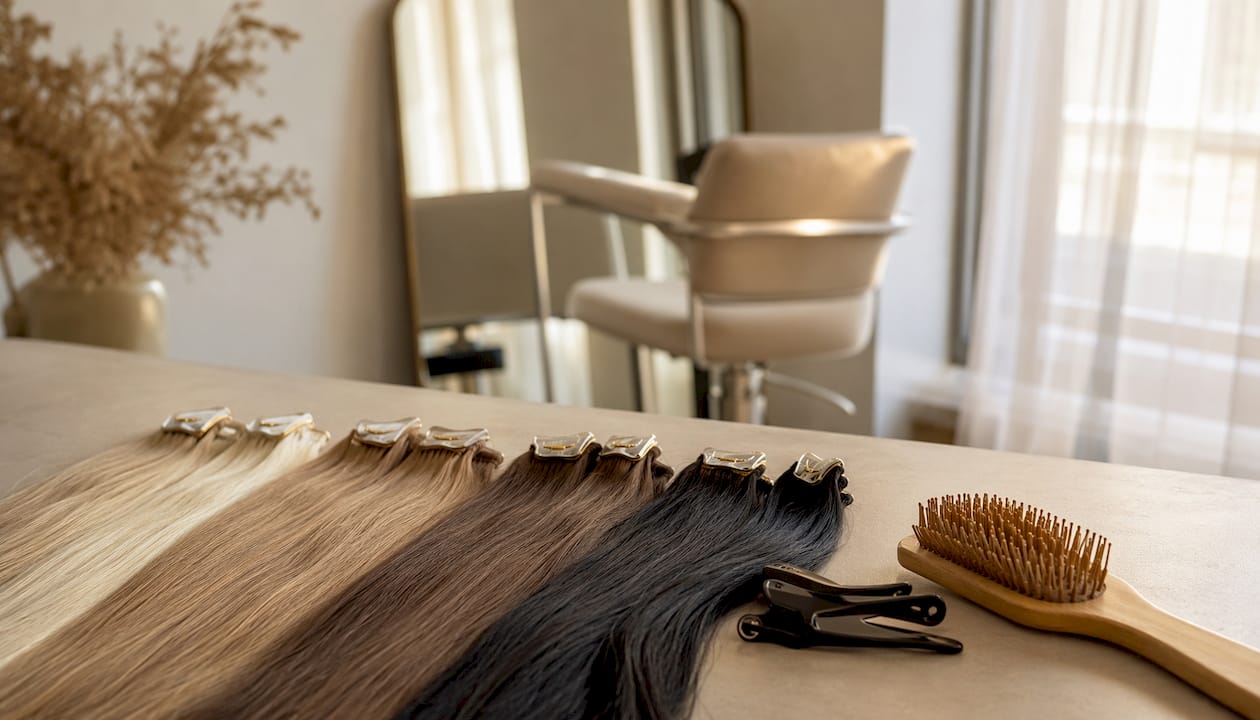
Remy human hair is the preferred base for premium double drawn extensions because the cuticles run in the same direction. That alignment reduces tangling and keeps the bundle looking smooth even at high density. Non-Remy hair processed to look double drawn tends to mat quickly once the silicone coating wears off.
How double drawn hair is made — and why it costs more
The process behind a double drawn bundle is straightforward in concept but labour-intensive in practice.
- Raw hair collection. Hair is gathered in ponytail form, keeping root-to-tip direction intact for Remy alignment.
- First comb-out. The bundle is combed to remove tangles and loose hairs.
- Manual sorting. Shorter strands are pulled out by hand, repeatedly, until the bundle meets the target full-length ratio. This step is what drives cost: it is slow, skilled work.
- Second pass (for super double drawn). The sorting is repeated to push the ratio from roughly 70–80% toward the 80–95% range.
- Wefting. The sorted hair is sewn or bonded into a weft and inspected for density consistency.
- Quality checks. Cuticle alignment, weft thickness, and tip uniformity are verified before packing.
The table below shows how the three main construction grades compare on the key factory metrics.
| Metric | Single drawn | Double drawn | Super double drawn |
|---|---|---|---|
| Full-length strand ratio | Moderate proportion | High proportion | Very high proportion |
| Tip appearance | Tapered | Blunt | Very blunt / thick |
| Relative cost | Lower | Higher | Highest |
| Labour intensity | Low | High | Very high |
For lengths of 24 inches and above, achieving true super double drawn ratios becomes practically difficult because raw hair of that length is rare. Buyers shopping for very long bundles should temper their expectations and ask suppliers for the declared ratio rather than trusting the grade label alone.
Single drawn vs double drawn: a side-by-side comparison
The choice between single drawn and double drawn comes down to the look you want, the weight your natural hair can carry, and your maintenance routine.
| Feature | Single drawn | Double drawn | Super double drawn |
|---|---|---|---|
| Ends appearance | Tapered, natural | Blunt, dense | Very blunt, blocky |
| Density / volume | Moderate | High | Very high |
| Weight on natural hair | Lighter | Heavier | Heaviest |
| Price point | Lower | Premium | Highest |
| Best for | Everyday, natural blend | Blunt cuts, events, volume | Maximum glamour, editorial |
| Tangling risk | Lower | Moderate–high | High |
| Available lengths | All lengths | All; ratio drops at 24"+ | Shorter lengths more reliable |
Double drawn bundles produce a seamless, salon-like density that single drawn simply cannot match at the tips. Single drawn, by contrast, tapers naturally and feels lighter for daily wear. The one-sentence rule: choose double drawn for sculpted, high-volume styles; choose single drawn when a natural blend and lighter weight matter more.
Statistic to note: Premium factories declare Double Drawn at approximately 70–80% full-length strands and Super Double Drawn at 80–95% — but no universal industry standard enforces these ranges, so always ask for the supplier’s declared figure.
How to identify double drawn hair when buying
Labelling is inconsistent across suppliers, so a visual and tactile check is worth doing before you commit.
Visual checks:
- Look at the weft from the side. A genuine double drawn bundle is noticeably thicker at the tips than a single drawn one of the same weight.
- Request close-up photos of the weft ends. Blunt, thick tips with few short hairs visible are the clearest sign of true double drawn construction.
- Check that density is consistent from the top of the weft to the bottom, not just at the root.
Questions to ask your supplier:
- “What percentage of strands are full length?” A trustworthy supplier will give you a declared longest-hair ratio rather than a vague grade name.
- “Is this Remy human hair with intact cuticles?”
- “Can you provide macro photos of the weft and tips before dispatch?”
Red flags to avoid:
- Grade names like “premium double drawn” or “luxury drawn” with no percentage stated.
- Very low prices for claimed double drawn at long lengths — genuine sorting is expensive.
- Blurry or distant product photos that make tip density impossible to assess.
Pros and cons of double drawn hair
The benefits
Double drawn hair delivers immediate, noticeable volume. Because the strands are uniform in length, the ends stay thick and full rather than thinning out, which suits blunt cuts, sleek ponytails, and any style where a polished, dense finish is the goal. You may also find you need fewer bundles to achieve the fullness you want, since each weft carries more usable length. For special occasions, the result is hard to beat.
The trade-offs
The higher cost is the most obvious drawback. Manual sorting is labour-intensive, and that cost passes to the buyer. Weight is the second consideration: a dense bundle is heavier than a single drawn equivalent, and that extra weight can place more tension at the roots, particularly on fine or fragile natural hair. Choosing a shorter length reduces this noticeably.
Tangling is the third trade-off. Dense blunt ends increase friction against clothing and other hair, which raises the risk of knots in humid conditions. A consistent detangling routine and silk or satin protection at night go a long way toward managing this.
Pro Tip: Ask your stylist to take a small trim or do light thinning at the tips after installation. You keep the double drawn density through the length while softening the blunt edge just enough to reduce friction tangles.
Who should choose double drawn hair?
Double drawn construction suits a specific kind of buyer. If your goal is a blunt-cut bob, a thick sleek ponytail, or a full, glamorous look for a wedding or event, the density and uniform length are exactly what you need. The volume boost is immediate and requires minimal styling to look full.
Hair type matters here. Medium to thick natural hair handles the additional weight of double drawn bundles well. If your natural hair is very fine or thinning, the extra weight can stress the roots and cause discomfort or, over time, breakage. In that case, a lighter single drawn option or a product designed for finer hair is a safer choice.
Length amplifies every trade-off. A 14-inch double drawn bundle is manageable for most wearers; a 24-inch one is considerably heavier and more prone to tangling. If you are new to extensions or have finer hair, starting at a shorter length lets you enjoy the density without the downsides.
Maintenance and care for double drawn extensions
A consistent routine protects your investment and keeps the blunt finish looking sharp.
- Detangle before washing. Start at the tips and work upward with a wide-tooth comb. Never pull from the root down on a dense bundle.
- Wash with a sulphate-free shampoo. Sulphates strip moisture and accelerate tangling in high-density hair. A gentle, moisturising formula preserves the cuticle layer.
- Condition mid-length to ends. Apply a lightweight conditioner from mid-shaft downward, avoiding the weft bonds. Leave for two to three minutes, then rinse thoroughly.
- Pat dry, do not rub. Friction while wet is when most tangling starts. Press the hair gently between a microfibre towel.
- Apply a silicone-free detangler. A lightweight spray keeps the blunt ends moving freely without product build-up.
- Use heat protectant before styling. A spray or serum applied before any heat tool protects the cuticle and reduces frizz.
- Sleep in a loose plait or braid. Securing the hair reduces overnight friction, which is the main cause of morning tangles in dense bundles.
- Brush twice daily. Morning and evening brushing with a soft-bristle extension brush prevents small knots from becoming large ones.
Pro Tip: Silk or satin pillowcases reduce friction significantly compared with cotton. If you prefer not to plait your hair at night, a satin bonnet achieves the same result.
For a full step-by-step Remy hair care routine, Naturylextensions has detailed guidance tailored to its extensions.
How to choose between single drawn and double drawn
Work through these four checkpoints before you buy.
1. What look do you want? If you are after a blunt cut, maximum volume, or a sculpted finish for an event, double drawn is the right construction. If you want a natural, seamlessly blended result for daily wear, single drawn is more forgiving.
2. How strong is your natural hair? Medium to thick hair handles double drawn weight comfortably. Fine or thinning hair is better served by a lighter bundle. Extensions that add volume safely without stressing the roots are a priority if your hair is fragile.
3. What is your budget? Double drawn costs more because of the sorting labour. If the price of a claimed double drawn bundle seems unusually low, the ratio is likely closer to single drawn.
4. Are you willing to maintain heavier bundles? Dense blunt ends require a consistent detangling routine. If you prefer low-maintenance wear, single drawn is the more practical choice.
Red flags at purchase:
- No declared full-length strand percentage from the supplier.
- Vague or distant product photos that hide tip density.
- No stated material (Remy human hair vs non-Remy).
- No exchange or return policy — a sign the seller is not confident in their product.
Always ask for the declared ratio, confirm the hair is Remy, and check the exchange policy before committing.
Expert insight: tangling, humidity, and long lengths
The reason double drawn hair tangles more than single drawn is mechanical, not a quality defect. Blunt ends create a larger, flat contact surface against clothing, other hair, and skin. In humid conditions, that surface area increases friction further, and knots form faster. Understanding this helps you manage it rather than blame the product.
For longer lengths, the effect compounds. A 20-inch double drawn bundle has significantly more contact surface than a 14-inch one, and the weight increases the downward pull that tightens knots once they form. Stylists often recommend keeping double drawn bundles at a comfortable maximum length for the wearer’s lifestyle rather than always choosing the longest available.
Distributing wefts strategically during installation, avoiding overly tight placements, and matching bundle weight to natural-hair strength are the most effective ways to reduce root tension. A professional installer who understands extension weight distribution makes a measurable difference to long-term comfort.
Pro Tip: If you are experiencing tangling at the nape or around the face, check whether the wefts in those areas are too dense for the natural hair underneath. Redistributing or removing one weft often resolves the problem without changing the overall look.
A caring for Remy hair extensions guide from Naturylextensions covers installation considerations and home-care steps in more detail.
Key takeaways
Double drawn hair delivers a blunt, uniform finish because a high proportion of strands are sorted to the same full length, making it the right choice for high-volume styles but a heavier, higher-maintenance option than single drawn.
| Point | Details |
|---|---|
| Definition | Double drawn = 70–80% full-length strands; uniform thickness root to tip; blunt ends. Super double drawn = 80–95% full-length strands. |
| Best use case | High-volume styles, blunt cuts, special events — not ideal for fine or thinning hair. |
| Key trade-off | Heavier and more prone to tangling than single drawn; requires a consistent care routine. |
| Buying check | Always ask for the declared full-length strand ratio — grade names alone are unreliable. |
| Naturylextensions | Offers ethically sourced Remy human hair extensions with free colour matching and UK delivery. |
Why the “double drawn” label alone is not enough
Most articles on this topic stop at the definition and the comparison table. What they underplay is how much the label varies between suppliers. A bundle sold as “double drawn” by one factory at 68% full-length strands and another at 79% will look and behave quite differently on your head, yet both carry the same name. The percentage is the product; the label is just marketing.
There is also a tendency to present double drawn as the premium default, the obvious upgrade from single drawn. That framing misses something. For everyday wear, a well-made single drawn bundle in Remy human hair often looks more natural and causes less root tension than a heavy double drawn one. The “better” construction depends entirely on the style and the wearer. Chasing the highest ratio without considering weight and maintenance is how buyers end up with extensions they find uncomfortable after a week.
The practical takeaway: ask for the number, match the construction to the occasion, and do not let a grade name do the thinking for you.
Naturylextensions Remy hair extensions: what to expect
If you have decided that double drawn density is what your style needs, the next step is finding extensions built to deliver it consistently. Naturylextensions sources premium, ethically sourced Remy human hair, with cuticles intact and aligned, so the density you see in the product photos is the density you wear.
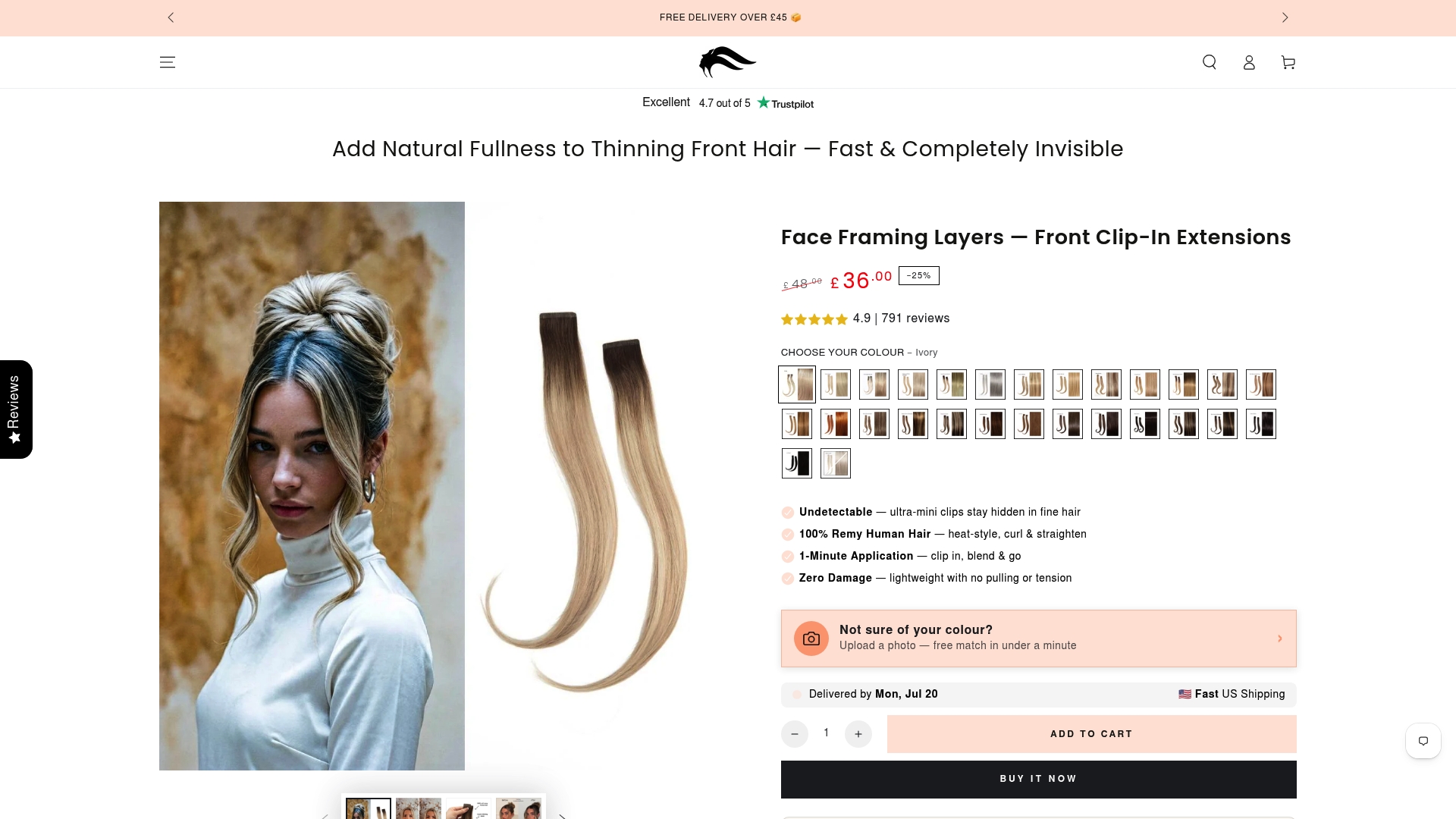
The range includes invisible wire extensions and Face-Framing Layers clip-ins, all available with a free AI colour-match service so you get the right shade without guesswork. UK delivery is fast, and a free exchange policy means you are not locked in if the shade or weight is not quite right. For anyone new to double drawn extensions, the colour-match service is a practical first step before committing to a full bundle.
Browse the full range at Naturylextensions or explore the Remy hair sourcing page to understand exactly what goes into each bundle before you buy.
Further reading and sources
Naturylextensions pages:
- What is Remy hair
- Single drawn hair explained
- Remy human hair care guide
- Caring for Remy hair extensions naturally
- Volume boost with hair extensions
External background sources used in this article:
- Super Double Drawn Hair vs Double Drawn Hair: What is It? — Lyn Hair
- Double Drawn Hair vs Single Drawn Hair — Sparx Hair
- Double Drawn Hair Extensions: Professional Factory Guide — Hair Notion
- Single Drawn vs Double Drawn Hair Extensions — Cliphair
- Single and Double Drawn Hair: Pros and Cons — 10by10styles
- Single-Drawn vs Double-Drawn: the Confusion Ends — Anka Hair
FAQ
What is double drawn hair?
Double drawn hair is an extension bundle in which the majority of strands are sorted to the same full length, producing uniform thickness and blunt ends from root to tip. Premium double drawn bundles typically contain 70–80% full-length strands, and super double drawn bundles declare 80–95%.
What is the difference between single drawn and double drawn hair?
Single drawn hair contains a mix of strand lengths, giving tapered ends and a lighter, more natural finish. Double drawn hair has most shorter strands removed, resulting in blunt, dense ends and noticeably more volume.
What are the disadvantages of double drawn hair?
The main disadvantages are higher cost, greater weight on natural hair, and an increased risk of tangling in humid conditions due to the dense, blunt ends creating more friction.
Is double drawn hair good quality?
Yes, when made from Remy human hair with intact cuticles and a declared full-length strand ratio. The grade name alone is not a reliable quality indicator; always ask the supplier for the percentage of full-length strands.
How do you identify double drawn hair?
Look for a weft that is thick and even all the way to the tips, with very few short hairs visible at the ends. Ask the supplier for the declared longest-hair ratio; a genuine double drawn bundle will have a stated percentage rather than a vague grade name.