Single drawn hair is a bundle of extensions containing strands of varying lengths, exactly as they were collected from the donor. A significant portion of those strands are shorter than the advertised length, which creates a bundle that is thick near the weft and tapers gently toward the ends. That taper is not a flaw. It is the natural shape of real, unblended hair, and it is what makes single drawn extensions blend so convincingly with your own.
What is single drawn hair?
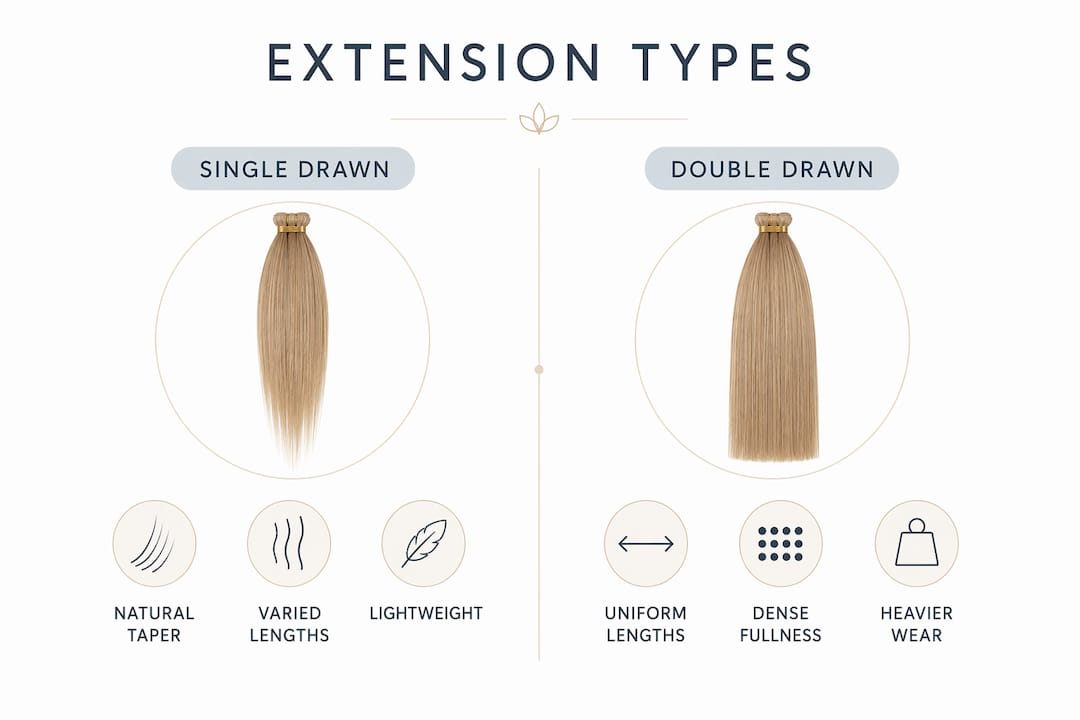
Single drawn hair keeps the natural mix of lengths that exists when hair is cut from a single donor. No shorter strands are removed. The bundle is wefted as collected, which means you get hair in its most authentic, unprocessed state.
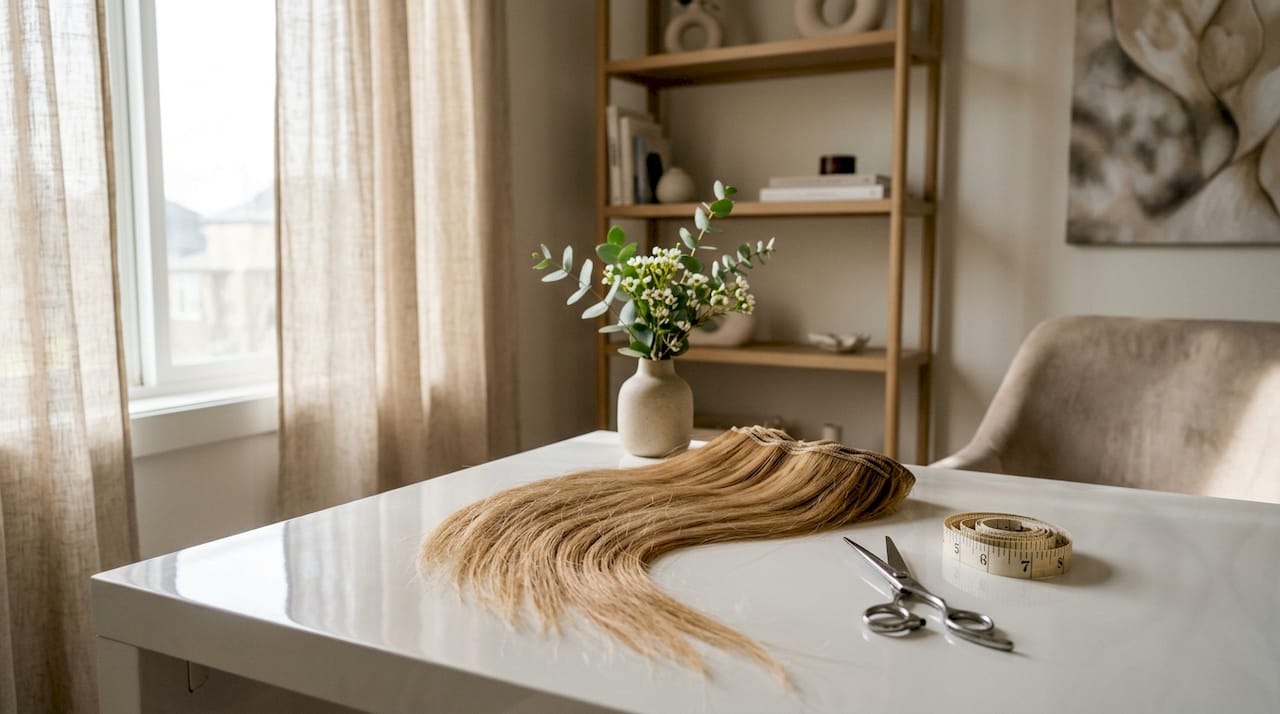
If you buy a 16-inch single drawn weft, roughly half of the strands will actually measure the full 16 inches. The rest will be somewhat shorter. This is not a quality issue. It mirrors exactly how hair grows on a real head, where every strand is at a slightly different stage of its growth cycle.
Key characteristics at a glance:
- Strands vary in length within the same bundle
- Thick and full at the weft, tapering toward the tips
- Creates a natural, layered, graduated finish
- Typically made from single-donor Remy hair with cuticles aligned
- More affordable than double drawn due to less processing
- Lifespan of 4–6 months with proper care
What is double drawn hair?
Double drawn hair goes through a sorting process after collection. Technicians remove the shorter strands by hand so that the finished bundle contains a large majority of fibres at the same length from root to tip. The result is a weft that stays equally thick all the way down, with blunt, dense ends.
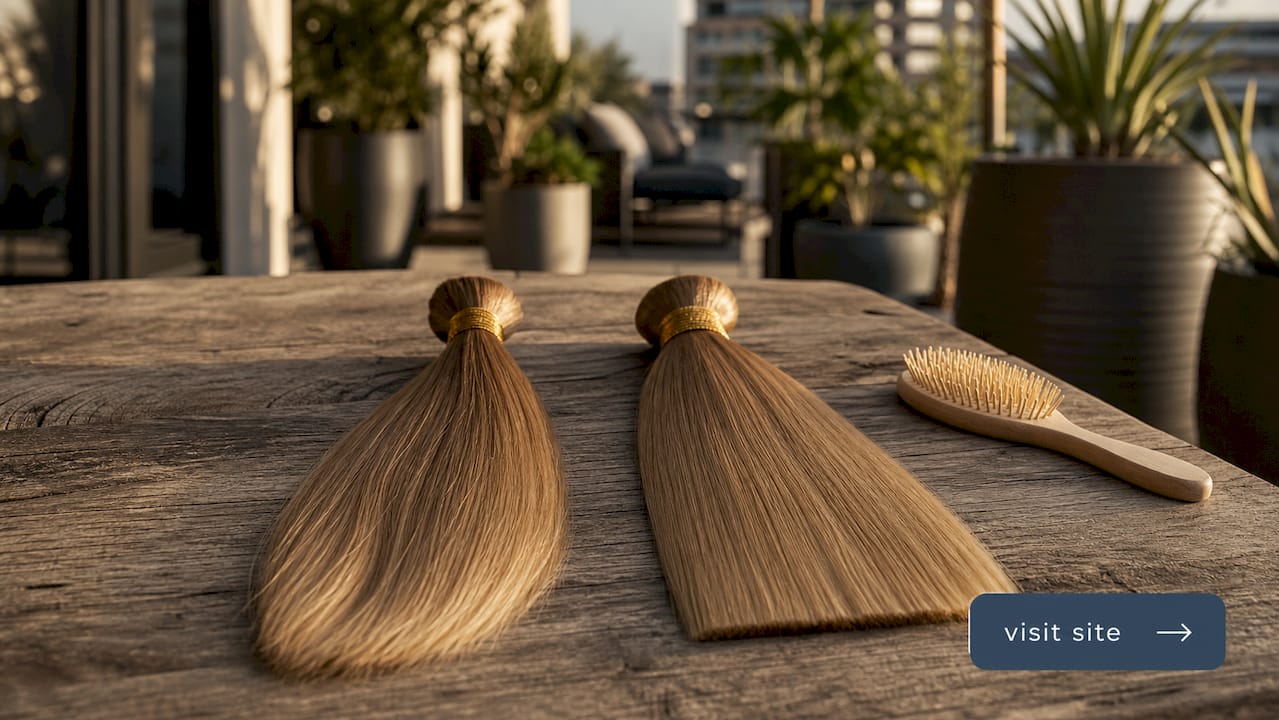
The name can mislead. “Double drawn” does not mean the hair was stretched or pulled twice. It refers to the hair passing through quality control twice, with shorter strands removed during each pass.
Key characteristics at a glance:
- Uniform strand length throughout the bundle
- Equal thickness from root to tip, no taper
- Dense, blunt ends that look full even after months of wear
- Requires more hours of hand sorting per bundle than single drawn
- Higher price point due to labour-intensive processing
- Lifespan of 12–18 months with proper maintenance
How do single drawn and double drawn hair extensions compare?
The core difference comes down to one thing: strand length uniformity. Everything else, including price, density, and lifespan, flows from that single distinction.
| Feature | Single drawn hair | Double drawn hair |
|---|---|---|
| Length uniformity | Natural variation; some shorter strands | Majority of strands at full stated length |
| Density/thickness | Tapers from weft to tips | Uniform thickness root to tip |
| Appearance | Natural, layered, graduated | Blunt, full, polished |
| Price | More affordable | Higher cost due to processing |
| Lifespan | 4–6 months | 12–18 months |
A few practical points worth understanding:
- “Double drawn” describes a sorting process, not a quality grade. Single drawn Remy hair can be just as high quality in terms of cuticle alignment and donor sourcing.
- The taper in single drawn hair mirrors authentic hair growth and is a sign of genuine single-donor hair, not necessarily inferior processing.
- Double drawn bundles often require fewer packs to achieve fullness, which can help offset their higher per-pack price.
- Single drawn extensions are the most widely available type in UK salons and retail, largely because of their lower production cost.
Advantages and disadvantages of each type
Single drawn hair
Advantages:
- Natural, blended finish that suits layered and casual styles
- Blends well with fine or thin hair without looking jarring or mismatched
- Lower price makes it accessible for everyday wear or first-time buyers
- Lighter weight, so more comfortable for long wear
- Easier to install and blend with your natural hair
Disadvantages:
- Tapered ends can look thin, especially after several months of wear
- Shorter lifespan of 4–6 months compared to double drawn
- Less volume at the tips, which may disappoint those expecting a dramatic, full look
- May require more packs to achieve the same density as double drawn
Double drawn hair
Advantages:
- Uniform density makes it ideal for dramatic volume and sleek, polished styles
- Longer lifespan of 12–18 months reduces the frequency of replacement
- Fewer bundles needed to achieve full coverage, offering value over time
- Ends stay thick and full even after extended wear
Disadvantages:
- Higher upfront cost due to the labour-intensive sorting process
- Heavier to wear, which some people find uncomfortable over a full day
- The blunt, uniform look can appear less natural against fine hair
- Achieving true single-donor double drawn is difficult; many bundles blend hair from multiple donors to replace the volume lost during sorting
Which is better: single drawn or double drawn hair?
Neither type is universally better. The right choice depends entirely on your hair type, the look you want, and how long you need the extensions to last.
Single drawn hair tends to work well when your natural hair is fine or thin and you want extensions that blend without contrast; prefer a layered, casual style rather than a blunt, uniform finish; are buying extensions for a specific event or shorter-term use; or have budget considerations.
Double drawn hair may be a better choice when you want maximum volume and a full, blunt finish from root to tip; are investing in extensions for long-term, daily wear; your natural hair is thick and you need extensions to match that density; or you are styling for a sleek, polished look.
Pro Tip: If you love the authenticity of single drawn hair but want denser ends, order a length longer than you need and have it trimmed. Cutting away the last few inches removes the taper entirely, leaving you with thick, blunt ends made from genuine single-donor hair.
How to choose between single drawn and double drawn extensions
Start with your natural hair texture. If your hair is fine or thin, single drawn extensions will create a proportional, graduated transition that looks far more natural than a blunt double drawn weft placed against wispy ends. You can read more about finding the right fit in the extensions for thin hair guide from Naturylextensions.
Consider the style you wear most often. Layered, tousled, or wavy styles suit single drawn hair well because the natural variation in length adds movement. Sleek, straight styles or blunt bobs tend to look better with double drawn, where the uniform density holds the shape cleanly.
Think about how long you want the extensions to last. Single drawn hair at 4–6 months is a sensible choice for someone who likes to change their look regularly. Double drawn at 12–18 months suits those who want a set-and-forget investment.
Key factors to weigh before buying:
- Your natural hair texture and density
- The style you wear day to day
- How long you need the extensions to last
- Your budget for both the initial purchase and ongoing maintenance
- Whether you prefer to buy multiple packs of single drawn or fewer packs of double drawn
Pro Tip: Single drawn hair is designed to be layered. For lengths up to around 16 inches, two packs typically give salon-level fullness. For 18 inches and above, three or more packs will give you the density you are looking for.
Industry insights on single drawn vs double drawn hair
One of the most persistent myths in the extensions industry is that double drawn hair is simply better quality. It is not. Double drawn is a stylistic choice, not a quality grade. The sorting process affects density and uniformity, not the underlying integrity of the hair itself.
The taper in single drawn hair is often a mark of authenticity. True single-donor hair is naturally single drawn, because every strand on a real head is at a different length. When you see that gentle taper, you are looking at hair that has not been cut, blended, or over-processed to achieve a uniform appearance.
Achieving genuine single-donor double drawn hair is difficult. To create a fully uniform bundle, manufacturers either discard a significant portion of the hair by weight, or blend in strands from other donors to replace lost volume. The first approach is wasteful and expensive. The second compromises the single-donor status entirely.
Key professional insights:
- The 15–25% price premium for double drawn is justified by its longer lifespan and material efficiency, but only when the client actually wants that result
- Single drawn hair is the dominant choice in UK salons because it suits a wider range of natural hair types
- For professionals sourcing extensions, events like Cosmoprof Worldwide offer direct access to suppliers where you can assess drawing quality in person before committing to wholesale orders
- The hackle sorting technique used in double drawn processing has roots in centuries of wig-making and requires skilled hand work that machines cannot replicate
How single drawn hair is processed
Single drawn hair starts as a ponytail cut directly from a donor. The hair is collected in its natural state, which means it already contains a full range of lengths, exactly as it grew. After collection, it is cleaned, conditioned, and checked for cuticle alignment to confirm it qualifies as Remy hair.
The wefting process is relatively straightforward. The hair is laid flat, aligned at the root end, and machine-sewn into a weft without any sorting to remove shorter strands. Because the processing is minimal, the hair retains its natural variation and its cuticle integrity. The entire process takes around 1–2 hours per bundle, which is why single drawn extensions cost less to produce and buy.
Quality single drawn hair should be collected ethically, never acid-bathed, and never coated with silicone to fake shine. Those shortcuts mask damage and lead to tangling and matting within weeks.
Common uses and applications of single drawn hair
Single drawn extensions suit a wide range of everyday styles and application methods. Their natural taper makes them particularly well suited to:
- Clip-in extensions for adding length and subtle volume without commitment
- Invisible wire extensions for a quick, damage-free transformation that sits naturally with your own hair
- Ponytail extensions where a graduated finish blends with your natural ponytail
- Layered and wavy styles where the variation in strand length adds movement and dimension
- Fine or thin hair where a blunt double drawn weft would look disproportionate
Single drawn hair is also the go-to choice for everyday wear because it is lighter and more comfortable than double drawn. For weddings, events, or occasions where you want a polished finish, pairing single drawn extensions with a good layered cut gives a result that looks genuinely grown from your own scalp. Good hair extension care practices will keep them looking their best throughout the wear period.
How to spot authentic single drawn hair
Genuine single drawn hair has a few tell-tale signs that are easy to check before you buy or after your order arrives.
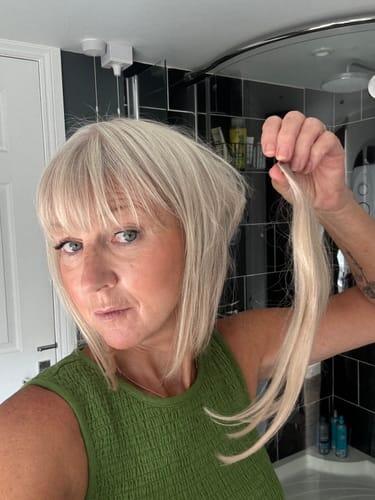
Hold the weft at the top and let it hang. Authentic single drawn hair will be noticeably thicker near the weft and taper gradually toward the ends. If the bundle is equally thick from top to bottom, it has been double drawn or the ends have been cut to disguise the taper.
Run your fingers through the ends. Single drawn ends feel slightly wispy and soft, not blunt or dense. That softness is a sign of natural length variation, not poor quality.
Check for cuticle alignment. Remy single drawn hair should have all cuticles running in the same direction. Rub a small section between your fingers upward and downward. Genuine Remy hair will feel smooth in one direction and slightly resistant in the other.
Look at how the extensions are described. Authentic single drawn hair is often listed as a length range, such as 14–16 inches, rather than a single precise length. That range reflects the natural variation in the bundle. A listing that promises every strand at exactly one length is describing double drawn hair, not single drawn.
Price and value: single drawn vs double drawn
Single drawn extensions are consistently more affordable than double drawn, typically by a meaningful margin. The lower price reflects the reduced processing time of 1–2 hours per bundle compared to the 4–6 hours required for double drawn.
That said, value is not the same as price. Single drawn hair may require more packs to achieve the same density as double drawn, which narrows the cost gap. Double drawn hair, with its 12–18 month lifespan versus 4–6 months for single drawn, can work out more economical over a full year of wear if you factor in replacement frequency.
A practical way to think about it: single drawn is the better value choice for shorter-term wear, occasional use, or fine hair where you do not need maximum density. Double drawn justifies its higher price for daily wear, dramatic styles, or anyone who wants to buy once and not think about replacement for over a year.
Key takeaways
Single drawn hair is the most authentic form of human hair extensions, offering a natural tapered finish that blends well with fine hair and suits layered styles.
| Point | Details |
|---|---|
| Natural taper is a feature | The graduated finish mirrors real hair growth and signals genuine single-donor sourcing. |
| Lifespan difference is significant | Single drawn lasts 4–6 months; double drawn lasts 12–18 months due to uniform density. |
| Processing time drives price | Single drawn takes 1–2 hours per bundle; double drawn requires 4–6 hours of hand sorting. |
| Double drawn is not better quality | It is a sorting process that creates uniformity, not a higher grade of hair. |
| Fine hair suits single drawn best | The natural taper blends proportionally with thin or fine natural hair. |
FAQ
What is the difference between single drawn and double drawn hair?
Single drawn hair contains a natural mix of strand lengths, creating a tapered bundle that is thicker at the weft and thinner at the ends. Double drawn hair has had shorter strands removed by hand so that the majority of fibres are the same length, giving a uniform, blunt finish from root to tip.
Is single drawn hair good quality?
Yes. Single drawn hair made from Remy, single-donor hair with aligned cuticles is high quality. The tapered ends reflect authentic hair growth, not inferior processing, and the extensions blend naturally with most hair types.
Is double drawn hair better quality?
Not automatically. Double drawn describes a sorting process that creates uniform density, not a higher grade of hair. For dramatic volume and long-term wear, it delivers better results. For a natural, layered look or fine hair, single drawn is often the more suitable choice.
What are the disadvantages of double drawn hair?
Double drawn hair costs more, is heavier to wear, and can look less natural against fine hair. Achieving true single-donor double drawn is also difficult, as manufacturers often blend hair from multiple donors to replace the volume lost during sorting.
How long does single drawn hair last?
With proper care, single drawn extensions typically last 4–6 months. Gentle washing, avoiding excessive heat, and storing them correctly will help you get the most from the wear period.