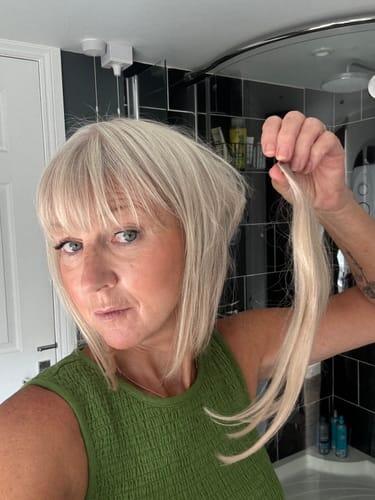
Thinning elsewhere too? Our guide to hair extensions for thin and fine hair covers the front, the sides and all-over volume as well as ponytails.
For thin or fine hair, a lightweight clip-in wrap ponytail in Remy human hair is the safest and most natural-looking starting point. It distributes weight across a wider base rather than concentrating it on a single bond, blends convincingly with sparse natural hair, and comes off at the end of the day with zero commitment.
The single most important rule for thin hair: choose a ponytail extension under 80g, made from Remy human hair, with a wrap or drawstring attachment. Anything heavier or poorly attached will pull, slip, and show.
Two close alternatives are worth knowing. A drawstring invisible wire ponytail suits anyone who wants a slightly more secure fit for an event, because the wire sits discreetly around your base ponytail and tightens without clips. A lightweight claw-clip ponytail is the fastest option for everyday wear, though it works best when your natural hair has at least some density at the crown.
- Wrap/clip-in: most versatile, suits most density levels, easiest to blend
- Drawstring/invisible wire: more secure for events, minimal visible attachment
- Claw-clip: fastest to apply, better for moderate rather than very fine hair
Key takeaways
A lightweight Remy human-hair clip-in or drawstring ponytail, colour-matched precisely and worn at low tension, is the safest and most natural-looking choice for thin or fine hair.
| Point | Details |
|---|---|
| Choose lightweight Remy hair | Aim for 60–80g; Remy human hair blends and moves more naturally than synthetic on fine hair. |
| Check minimum hair length | You need at least 8–12cm of natural hair to anchor a ponytail extension securely. |
| Colour match before buying | Use a free AI colour-match service or order a swatch; mismatches show more on fine hair. |
| Apply with low tension | Backcomb the base lightly, use a fine elastic, and wrap a strand to hide the clip. |
| Naturyl Extensions for thin hair | Lightweight clip-in Remy ponytails with free colour-match and free UK exchange, available at naturylextensions.com. |

Recommended for this guide
Clip-In Ponytail Extensions
A full, swishy ponytail in under two minutes, colour-matched to your hair.
100% Remy human hair · 7 shades · from £99 · Rated 4.7 “Excellent” on Trustpilot · Free UK delivery · Free colour exchanges
Shop ponytail extensions → Free colour match from a photoWhich types of ponytail extensions actually work for thin hair?
Not every ponytail style is built equally for fine hair. The key variable is how the attachment spreads weight across your natural strands, because fine hair has a lower load tolerance than thick hair.
| Ponytail type | Attachment method | Weight distribution | Best for | Fine-hair suitability |
|---|---|---|---|---|
| Wrap/clip-in | Small clip + wrapped strand | Across base ponytail | Everyday and events | Excellent |
| Drawstring/invisible wire | Wire loop + drawstring | Around full base | Events, secure hold | Excellent |
| Claw-clip ponytail | Claw grip | Single pressure point | Quick daily use | Moderate |
| Weft ponytail (sewn-in) | Braided base | Across braid | Long-term wear | Poor without stylist |
Clip-in and tape-in wefts are recommended for fine and thinning hair precisely because they spread weight across a wide weft that distributes weight safely rather than concentrating it on a single small bond. A wrap/clip-in ponytail follows the same logic: the clip anchors to a gathered base, and a thin strand of hair wraps around to hide it, so no single shaft of natural hair bears the full load.
Invisible wire drawstring styles are similarly gentle. The wire distributes tension evenly around the circumference of your base ponytail rather than gripping one spot. For very fine hair, this even spread is what keeps the style comfortable across a full day.
Claw-clip ponytails are convenient but concentrate pressure at one point. On very fine or fragile hair, that single grip can cause slippage and, over time, localised stress. They are fine for occasional short-term wear, not daily use.
- Avoid sewn-in or braided ponytail bases without a professional fitting: the braid tension alone can strain fine hair.
- Synthetic ponytails tangle faster, cannot be heat-styled safely, and rarely match Remy human hair’s natural movement on sparse hair.
Pro Tip: When browsing product pages, look for the gram weight listed in the product specs. For fine hair, aim for a lightweight ponytail extension. If a product lists no weight at all, treat that as a red flag and move on.
How do you choose the right ponytail for fine or thin hair?
Buying the wrong ponytail extension is easy when product pages are vague. These are the filters that actually matter.
Minimum natural hair length
You need enough natural hair to gather into a small base ponytail that the extension can anchor to. As a general guide:
- Wrap/clip-in ponytail: natural hair from about a few inches at the nape
- Drawstring/invisible wire ponytail: natural hair from a short length suitable to loop around, as the wire needs something to loop around
- Claw-clip ponytail: works best from a moderate length upwards, as the claw needs a gathered bunch to grip
What to check on a product page
Manufacturers who publish bond-weight specs and weft dimensions make safer choices easier for buyers with fine hair; the absence of these specs is a red flag. Before you buy, confirm:
- Gram weight: 60–80g for fine hair; avoid anything over 100g as a first purchase
- Weft width: wider wefts (30–40mm) spread load more safely
- Attachment size: small clips and thin drawstrings are preferable to bulky clamps
- Material: Remy human hair, with cuticles aligned in one direction, for natural movement and longevity
- Returns and exchange policy: a free exchange option protects you if the shade is slightly off
Colour matching
Colour mismatch is more visible on fine hair than on thick hair because sparse strands let the extension show through. Even a close tonal difference can look obvious at the ponytail base. A free AI colour-match service, like the one Naturyl Extensions offers, reduces this risk considerably. If you are between shades, ordering a paid swatch before committing to a full ponytail is a sensible step.

For a deeper look at extensions for thin hair and how to evaluate options by density and texture, Naturyl Extensions has a dedicated guide.
Typical UK price ranges
Quality Remy human-hair clip-in ponytail extensions in the UK generally fall between £30 and £90, depending on length and gram weight. Synthetic options are cheaper but rarely worth it for fine hair given the blending and longevity trade-offs. Budget at the lower end of the Remy range for shorter lengths (35–45cm); longer or thicker pieces sit toward the top.
How to apply a ponytail extension on thin hair so it stays put
The base preparation is everything. A poorly secured natural ponytail will let the extension slip within an hour, regardless of how good the product is.
- Start with dry, lightly texturised hair. Apply a small amount of texturising spray or dry shampoo to your roots. Fine hair is slippery; a little grip product at the base makes a real difference.
- Gather your natural hair into a low or mid ponytail. Keep it tight but not painfully so. Use a fine elastic band that matches your hair colour.
- Backcomb the base of your ponytail lightly. Just two or three strokes with a fine-tooth comb at the root area creates a small amount of texture for the clip to grip.
- Attach the clip-in ponytail. Open the clip, position it directly over your elastic, and press it shut. For a drawstring style, loop the wire around your base ponytail and pull the drawstring until snug.
- Wrap a thin strand of hair around the base. Take a small section from the underside of your natural ponytail, wrap it around the join between your hair and the extension, and secure with a small grip or bobby pin underneath.
- Blend the ends. Gently comb the extension into your natural hair at the tail. If lengths differ, a light curl or wave unifies them.
For a full visual walkthrough, the step-by-step ponytail installation guide from Naturyl Extensions covers each stage in detail.
Pro Tip: Never pull the elastic so tight that you feel tension at the hairline. On fine hair, that tension accumulates quickly. A medium-firm hold is enough; the wrap strand and grip do the rest.
- Use a fine, snag-free elastic rather than a thick band.
- Keep a few small clear or colour-matched grips in your bag for mid-day adjustments.
- If the extension feels heavy after an hour, the gram weight is likely too high for your density.
Blending and styling tips that make thin hair look fuller
The extension itself adds length, but blending is what makes it look like your own hair. These techniques work consistently on fine hair.
- Match the texture before you attach. If your natural hair is straight, attach the ponytail straight. If you plan to add waves, curl both your natural hair and the extension together after attaching, so the texture is uniform from root to tip.
- Use a light texturising spray on the extension. Remy human hair can look slightly shinier than fine natural hair. A small mist of texturising spray dulls the sheen just enough to match.
- Curl in sections from mid-length downward. Use a 25–32mm barrel at 160–180°C. Curling adds volume and disguises any density difference between your natural hair and the extension.
- Position the base ponytail slightly lower than you think. A mid or low ponytail sits closer to where your hair is densest, making the base easier to hide and the overall style more convincing.
- For an event updo, wrap the extension into a loose bun or twist and pin it. The extra length gives you material to work with that fine natural hair alone rarely provides. For formal event styling ideas, hair accessories for formal occasions can complement a ponytail extension beautifully.
Pro Tip: Distribute the extension’s weight evenly by fanning the weft slightly before attaching. Bunching all the hair to one side of the base creates an uneven pull on fine strands underneath.
For more detailed blending techniques, the Naturyl Extensions guide on styling ponytail extensions naturally covers sleek, bouncy, and event looks.
How to care for Remy human-hair ponytail extensions
Remy human-hair ponytails last considerably longer than synthetic alternatives when maintained correctly. The cuticle alignment that makes them blend so well also makes them responsive to the same care routine as your natural hair.
- Wash infrequently. Unless you use heavy product, washing every 10–15 wears is sufficient. Over-washing strips the hair’s natural oils and shortens lifespan.
- Use sulphate-free shampoo and a moisturising conditioner. Apply conditioner from mid-length to ends only; avoid the weft or clip area.
- Wash gently. Submerge the ponytail in cool water, work product through with your fingers in a downward motion, and rinse thoroughly. Never scrub or bunch the hair.
- Air-dry where possible. Lay the ponytail flat on a towel or hang it to dry. If you use a dryer, keep it on a low heat setting.
- Heat-style at 160–180°C maximum. Always apply a heat protectant spray before using straighteners or a curling iron. Remy hair tolerates heat well within this range; higher temperatures cause irreversible dryness.
- Store in a silk or satin bag. Loose storage in a drawer causes tangling and matting. A dedicated bag keeps the hair aligned and protected.
- Brush from ends upward. Use a soft-bristle or loop brush, starting at the tips and working toward the weft. Never drag a brush straight through from root to end.
Pro Tip: A small amount of lightweight argan oil applied to the ends after washing keeps Remy hair looking glossy and reduces friction-related tangling during storage.
Can you use ponytail extensions on very thin or thinning hair?
The short answer is yes, in most cases, provided you choose the right attachment style and weight. Extensions and fillers can significantly improve the look of fine hair and thinning ponytails, though they restore appearance and styling options rather than regrowing hair. Setting that expectation clearly matters.
The main risk for very fine or thinning hair is traction. Repeated high-tension styles can contribute to traction alopecia, a form of hair loss caused by sustained pulling at the follicle. A clip-in or drawstring ponytail worn at a comfortable tension and removed daily carries a much lower risk than a permanently bonded extension or a chronically tight style.
When to pause before buying: if your hair is actively shedding more than usual, if your scalp is tender or inflamed, or if you have been diagnosed with alopecia areata or another scalp condition, consult a trichologist or dermatologist before using any extension. Extensions are not suitable as a cover for an untreated scalp condition.
- Avoid wearing any ponytail extension for more than 8–10 hours at a stretch.
- Rotate your ponytail position (low, mid, side) across different days to avoid repeated tension at the same point.
- Micro rings and miniature micro rings can be low-damage when padded and fitted correctly, but for a removable ponytail, clip-in and drawstring styles remain the lowest-risk daily option.
- If you notice increased shedding after wearing extensions, take a break and seek professional advice.
Pro Tip: Alternate your ponytail extension days with loose, low-tension styles. Giving your natural hair two or three days of rest between extension wears reduces cumulative stress on fine strands.
What choosing ponytails for thin hair has taught us
There is a tendency in the extensions market to treat fine hair as a problem to solve with more product. More volume, more grams, longer lengths. The reality is the opposite: fine hair needs less, not more. A 60g Remy clip-in ponytail, colour-matched precisely and attached with a light hand, will look more convincing and feel more comfortable than a 120g piece forced onto sparse roots.
The other thing that gets underestimated is colour matching. On thick hair, a shade that is slightly off reads as a highlight. On fine hair, it reads as an extension. A free AI colour-match service or a paid swatch is not a luxury for fine-hair buyers; it is the step that determines whether the result looks natural or obvious.
Naturyl Extensions builds its ponytail range with both of these principles in mind: lightweight Remy human hair, a free AI colour-match tool, and a free exchange policy so you are not stuck with a shade that does not work. For fine hair specifically, that combination of lightweight construction and accurate colour is what separates a good result from a great one.
Naturyl Extensions ponytail extensions for thin hair

Naturyl Extensions offers clip-in Remy human-hair ponytail extensions designed with fine hair in mind: lightweight construction, a wrap attachment that hides the base cleanly, and Remy hair that moves and blends like your own. The free AI colour-match service means you can submit a photo and get a shade recommendation before you order, which is particularly useful when your natural hair is fine enough that a mismatch would show.
UK delivery is fast, and the free exchange policy means that if the shade or weight is not quite right, you can swap without hassle. For anyone considering an invisible wire option alongside a ponytail, the full range is available at Naturyl Extensions. Browse the ponytail collection, use the colour-match tool, and place your order with confidence.
Ready to try it?
Clip-In Ponytail Extensions
A full, swishy ponytail in under two minutes, colour-matched to your hair.
100% Remy human hair · 7 shades · from £99 · Rated 4.7 “Excellent” on Trustpilot · Free UK delivery · Free colour exchanges
Shop ponytail extensions → Free colour match from a photoFAQ
Can you put ponytail extensions in very thin hair?
Yes. A lightweight clip-in or drawstring ponytail in Remy human hair works well on thin hair, provided you gather enough natural hair (at least 8–10cm) to form a small base and keep the attachment tension low.
What are the best ponytail extensions for thin hair?
Lightweight clip-in or invisible wire drawstring ponytails in Remy human hair, weighing 60–80g, are the most suitable. They distribute weight across the base rather than concentrating it on individual strands, reducing the risk of slippage and stress on fine hair.
Which hair extensions are least damaging for very thin hair?
Clip-in and drawstring ponytail extensions are the lowest-risk option for daily wear because they are fully removable. For longer-wear methods, tape-ins and clip-ins spread weight across a wider weft and are generally recommended over single-bond methods for fine hair.
Are ponytails bad for thinning hair?
A ponytail worn at moderate tension and removed daily is unlikely to cause harm. The risk arises from repeated high-tension styles that contribute to traction alopecia. Rotating your ponytail position and taking regular breaks significantly reduces that risk.
How long do Remy human-hair ponytail extensions last?
With proper care (gentle washing every 10–15 wears, heat-styling at 160–180°C with a protectant, and storage in a silk bag), a quality Remy human-hair ponytail extension typically lasts 6–12 months of regular use.