Choose double drawn for a thick, uniform finish and single drawn for softer, natural-looking movement, and let your budget and desired silhouette decide the rest.
TL;DR:
- Double drawn hair contains around 70–90% full-length strands, resulting in a thicker, more uniform appearance compared to single drawn hair, which has about 50–70%.
- Manufacturing double drawn hair requires a second sorting process that discards more shorter strands, which explains its higher cost and longer-lasting fullness.
- The difference in appearance and weight affects comfort, with double drawn being heavier and better suited for occasion wear, while single drawn is lighter and more natural-looking for daily use.
- Buyers can identify the grade by performing simple tests such as the ponytail fan test, checking tip density against root, or measuring individual strands against the labeled length.
- Price premiums for double drawn hair reflect the greater raw material loss during production, not necessarily better quality, so transparency about percentage ratios is essential when choosing a product.
Table of Contents
- Double drawn vs single drawn: what the terms actually mean
- Why double drawing costs more: the manufacturing story
- How to spot single drawn vs double drawn before you buy
- Appearance, comfort and cost: the real trade-offs
- Choosing between single and double drawn for your hair and budget
- Expert notes from Naturylextensions on sourcing and drawing level
- How I guide clients through this decision
- Which Naturyl set matches the look you’re after
- Sources
- FAQ
Double drawn vs single drawn: what the terms actually mean
“Drawing” is a sorting process, not a treatment. When raw human hair is collected, it arrives in bundles with strands of wildly different lengths mixed together. A processor combs through that raw hair and pulls out the shorter pieces, leaving behind a bundle where more strands share the same length. Do that once, and you get single drawn hair. Do it a second time, sorting even more aggressively, and you get double drawn hair.
Neither term describes how the hair was grown, coloured, or textured. It is purely about length uniformity within a bundle, a distinction Conde Professional’s guide to double drawn hair makes clear when it notes that the same raw-grade Remy hair can be sold as either single or double drawn depending only on how it was sorted. A supplier could take identical quality hair from the same donor and produce both grades from it.
What differs is the proportion of full-length strands you end up with:
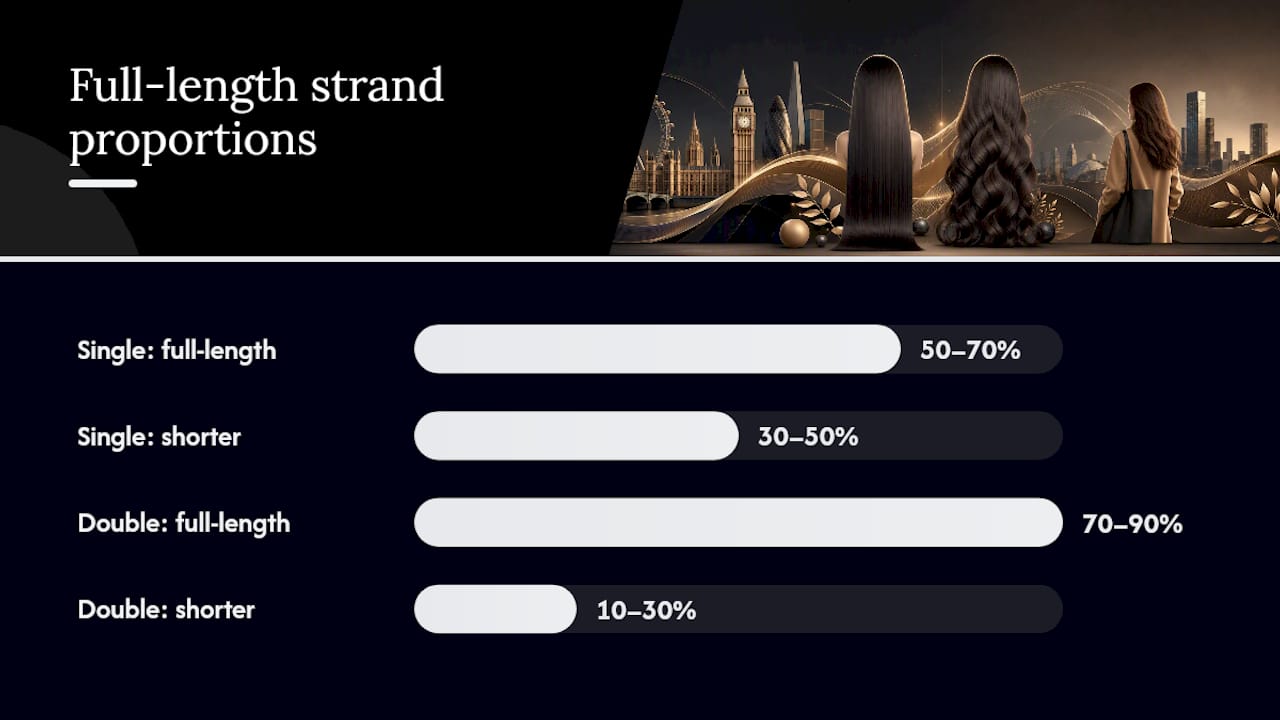
- Single drawn hair typically contains around 50–70% of strands at the labelled length, with the remainder shorter, which is what produces the tapered, feathered ends you see through the tips.
- Double drawn hair typically contains around 70–90% of strands at the labelled length, giving a much more consistent thickness from root to tip.
These ranges come from industry reporting compiled by Bombshell Extensions, and they are worth remembering because they are the single most useful number in this entire comparison. If you take away nothing else, take away this: double drawn is not “better hair,” it is “more full-length hair per bundle.” That is the whole trick.
If you’re deciding between the two for thin or fine hair, this percentage gap explains why one option can look dramatically fuller even when both are made from comparable source hair.
Why double drawing costs more: the manufacturing story
The reason double drawn hair carries a premium isn’t marketing. It’s arithmetic.
Single drawn production is a one-pass sort: raw hair goes through a sorting machine or hackle once, shorter strands are removed, and the remaining bundle is wefted. Double drawn production repeats that sort a second time, manually, pulling out even more of the shorter strands that survived the first pass. Each extra pass removes material, and that material has to come from somewhere. To produce one kilogram of finished double drawn weft, a manufacturer typically needs significantly more raw hair than they would for the equivalent weight of single drawn weft, because so much of the shorter hair ends up discarded or sold separately as a lower grade.
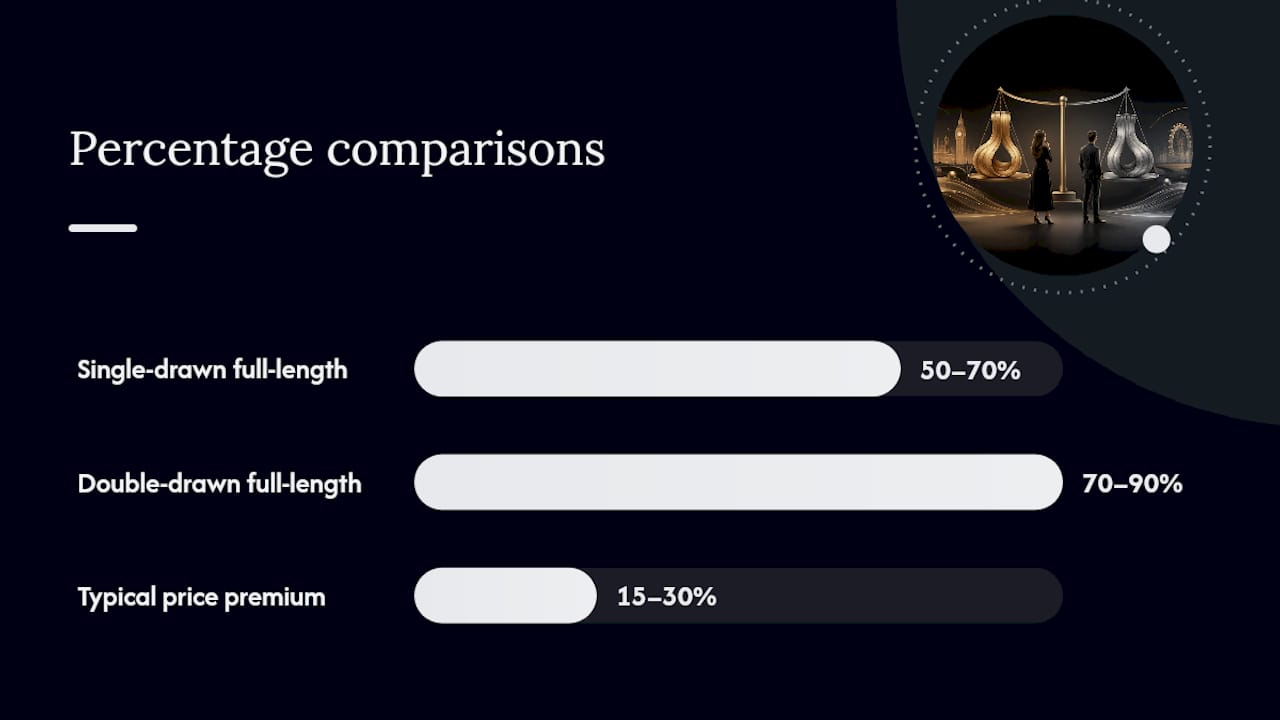
Belacio’s guide to weft hair grades puts this yield loss at around 25% of raw material for the same finished weight, and connects it directly to the 15–30% price premium double drawn hair commands over single drawn hair of comparable origin and quality. You’re not paying extra for better hair. You’re paying for the hair that got thrown away to make what’s left uniform.
Cost-per-month reality check: A single drawn set that thins visibly after four months of wear and needs replacing costs more over a year than a double drawn set that holds its fullness for eight months, even though the double drawn set had the higher price tag on day one.
This manufacturing gap also explains a frustration many buyers run into: two suppliers can both advertise “double drawn” hair at very different prices, because there’s no universal industry standard enforcing exactly what percentage qualifies for the label. Both are technically accurate, but they are not the same product, which is why Conde Professional flags this inconsistency as a genuine source of buyer confusion across the market.
- One-pass sorting removes only the shortest outliers, keeping costs down.
- Two-pass sorting removes far more raw material, driving both quality and price up.
- Percentage labelling varies by supplier, so the word “double drawn” alone tells you less than the number attached to it.
How to spot single drawn vs double drawn before you buy
You don’t need to be a hair technician to tell these apart. A few simple checks will tell you more than most product descriptions do.
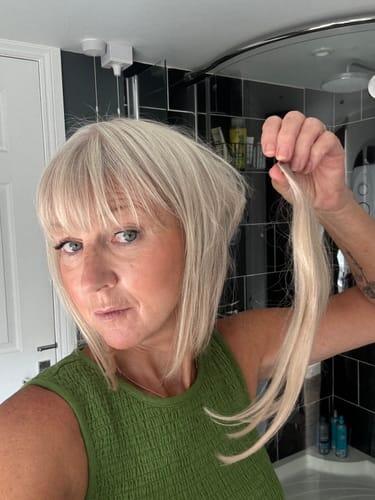
- Do the ponytail fan test. Gather a sample weft or a full set into a ponytail shape and look at the ends face-on. Single drawn hair fans out into a soft V or cone shape, because strands end at different points. Double drawn hair falls in a much straighter, blunter line across the bottom, because most strands stop at the same length.
- Check tip density against root density. Hold a weft up to the light. If the tips look noticeably thinner than the top, you’re looking at single drawn hair. If the thickness stays fairly even all the way down, that’s double drawn.
- Try the 20-strand count. Pull 20 individual strands from a sample and lay them side by side against a ruler or tape measure. If around 14 to 16 of them (70 to 80%) reach the labelled length, you’ve got genuine double drawn hair, a method recommended by Hair Extensions By Nature’s wholesale guide. Fewer than that suggests single drawn, whatever the listing says.
- Read the listing for a stated percentage, not just the label. Reputable sellers will tell you the actual full-length ratio. A listing that says “double drawn” with no number attached is asking you to take it on faith.
Pro Tip: Ask any seller for a close-up photo of the weft ends before buying online. A blurry stock photo showing only the top of the hair is usually hiding exactly the detail you need to see.
Appearance, comfort and cost: the real trade-offs
The decision between these two grades comes down to four practical factors, and they pull in different directions depending on what you want from your hair.
Appearance. Double drawn gives you that thick, blunt-cut look popular in editorial and bridal styling, where every inch reads as full. Single drawn gives you softer, more natural-looking ends that blend more easily if your own hair has any layering, because the tapering mimics how real hair grows out unevenly.
Comfort. More full-length strands packed into a weft means more hair, and more hair means more weight. Double drawn extensions, particularly in longer lengths, sit heavier on the scalp and can feel warmer during long wear. Single drawn extensions are lighter, which matters if you’re wearing them all day or if you have a sensitive scalp.
Longevity and value. This is where the cost-per-month argument from Belacio’s guide earns its keep. Because double drawn wefts keep their fullness for longer as strands naturally shed with wear, the higher upfront price can work out cheaper across a year of ownership than replacing a thinner single drawn set more frequently.
Best applications. Neither grade wins outright, they suit different uses:
- Clip-in sets for occasional glam or events often benefit from double drawn fullness, since you want maximum visual impact for a few hours.
- Everyday invisible wire extensions worn daily can suit either grade, depending on whether you’re prioritising a natural blend or a fuller silhouette.
- Ponytail extensions almost always look better double drawn, since a thin, wispy ponytail defeats the purpose of adding one.
- Hand-tied wefts for fine or thinning hair often work best single drawn, so the weight stays manageable against delicate natural strands.
Choosing between single and double drawn for your hair and budget
Start with your own hair density, not the product description. If your natural hair is already fine or fragile, a fully double drawn set can pull and feel heavy within a few hours, so look at how the extension’s thickness compares to natural volume before committing to the densest option available. If your hair is thick and you want extensions that disappear into it seamlessly, single drawn’s lighter build and tapered ends often blend more convincingly.
Next, think about the silhouette you actually want day to day. A blunt, glossy, uniform line down the back reads as polished and formal, closer to what you’d see in a salon finish or bridal look. Tapered, natural-feeling ends read as more relaxed, more like hair that grew that way, which suits people who want their extensions to be genuinely undetectable rather than visually impressive.
Installation method matters too. Clip-in and ponytail pieces are worn intermittently and removed each day, so the extra weight of double drawn hair is far less of an issue than it would be in a semi-permanent method worn around the clock. If you’re leaning towards a fuller complete set covering front, sides and back, factor in that the cumulative weight of several double drawn pieces adds up quickly.
Before you buy from any UK supplier, run through this checklist:
- What percentage of strands reach the full advertised length? Ask for the number, not just the label.
- What’s the weight per bundle or per weft, in grams? This tells you how much hair you’re actually getting for the price.
- Can they provide close-up photos of real stock, not just styled marketing shots?
- What’s the exchange or refund policy if the hair doesn’t match what was described?
The table below sets out how the two grades typically compare across the factors that matter most when you’re choosing.
| Factor | Single drawn | Double drawn |
|---|---|---|
| Full-length strand percentage | ~50–70% | ~70–90% |
| End appearance | Tapered, feathered | Blunt, uniform |
| Weight and comfort | Lighter, easier for all-day wear | Heavier, better for shorter wear periods |
| Typical price position | Lower upfront cost | 15–30% premium over comparable single drawn |
| Best suited to | Everyday wear, fine or thin natural hair | Occasion wear, ponytails, maximum fullness |
If you’re weighing this decision alongside general concerns about thinning or fine hair, it’s also worth reading wider context on managing thin hair, since the same weight and density principles that apply to extensions apply to how your natural hair responds to added strain.
Expert notes from Naturylextensions on sourcing and drawing level
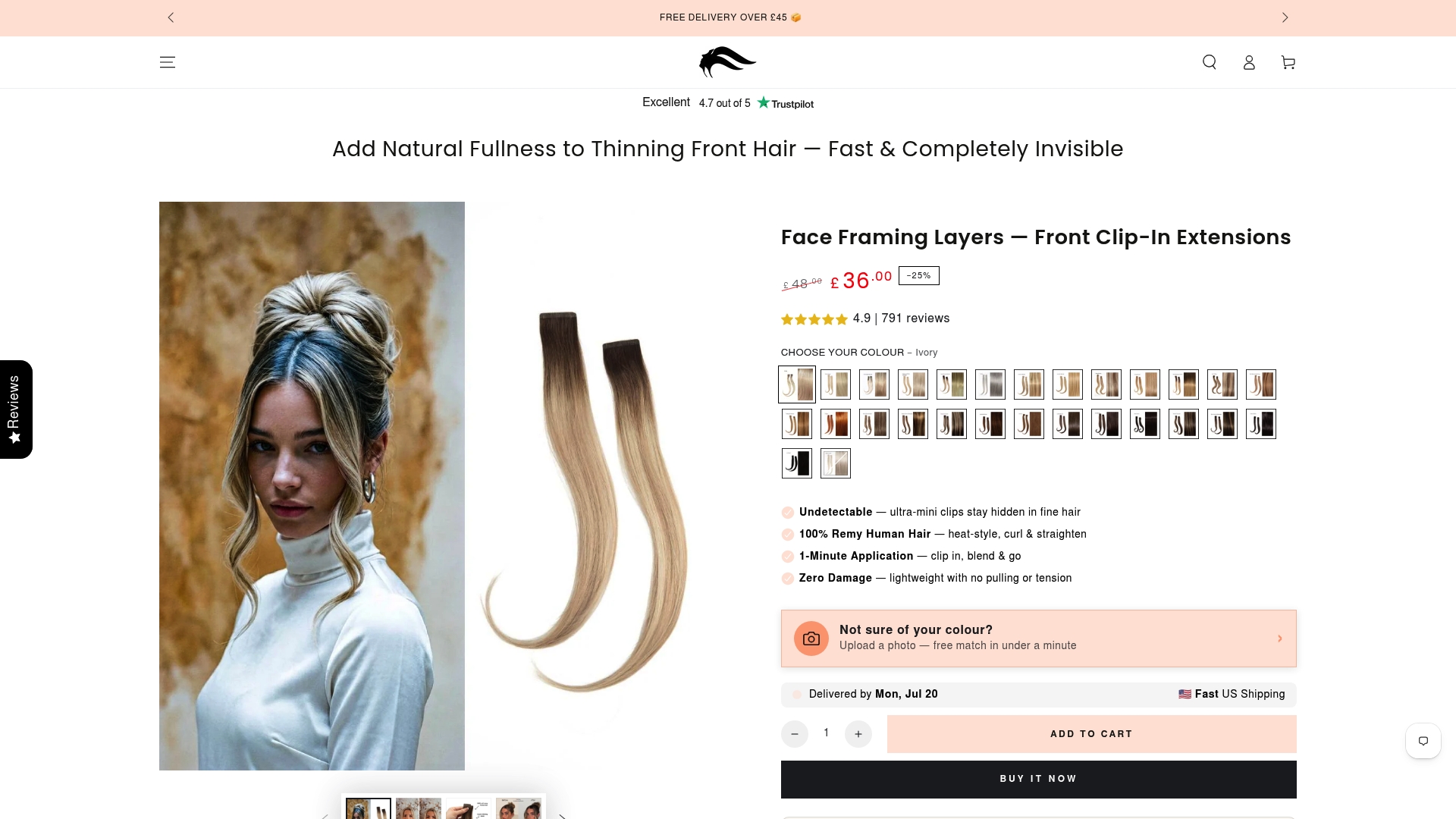
At Naturylextensions, drawing level is a deliberate specification, not an afterthought. Our invisible wire extensions are built to give a natural taper that blends against your own hairline, while our ponytail extensions favour a fuller, more consistent draw because a ponytail lives or dies on visible density. Our Face-Framing Layers clip-ins sit closer to a single drawn build, since softness around the face reads as more natural than a hard, blunt edge.
Every bundle we sell is ethically sourced Remy human hair, meaning the cuticles remain intact and aligned in one direction. That matters regardless of drawing grade, because misaligned cuticles are what actually cause tangling and matting, not the length distribution within the weft.
We back every purchase with a free AI colour-match service, so you’re never guessing whether your extensions will sit right against your natural shade, alongside free exchanges if the fullness or finish isn’t what you expected, and fast UK delivery. For longevity, whichever grade you choose, wash with sulphate-free shampoo, dry before heat styling, and store on a hanger rather than folded in a drawer to protect the strand alignment that keeps either drawing type looking its best.
How I guide clients through this decision
Most people ask me for “the good hair,” as if drawing level alone answers that. It doesn’t. The client who wants a bridal ponytail and the client who wants invisible everyday length need different answers entirely.
I often recommend a modified single drawn option for clients with fine natural hair who still want fuller ends than a standard single drawn set gives them, splitting the difference on weight without the full cost of double drawn. One client, planning a wedding, assumed she needed double drawn throughout. She ended up happier with double drawn only in her ponytail piece and lighter single drawn extensions everywhere else, because her scalp couldn’t comfortably carry a fully double drawn set for a twelve-hour day.
— Sam
Which Naturyl set matches the look you’re after
If you’ve read this far, you already know whether you’re chasing a blunt, dense finish or a soft, natural taper, and that’s exactly the decision Naturylextensions builds its range around. Where a generic supplier sells you a vague “double drawn” label with no percentage attached, we specify drawing level per product, so you know precisely what you’re buying before it arrives, backed by a free AI colour-match, free exchanges, and fast UK delivery that removes the guesswork entirely.
If you want the fuller, uniform look for everyday wear, our Remy human hair invisible wire extensions are built with that consistency in mind and remain our most requested route to instant length and volume. Planning a longer style and need extra coverage at the root? Pair your set with our additional length wires for a fuller finish without adding unnecessary weight. Start with a free colour match on either product page, and you’ll know within minutes whether it’s the right fit before you spend a penny.
Sources
- The difference between single and double drawn wefts | Bombshell Extensions
- Weft hair 101 — grades, types and how to choose right | Belacio
FAQ
Which is better, single drawn or double drawn hair?
Neither is universally better. Double drawn suits a blunt, dense look and holds fullness longer, while single drawn suits a natural taper and feels lighter for daily wear, so the right choice depends on the style and comfort you want.
Is double drawn hair worth the money?
Often, yes, because the 15–30% price premium reflects real extra raw material and typically delivers longer-lasting fullness, which can lower the cost-per-month compared with replacing a thinner set more often.
What is the meaning of double drawn?
Double drawn describes a hair bundle that has been sorted twice to remove shorter strands, leaving around 70–90% of strands at the full advertised length for a uniform, blunt finish.
Which is better between SDD and DD hair?
Single drawn (SDD) gives a lighter, more tapered result suited to everyday wear, while double drawn (DD) gives a fuller, heavier result suited to occasions and ponytails. Naturylextensions matches drawing level to the product, using single drawn builds for face-framing pieces and fuller double drawn construction for ponytails.