TL;DR:
- Achieving natural-looking hair extensions depends on matching texture, color, density, and proper preparation. Correctly blending these factors ensures extensions appear seamless and fully integrated with your natural hair. Proper styling, layering, and professional guidance enhance the blend’s realism across all hair types.
Getting hair extensions to look genuinely natural is something many people assume requires an expensive salon appointment. The truth is that understanding blendability in extensions comes down to a handful of specific factors you can learn and apply yourself. Whether you are considering your first set of extensions or have tried them before without success, the key lies in matching texture, colour, density, and preparation. Get those four things right, and extensions stop looking like an add-on and start looking like your actual hair.
Table of Contents
- Key takeaways
- Understanding blendability in extensions: the core factors
- Getting colour matching right
- Preparing your hair before application
- Cutting, layering, and styling techniques
- Adapting blendability to your hair type
- My honest take on blendability
- Find your perfect blend with Naturylextensions
- FAQ
Key takeaways
| Point | Details |
|---|---|
| Match texture and density first | Choosing extensions that share your natural hair’s texture and weight prevents visible attachment points and unnatural movement. |
| Colour matching at mid-lengths | Match your extension shade to the mid-lengths and ends of your hair, not the roots, for the most natural transition. |
| Prepare your hair before applying | Clean, dry, and properly sectioned hair creates a better base for extensions and improves the overall blend. |
| Cut and layer after application | Having extensions trimmed and layered to suit your natural shape removes blunt lines and creates cohesive movement. |
| Choose extensions suited to your hair type | Fine hair needs lightweight options; curly hair needs matched curl patterns. There is no universal extension that suits everyone. |
Understanding blendability in extensions: the core factors
Successful blendability depends on matching extension hair type, texture, and density to your natural hair. That sounds straightforward, but most people underestimate how many variables fall under those three categories.
Hair texture refers to the physical structure of each strand: straight, wavy, or curly. If your natural hair has a loose wave pattern and you apply poker-straight extensions, the two will behave differently as soon as humidity or movement enters the picture. The extensions will sit flat while your natural hair starts to wave, and the join between the two becomes obvious. Choosing extensions that genuinely reflect your hair’s natural texture matters far more than most people expect.
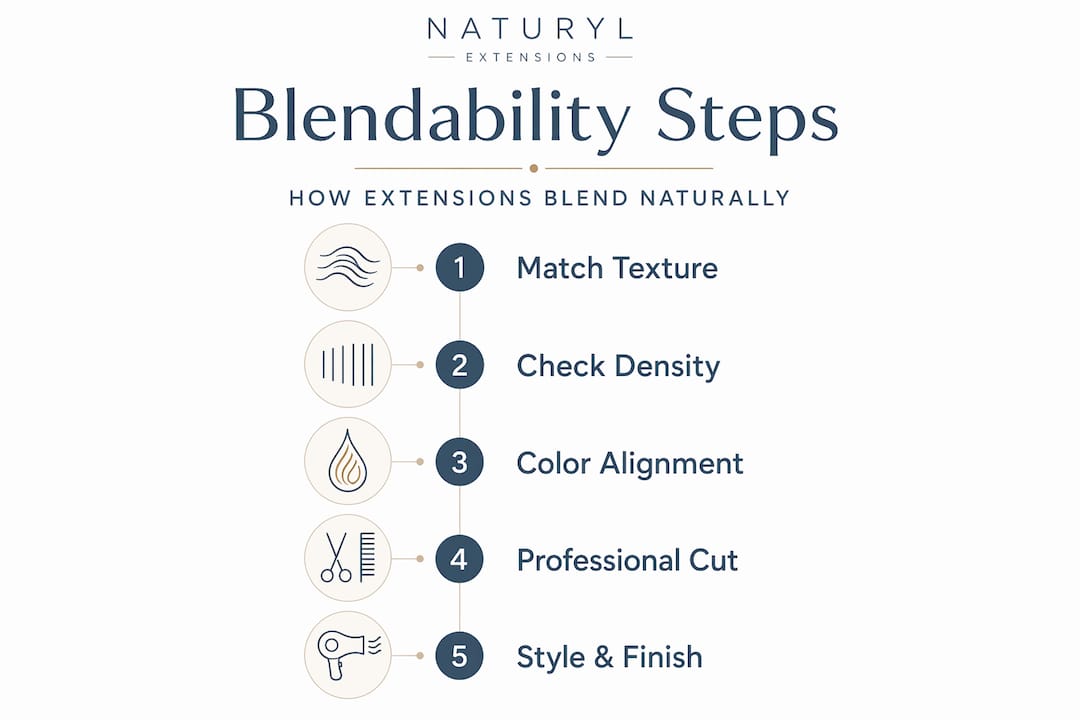
Density is the other factor that frequently gets overlooked. Density refers to how much hair you actually have on your scalp, not the thickness of each individual strand. A person with fine but plentiful hair has different density needs from someone with thick individual strands but sparse coverage. Incorrect placement or weight of extensions can cause visible lines, damage, or discomfort when the density does not match.
Comparing hair types and recommended extensions
| Hair type | Texture | Recommended extension type | Ideal density |
|---|---|---|---|
| Fine and straight | Silky, flat-lying | Tape-in, halo | Lightweight (100g or under) |
| Medium, naturally wavy | Slight wave, moderate body | Invisible wire, clip-in | Medium (100g to 160g) |
| Thick and straight | Dense, strong | Clip-in, invisible wire | Medium to heavy (160g+) |
| Curly or coily | Defined curl pattern | Human hair clip-in | Matched to curl type, medium to heavy |
Key points to check before choosing your extensions:
- Does the extension hair type mirror your own curl or wave pattern?
- Is the weight of the extension set appropriate for your hair’s natural volume?
- Will the extension fabric move and behave similarly to your own hair?
Getting colour matching right
Colour is often the most visible indicator that extensions are not blending well. Matching extensions to mid-lengths and ends rather than your roots creates a far more natural transition because most natural hair is slightly darker at the root and lighter through the lengths.
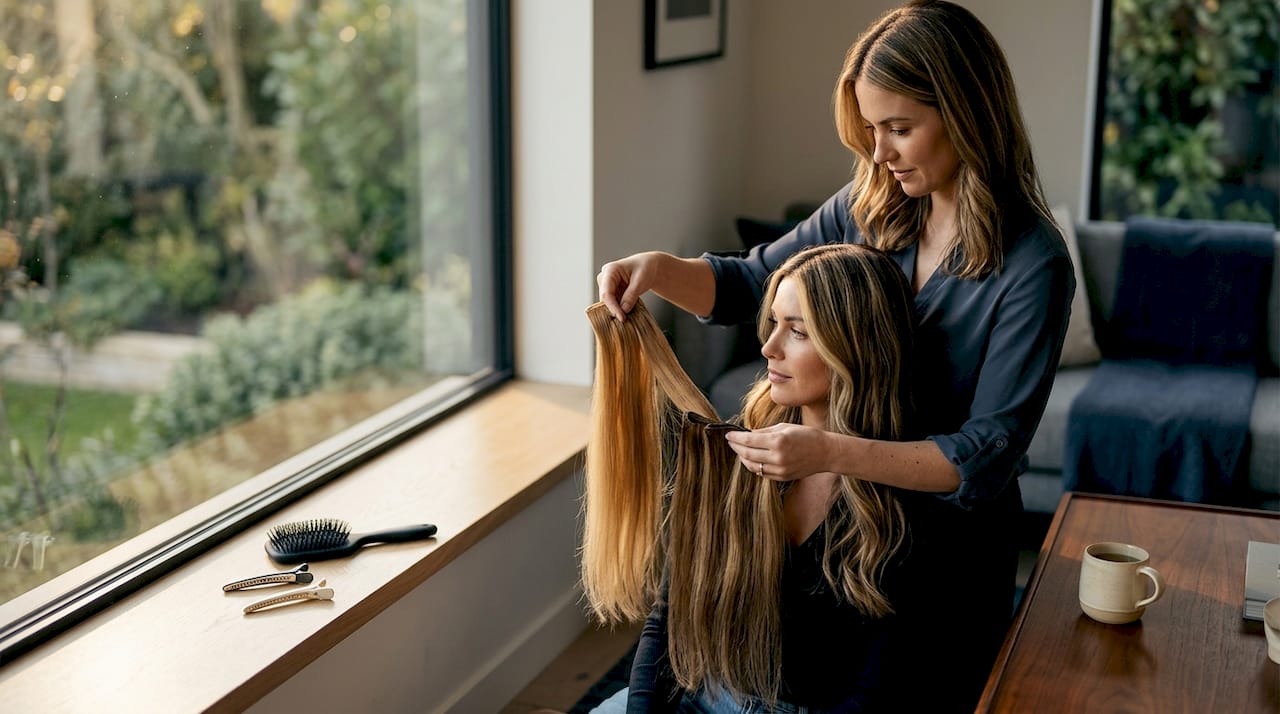
Understanding undertones is what separates a convincing blend from an obvious one. Hair has warm undertones (red, copper, gold), cool undertones (ash, blue, violet), or neutral undertones that sit between the two. Placing warm-toned extensions against cool-toned natural hair creates a mismatch even when the overall shade appears similar. Holding a potential extension swatch next to your hair in natural daylight, not bathroom lighting, will reveal the undertone difference clearly.
Mixing multiple shades of extensions creates multi-dimensional colour that prevents flatness and enhances the appearance of natural depth. Professionals rarely choose a single-shade extension set for this reason. Blending a slightly lighter shade through the lengths alongside your main match replicates the natural variation that sun exposure and hair health create over time.
Practical steps for better colour matching:
- Take a strand of your natural hair into natural daylight and note whether the overall tone is warm, cool, or neutral.
- Request colour swatches before committing to a full set, and compare them against your mid-lengths.
- If you colour your hair, match your extensions to your current shade, not your desired future colour.
- When in doubt, go slightly lighter rather than darker. Lighter extensions tend to blend more naturally than those that are too dark.
Pro Tip: If you are between two shades, buy both and blend them within the same set. The two-tone effect is far closer to how natural hair grows than any single shade.
Preparing your hair before application
How you prepare your natural hair before applying extensions has a direct effect on how well they blend and how long that blend lasts. Properly preparing hair through cleansing, drying, and sectioning improves both extension hold and blending results.
Follow these steps before you apply your extensions:
- Wash your hair with a clarifying or sulphate-free shampoo to remove product build-up, oils, and residue. Extensions grip and sit better against clean hair.
- Dry your hair completely. Applying extensions to damp or slightly wet hair causes slippage and affects how the two textures interact. Blow-dry on a medium heat setting and allow a few minutes to cool.
- Add grip if your hair is fine or slippery. A light spritz of dry shampoo at the roots gives extensions something to hold on to. Alternatively, lightly backcomb the roots in the section where extensions will sit.
- Section from the nape upwards. Start by clipping the top layers away and working in horizontal sections from the base of your neck upward. This layering method conceals attachment points naturally under the hair above.
- Detangle thoroughly. Use a wide-tooth comb or loop brush from ends to roots before beginning. Tangles caught mid-application disrupt the sectioning and make attachment points visible.
Pro Tip: A mini crimper run lightly across the root area where a weft will sit creates instant grip without heavy teasing. It adds texture without damaging the hair shaft, and extensions sit far more securely as a result.
Cutting, layering, and styling techniques
Even perfectly matched extensions benefit from professional cutting after application. Cutting and layering extensions with point-cutting or razoring softens the ends and prevents the “shelf effect,” which is the horizontal line that appears when extensions sit bluntly against your natural hair.
A skilled stylist will blend the extensions into your natural shape by removing bulk at the perimeter and adding soft layers through the length. You do not need a dramatic haircut. Even removing a small amount from the ends and adding a few face-framing layers changes how cohesive the overall look appears.
Styling both your natural hair and extensions together is just as important as the cut:
- Use heat tools on both. Run a curling wand or straightener through both your natural hair and extensions in the same pass. This unifies texture and prevents the two sections from drying or curling at different rates.
- Soft waves are the most forgiving style. Curling or waving the hair conceals transition lines far better than straight styles, which show every variation in texture and thickness.
- Backcombing at the root adds volume that draws attention away from weft lines and creates the appearance of natural fullness.
- Maintain extensions with appropriate products. Gentle brushing with a loop brush and sulphate-free shampoos preserves the extension quality and keeps the blend looking fresh between wash days.
For a step-by-step approach to styling extensions after application, the flawless natural extensions guide covers the process in practical detail.
Adapting blendability to your hair type
Not every hair type responds to extensions in the same way. Knowing the specific challenges your hair type presents allows you to choose the right method from the outset.
Fine or thin hair requires the lightest possible extension options. Lightweight extension types such as tape-in or halo extensions work best for fine or thin hair because heavier sets create a visible weight difference that drags thin hair down rather than lifting it. Refer to guidance on choosing the right volume for fine strands before selecting your set.
Curly or coily hair presents a different challenge altogether. Extensions must share the same curl type and density to avoid obvious texture differences. Human hair extensions are the strongest choice here because they can be heat-styled to match your specific curl pattern after application.
Short hair benefits from halo or tape-in styles that sit close to the scalp rather than clip-ins, which can create obvious bulk on shorter lengths.
Common troubleshooting issues and their causes:
- Visible weft lines or “shelf” appearance: Usually caused by insufficient layering or too much weight placed too high in the hair.
- Extensions slipping out: Most often a result of applying onto oily or product-heavy hair, or using a weight that exceeds what the natural hair can grip.
- Colour mismatch becoming obvious over time: Natural hair colour shifts with washing and sun exposure. Check your extension match every few months and adjust accordingly.
- Texture difference becoming noticeable: Occurs when extensions have not been styled alongside natural hair, or when the extension type does not match the natural hair’s curl or wave pattern.
My honest take on blendability
I have seen the same avoidable mistakes come up repeatedly when people struggle with getting extensions to blend. The most common one is prioritising colour and ignoring texture entirely. Someone will spend considerable time selecting the perfect shade, then attach extensions that sit straight against naturally wavy hair and wonder why the result looks off.
In my experience, texture and density compatibility are the two factors that separate extensions that look genuinely worn from extensions that look applied. Colour is visible and gets most of the attention, but it is the way the hair moves that ultimately tells you whether the blend is convincing.
I also think people underestimate the role of patience in getting a good blend. The first time you apply extensions will almost never be perfect. Your sectioning will improve, your understanding of your own hair’s weight and behaviour will deepen, and you will get better at working with the tools. That is entirely normal. What I would caution against is adjusting only the colour after a disappointing result. In most cases, the texture or weight is the real issue.
Consulting an expert, even for a single session, is genuinely worth the time. Not because you cannot learn to do this yourself, but because a professional eye on your specific hair type will give you feedback that no article can fully replicate.
— Sam
Find your perfect blend with Naturylextensions
If you are ready to put what you have learned into practice, Naturylextensions makes it straightforward to find extensions that match your hair type, texture, and colour. Every product in the range uses ethically sourced Remy hair that moves and behaves like natural hair, which is the single biggest factor in achieving a convincing blend at home. The invisible wire extensions are particularly well-suited to fine and medium hair types, sitting comfortably and without visible attachment points. Whether you are new to extensions or returning after a less successful experience, the Naturylextensions collection is designed to take the guesswork out of compatibility. Browse the full range and take the first step towards a look that feels genuinely yours.
FAQ
What does blendability mean in hair extensions?
Blendability refers to how naturally an extension integrates with your natural hair in terms of texture, colour, density, and movement. Extensions with high blendability are indistinguishable from your own hair when applied correctly.
How do I match extension colour to my natural hair?
Match extensions to the mid-lengths and ends of your hair rather than the roots, and compare shades in natural daylight to identify undertone differences. Blending two closely related shades gives a more natural result than a single flat colour.
Which extensions work best for fine hair?
Lightweight options such as halo extensions or tape-in extensions suit fine hair best because they add volume without creating visible bulk or placing excessive weight on delicate strands.
Why do my extensions look obvious after a few days?
The most common reasons are texture mismatch, applying extensions to hair that still had product residue on it, or failing to style both natural hair and extensions together with heat tools. Revisiting your preparation routine and using a unifying styling technique usually resolves this.
Can I blend extensions with curly hair?
Yes, but curl pattern matching is critical. Extensions must share the same curl type as your natural hair, and human hair extensions are strongly preferred because they can be styled to match your specific curl definition after application.