


TL;DR:
- Color matching hair extensions involves carefully assessing depth, undertone, and dimension to ensure a natural blend. Using physical tools like swatches and the Three-Window Protocol across different lighting environments minimizes mismatches and guarantees a flawless, seamless extension installation. Properly layered shades and attention to lighting conditions are essential for achieving a harmonious and authentic look.
Colour matching is defined as the process of aligning the depth, tone, and undertone of hair extensions with your natural hair to create a seamless, undetectable blend. The role of colour matching extensions goes far beyond simply picking a shade that looks close on a colour chart. Even slight mismatches in undertone or shade are readily detected by the human eye, breaking the illusion of natural hair entirely. Getting this right is the single most important factor in achieving a flawless extension installation, and it is where most people go wrong.
What is the colour matching process for extensions and why does it matter?
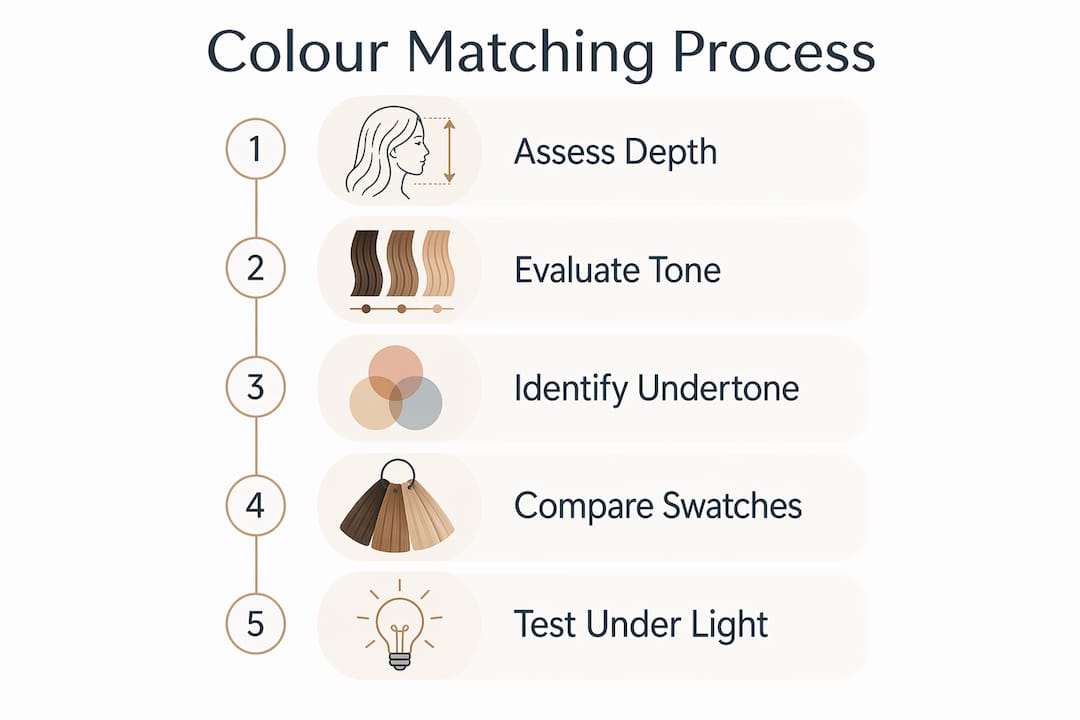
The colour matching process for hair extensions involves evaluating five key dimensions: depth (how light or dark), tone (the dominant colour family), undertone (cool, neutral, warm, or gold), dimension (whether the hair is flat or multi-tonal), and texture. Miss any one of these, and the result looks artificial regardless of how well the extensions are applied.
The standard professional colour scale runs to 22 levels, but 80% of colour matches fall within just 8 of those levels. This means most people sit within a predictable range, which makes the matching process more manageable once you understand where to look. The challenge is not the number of options. It is knowing which dimensions to prioritise.
Here is a step-by-step overview of how the colour matching process works in practice:
- Identify your root depth. Hold a strand of your natural hair against a white background in daylight. Determine whether it reads as a level 1 (black) through to level 10 (lightest blonde).
- Assess your undertone. Look at the warmth in your hair. Cool hair has ashy or grey tones. Warm hair reads golden, copper, or red. Neutral hair sits between the two.
- Check your ends separately. If your hair has faded, been highlighted, or grown out, your ends may be two or three levels lighter than your roots. Extensions need to reflect this variation.
- Evaluate dimension. Flat, single-toned hair is rare in nature. Most natural hair contains subtle highlights and lowlights. A single-shade extension will look flat against naturally dimensional hair.
- Confirm under multiple light sources. Colour reads differently under salon lighting, daylight, and office lighting. Always check your match in more than one environment before committing.
Pro Tip: Never match extensions to the ends of your hair. The ends are almost always lighter and more faded than the mid-shaft and roots. Match to the mid-shaft for the most accurate and natural result.
Colour-match failures most commonly occur when someone selects a shade one level too dark for their roots, or when they choose cool-toned extensions to sit next to warm natural hair. The result in the latter case is a grey, washed-out appearance that no amount of styling can fix.
How do professional tools and techniques improve colour matching?
Professional stylists rely on physical tools and structured protocols rather than guesswork. The most reliable method is the Three-Window Protocol, which involves assessing your extension colour sample under three distinct lighting conditions before installation.
The Three-Window Protocol works as follows:
- Indoor salon lighting: Fluorescent or LED salon lights tend to flatten colour and suppress warmth. A match that looks perfect here may appear too cool or too dark in other environments.
- Outdoor or north-facing daylight: Natural daylight is the most honest light source for colour evaluation. It reveals undertones, dimension, and any tonal inconsistencies that artificial light conceals.
- Neutral interior lighting: Office lighting or a bathroom with a standard bulb sits between the two. This is the environment most people see themselves in daily, so a match must hold up here too.
Stylists who use multi-light protocols experience near-zero colour-match failures. This is not a coincidence. Each lighting environment reveals a different aspect of the colour, and only by checking all three can you confirm a true match.
Physical colour rings and swatches are the other non-negotiable tool. Viewing a swatch in person against your own hair in natural light is far more accurate than any online comparison. Digital screens alter warmth, saturation, and depth in ways that make reliable colour selection impossible.
| Tool | Purpose | Best used when |
|---|---|---|
| Colour ring | Compare multiple shades side by side | In-person consultation or salon visit |
| Physical swatch | Hold directly against natural hair | Checking depth and undertone accuracy |
| Three-Window Protocol | Verify match across lighting environments | Before finalising any extension purchase |
| Multi-dimensional wefts | Mimic natural hair variation | Matching highlighted or dimensional hair |
Premium extensions such as Alma EverWefts are designed with multi-dimensional colour blends built in, which means they replicate the natural variation of real hair without requiring chemical processing. This built-in dimension makes blending significantly easier, particularly for clients whose natural hair is not a single flat shade.
Pro Tip: When ordering extensions online, request a physical swatch before purchasing a full set. Most reputable suppliers offer this service, and it eliminates the guesswork that leads to costly returns.
What are the best practices for blending extensions with your natural hair?
Blending extensions with your natural hair requires more than a close colour match. It requires understanding how your hair’s colour varies from root to tip, and selecting or layering extensions to reflect that variation.
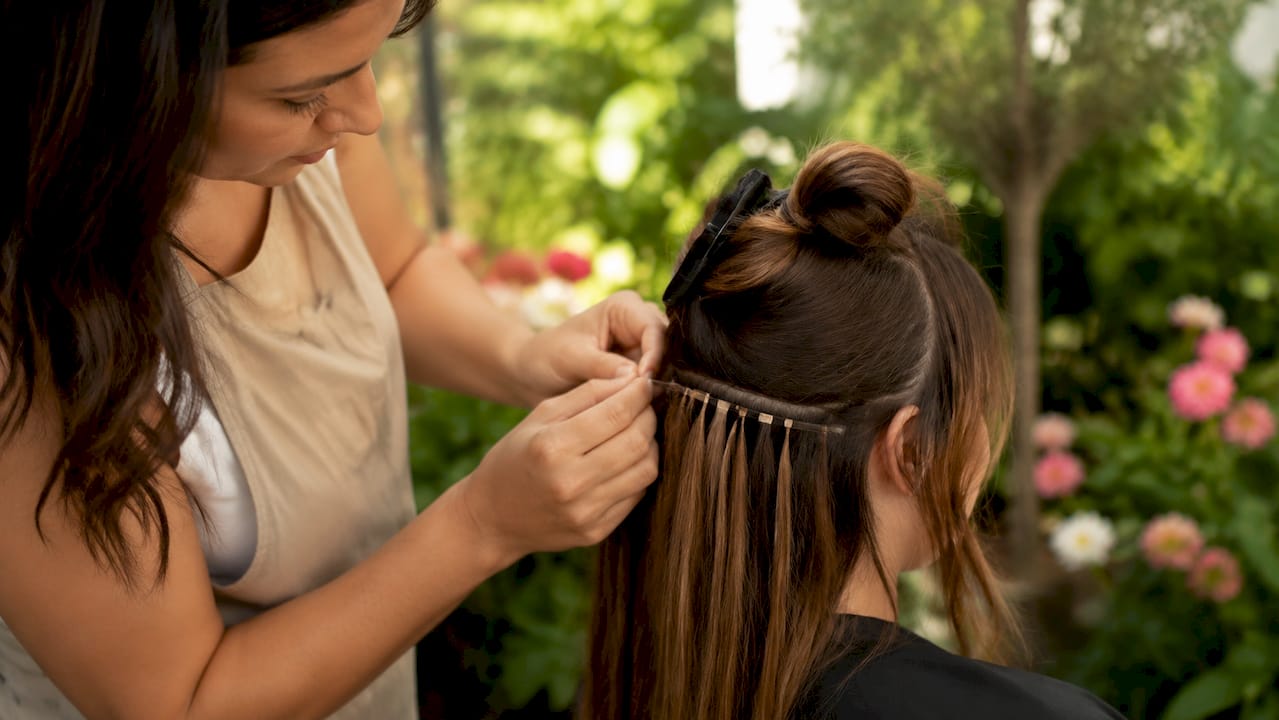
Clients with balayage or highlighted hair need to match at multiple colour levels simultaneously. A single-shade extension set will not replicate the gradual transition from a darker root to lighter ends. The solution is to use two or three extension shades, layering them so the lighter shades sit towards the face and ends while the deeper shades blend into the root area.
Here are the key practices for achieving a natural blend:
- Layer shades for dimension. Use a slightly deeper shade at the root and a lighter shade towards the ends. This mirrors the way natural hair grows and fades over time.
- Match the mid-shaft, not the ends. The mid-shaft of your hair is the most consistent and accurate reference point for colour matching.
- Consider your styling routine. If you regularly use heat tools, your extensions will need to withstand the same temperatures as your natural hair. Remy human hair extensions, which have the cuticle intact and aligned, respond to heat styling in the same way natural hair does, making them the most reliable choice for colour-matched blending.
- Avoid single-shade extensions for highlighted hair. A flat, single-toned extension set against naturally highlighted hair will always look artificial. Opt for extensions with built-in dimension or blend two shades together.
- Check the blend after styling. Colour matching should be assessed on styled hair, not just on raw extensions held against your head. Blow-drying or curling can shift how the colour reads, so always do a final check once your hair is in its finished state.
You can find more detailed guidance on blending hair extensions naturally in Naturylextensions’ expert guide, which covers techniques for avoiding visible extension lines.
Custom blending with stacked wefts of different shades is one of the most effective methods for mimicking balayage and ombré styles without any chemical processing. This preserves the integrity of both your natural hair and the extensions, while delivering a result that looks genuinely natural.
How does lighting affect colour matching for hair extensions?
Lighting is the most underestimated factor in the colour matching process, and most colour-match failures result from the lighting environment rather than the hair product itself. Understanding how different light sources alter colour perception will save you from expensive mistakes.
| Light source | Effect on colour perception | Reliability for matching |
|---|---|---|
| Salon fluorescent lighting | Flattens warmth, can make hair appear cooler | Low to moderate |
| Natural daylight (north-facing) | Reveals true depth, tone, and undertone | High |
| Phone flash photography | Washes out colour, distorts warmth | Very low |
| Office or bathroom bulb | Adds warmth, can make cool tones appear neutral | Moderate |
Digital photos and screen displays distort true hair extension colours, making them unreliable for accurate colour selection. A shade that photographs as a warm medium brown may arrive looking noticeably cooler or darker in person. This is why physical swatches and in-person evaluation are non-negotiable for accurate colour matching.
The practical solution is to take your extension swatch or colour ring outside during daylight hours and hold it directly against your hair at the mid-shaft. North-facing daylight is ideal because it provides consistent, shadow-free illumination without the warmth bias of direct sunlight. If outdoor evaluation is not possible, a neutral interior room with a standard bulb is the next best option.
Pro Tip: Avoid assessing your colour match under bathroom lighting alone. Most bathroom lights add warmth to everything, which can make a cool-toned extension appear to match warm natural hair when it does not.
When communicating with a stylist or supplier, describe your hair’s undertone explicitly rather than relying on photos. Saying “my hair is a level 6 with warm golden undertones” gives far more useful information than sending a photograph taken on a phone.
Key takeaways
Precise colour matching is the foundation of a natural-looking extension installation, requiring accurate assessment of depth, undertone, dimension, and lighting before any purchase is made.
| Point | Details |
|---|---|
| Match mid-shaft, not ends | Ends are usually faded; mid-shaft gives the most accurate colour reference. |
| Use the Three-Window Protocol | Check your match under salon, daylight, and neutral interior lighting before committing. |
| Layer shades for dimension | Single-shade extensions look flat; blend two or three shades to mimic natural hair. |
| Avoid digital photos for matching | Screens distort colour; always use physical swatches in natural daylight. |
| Undertone accuracy is critical | Cool extensions next to warm natural hair create a grey, unnatural appearance. |
Sam’s take: why colour matching is where extensions succeed or fail
After working with hair extensions for years, I have come to a clear conclusion: the colour match is the installation. You can have the finest Remy human hair, applied with perfect technique, and it will still look wrong if the undertone is off by even half a level. Most people focus on length, volume, and application method when choosing extensions. Undertone is almost always an afterthought, and that is precisely why so many extension wearers end up with a result that looks “almost right” rather than genuinely natural.
The most common mistake I see is matching to the ends of the hair. Ends are the oldest, most processed, and most faded part of the hair. They are not representative of the hair’s true colour. Matching to them produces extensions that look correct in isolation but sit visibly lighter than the rest of the hair once installed.
The other thing I would push back on is the idea that colour matching is only a concern for people with complex hair colour. Even someone with a simple, single-process colour needs to get the undertone right. I have seen warm-toned natural hair paired with cool-toned extensions, and the result is a grey, flat appearance that no styling can disguise. Understanding your hair’s undertone is not an advanced skill. It is the starting point.
My advice is to invest time in the matching process before you invest money in the extensions. Use physical swatches, check them in daylight, and do not rely on what you see on a screen. The colour matching guide from Naturylextensions walks through this process in detail and is worth reading before you make any purchase.
— Sam
Find your perfect match with Naturylextensions
Naturylextensions offers a range of premium Remy human hair extensions designed to blend naturally with your own hair, with colour options spanning the full depth and tone spectrum. Each set is crafted from ethically sourced Remy hair, meaning the cuticle is intact and aligned for natural movement, shine, and colour accuracy. The invisible wire extensions are particularly popular for their ease of use and comfort, requiring no heat, glue, or clips for application. Naturylextensions also offers a free exchange policy, so if your first colour choice is not quite right, you can swap it without hassle. Visit Naturylextensions to explore the full range and find the shade that matches your natural hair.
FAQ
What is the role of colour matching in hair extensions?
Colour matching ensures that extensions blend naturally with your own hair by aligning depth, tone, and undertone. Without an accurate match, even well-applied extensions will look artificial.
How do I choose the right hair extension colour?
Match to the mid-shaft of your natural hair, not the ends, and assess the match under natural daylight using a physical swatch. Identify your undertone (cool, neutral, or warm) before selecting a shade.
Why do extensions look different in photos than in person?
Digital screens and phone cameras distort colour by altering warmth and saturation. Always use physical swatches in natural daylight for accurate colour evaluation.
What is the Three-Window Protocol for colour matching?
The Three-Window Protocol involves checking your extension colour sample under indoor salon lighting, outdoor daylight, and neutral interior lighting. This method identifies shade inconsistencies before installation and prevents colour-match failures.
Can I match extensions to highlighted or balayage hair?
Yes, but a single shade will not replicate the natural transition. Layer two or three extension shades, placing lighter shades towards the face and ends, to mimic balayage transitions accurately.


