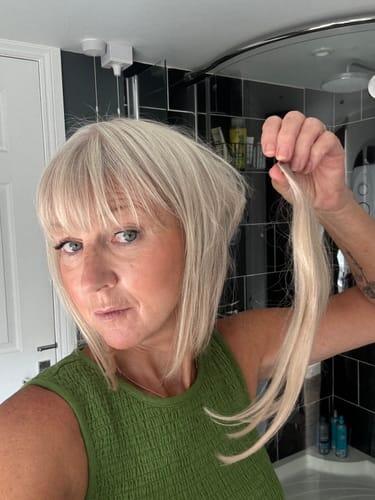
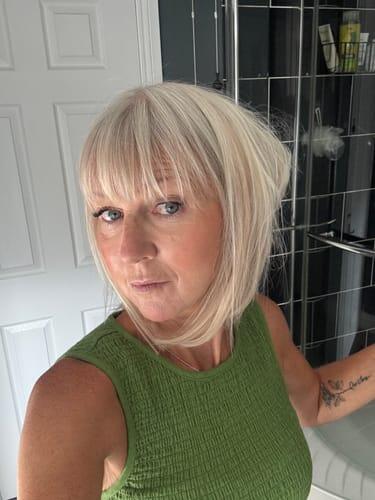
Published September 2026. Written from 375 verified Naturyl customer reviews, including the ones from customers who got the shade wrong the first time — those are the most useful reviews we have on this subject.
The short answer
Match the mid-lengths and ends of your hair, in daylight, with no lamp on. Not your roots — the piece hangs alongside the middle and the bottom of your hair, and that is the only part it ever sits against.
And the thing worth knowing before you spend anything: a screen cannot settle a shade. Every monitor and every photograph shifts colour, and shade names are marketing rather than a standard. Two things do settle it: a free colour match from a photo, and a £3 tester held against your own hair.
Why extension shades are so hard to match on a screen
People assume matching extensions is like matching paint. It is not, for three reasons that stack up at once.
Shade names mean nothing across brands, and not much within one. No industry standard sits behind "caramel" or "toffee" or "mixed blonde" — a name is a description somebody wrote, and it can be a long way from what arrives. The photograph of the actual hair matters far more than the word above it.
Screens are not neutral. The same swatch looks different on a warm phone, a cool laptop and a printed page. Light shades suffer worst: silvers and pale blondes almost always photograph lighter and flatter than they look in your hand.
Your own hair is not one colour. Almost nobody's is — regrowth at the roots and older colour at the ends, or three or four tones if you have highlights. "What colour is my hair" already has more than one answer, which is what the next section fixes.
"Quality of hair good. I have ordered 3 as the colours do not match the description. The Hot toffee was more ash blonde, then I ordered the brown blend which was not much different to the hot toffee."alison, verified buyer
That is a three-star review and we have left it up, because it is the honest version of this problem and the reason the rest of this page exists. Names drift. Look at the hair.

Hot Toffee

Natural Caramel
Match the part of your hair the piece actually touches
This single rule fixes most mismatches, and it costs nothing to apply.
A wire piece sits roughly where a headband would, with your own hair over it; a front clip-in sits an inch or two behind your hairline. Either way the extension hair hangs down, alongside your mid-lengths and ends, never near your roots — so it only has to agree with the bottom two-thirds of your hair. Match your roots instead, which is the instinct because roots are what the mirror shows you, and you will buy too dark if you colour your hair and too light if you are going grey.
The mirror test, before you spend anything: pull the underneath section of your hair forward over your shoulder, in daylight, and look at the last four inches. That colour, not the one at your parting, is the colour you are shopping for.
What to match to, for your hair
Find the row that describes your hair this week, not the week after a colour appointment.
The five-minute check, before you order anything
- 1Stand at a window, with every lamp off. Indoor bulbs are warm and make cool hair look beige. Overcast daylight is the light that tells the truth — better than direct sun.
- 2Work out whether you are warm or cool. Hold plain white paper next to your hair. Golden, orange or cream against it means warm; ashy, blue or steely means cool. Getting this wrong shows more than being a shade too light or too dark.
- 3Count your tones. Look at that underneath section again: one colour top to bottom, or more? One means a solid shade. More than one means a blended or rooted shade — a solid one will look like a panel.
- 4Send a photo and let someone else decide. Our colour match is free and needs one daylight photo of your hair down. It usually comes back with two shades, so you can see how close the call is. No obligation to buy.
- 5If it is close, order the testers. A swatch held against your own hair in daylight answers in ten seconds what a photograph never will — and at £3 it is a fraction of the piece.
"The AI bot correctly suggested the mixed brown blend (I am Brown with blonde highlights on crown and front) but I also ordered colour swatches to be sure."Michelle G., verified buyer
Belt and braces, and the right instinct: the photo match narrows it to one or two, the swatches settle which.


Free, and it takes one photo
Colour match from a photograph
Send one daylight photo of your hair down and we come back with the shade — usually two, so you can see how close the call is. If it is close, £3 testers settle it against your own hair before you commit.
Free · no obligation · 29 shades · Rated 4.7 "Excellent" on Trustpilot · Free colour exchanges
Get a free colour match → See all the shadesWhen you are stuck between two shades, buy the lighter one
This rule resolves a close call, and it comes from what human hair will and will not do once it is no longer growing from a scalp.
You can take real human hair extensions darker. You cannot reliably take them lighter. A semi-permanent or a toning shampoo brings a shade down to meet you; bleach will not take it back up, because hair with no blood supply does not recover from being lightened. So the lighter of two shades has a route out and the darker one does not.
"I had the silver but they arrived too blonde so I dyed the colour to match and they are perfect. Very full pieces . Will definitely get some more"Julie B., verified buyer
The catch, and it is a real one — the moment you put colour on an extension, it stops being returnable. That is true here and at every brand worth buying from, because nobody can resell a piece somebody else has dyed. Our policy says it plainly: if you dye the extensions, or use a silver or purple shampoo, and it does not turn out as expected, we cannot accept the return.
So do it in the right order. Decide whether the shade is wrong before you reach for anything — if it is, exchange it, which is free and is what the window is for. Only colour a piece you have decided to keep, and test a small section at the back first: wet hair reads about two shades darker than it will look dry.
What it actually costs if you still get it wrong
Everybody focuses on the price of the piece. When you are unsure, the number that matters is what the mistake costs.
You have 14 days from receiving it. Exchanging for another colour or length is free. A cash refund instead costs £10 for the label and admin. Testers are £3 and not returnable. And the piece has to come back as it arrived: unworn, in its net, wires and clips in the packet.
So the cheapest way to get this right is to spend £3 first — and the most expensive is to guess, dye it, and talk yourself out of both the exchange and the refund.
"I'm really happy with these extensions. They look great and are secure and comfy to wear. If you are unsure about your colour, I'd recommend ordering a tester, as there is a £10 admin charge if you return. I use two around the front and I love how they look."Jann R., verified buyer
"Original order was not a good colour match for my hair, ordered some colour testers then exchanged for teddy bear blonde which is perfect! This is by far the most natural looking extension I've tried for my very thin hair."Kelly H., verified buyer
Both are five-star reviews from people whose first order was wrong. That is the normal shape of this purchase, not a failure — and it is why the exchange is free.
The cheapest way to test a shade on your actual head
A swatch tells you the colour. It does not tell you how a shade behaves once it is in your hair, under your own lighting, all day. Two small front clip-ins are the least you can spend to find that out — and if they disappear, a full piece in the same shade will too.

The least you can spend to test a shade
Face-Framing Layers
Two small pieces on inch-wide clips, in 29 shades — the same range as the full wire pieces. Almost nothing to hide, and the cheapest way to see a shade living in your own hair rather than lying in your hand.
Front clip-in extensions · 100% Remy · £36 · Free UK delivery · Free colour exchanges
Shop Face-Framing Layers →Common questions
How do I colour match hair extensions to my own hair?
Match the mid-lengths and ends of your hair rather than your roots, in daylight with no lamps on — that is the only part of your hair an extension ever sits against. Work out whether you are warm or cool by holding plain white paper beside your hair, then send a daylight photo for a free match, or order tester swatches and hold them against your hair at a window.
Can you colour match hair extensions online?
You can get very close, but not all the way. A photo match narrows 29 shades down to one or two reliably. What a screen cannot do is tell those last two apart, because your monitor and your camera both shift colour — that is what a physical swatch is for.
Should I match my roots or my ends?
Your ends, and the mid-lengths just above them. A wire piece sits where a headband would and a front clip-in an inch or two behind your hairline, so the extension hair hangs alongside the bottom two-thirds of your hair and never reaches your roots. Matching your roots is the most common reason a shade arrives looking wrong.
What if I am between two shades?
Order the lighter one. Real human hair takes a semi-permanent or a toning shampoo and goes darker perfectly well, but it does not go lighter — hair no longer growing from a scalp does not recover from bleach. The lighter shade has a way out; the darker one does not.
Can you dye hair extensions to match your hair?
Yes, if they are real human hair, and customers do it when a shade arrives lighter than expected. Two warnings: dyeing voids the return and exchange, so only colour a piece you have decided to keep, and test a small section underneath first — wet hair looks about two shades darker than it will when dry.
What happens if the colour is wrong when it arrives?
Exchange it. You have 14 days, exchanging for another colour or length is free, and it must come back unworn in its original packaging with the wires and clips. A cash refund instead costs a £10 admin fee. Plenty of people get it right on the second order rather than the first — that is what the window is for.