TL;DR:
- Hair evolved around 300 million years ago from synapsid ancestors, repurposing keratin proteins already present in animals. It forms through active cell division within follicles, producing dead keratinised strands that reflect biological, cultural, and evolutionary origins. Understanding hair’s biological and cultural roots informs better care, ethical sourcing, and respectful appreciation of diverse hair types and textures.
Hair is a protein filament that grows from follicles embedded in the skin, composed primarily of alpha-keratin and present across nearly the entire human body. Understanding what is hair origin means looking at three distinct levels: the evolutionary story that produced hair in the first place, the cellular biology that forms each strand, and the cultural meanings that different hair types carry across communities. Whether you are curious about the science behind your own hair, exploring hair type origins, or making informed decisions about hair care and extensions, this guide covers all three dimensions clearly and thoroughly.
What is the evolutionary origin of hair?
Hair originated in synapsid ancestors approximately 300 million years ago, making it one of the defining biological traits of the mammalian lineage. Fossil evidence from late Middle Jurassic cynodonts confirms that hair was present no later than around 220 million years ago. This places the emergence of hair well before modern mammals as we recognise them today.
The evolutionary advantages hair provided were significant and varied:
- Thermoregulation: Hair traps a layer of warm air close to the skin, helping early mammals maintain body temperature in fluctuating environments.
- Sensory function: Specialised hairs, particularly vibrissae (whiskers), evolved to detect environmental stimuli with precision.
- Camouflage and signalling: Coat patterns and colouration served as survival tools and social signals within species.
- Protection: Hair shields the skin from UV radiation, minor abrasions, and environmental debris.
One of the more surprising facts about hair history is that the molecular building blocks of hair predate hair itself. Alpha-keratin genes exist in non-mammals such as chickens and green anole lizards, meaning these proteins evolved long before true hair emerged in mammals. Hair did not invent keratin; it repurposed a protein already present in the animal kingdom.
Hair’s evolutionary origin is not a single event but a gradual repurposing of existing biological materials into a new and highly adaptable structure.
Understanding where hair comes from at this level matters because it explains why hair is so biologically complex. It is not a simple surface feature. It is a system shaped by hundreds of millions of years of adaptation.
How is hair formed in the body?
The biological process of hair formation, known in the industry as folliculogenesis and keratinisation, begins deep within the skin at a specialised structure called the hair follicle. The hair shaft itself is composed of dead, keratinised cells, but the follicle that produces it is very much alive and metabolically active.
Here is how the process unfolds from root to tip:
- Cell division at the bulb: Living matrix cells at the base of the follicle divide rapidly, producing new cells that push upward through the follicle channel.
- Keratinisation: As cells move away from the blood supply at the bulb, they fill with keratin protein and gradually lose their nuclei, becoming the hard, fibrous cells that form the hair shaft.
- Cortex and cuticle formation: The inner cells form the cortex, which gives hair its strength and colour through melanin pigment. The outer cells flatten into the cuticle, the protective overlapping scale layer visible under a microscope.
- Sebaceous gland contribution: The sebaceous gland attached to each follicle secretes sebum, an oily substance that coats the hair shaft and maintains moisture balance.
- Arrector pili muscle: This small muscle connects the follicle to the skin surface and contracts in response to cold or stress, producing the familiar sensation of goosebumps.
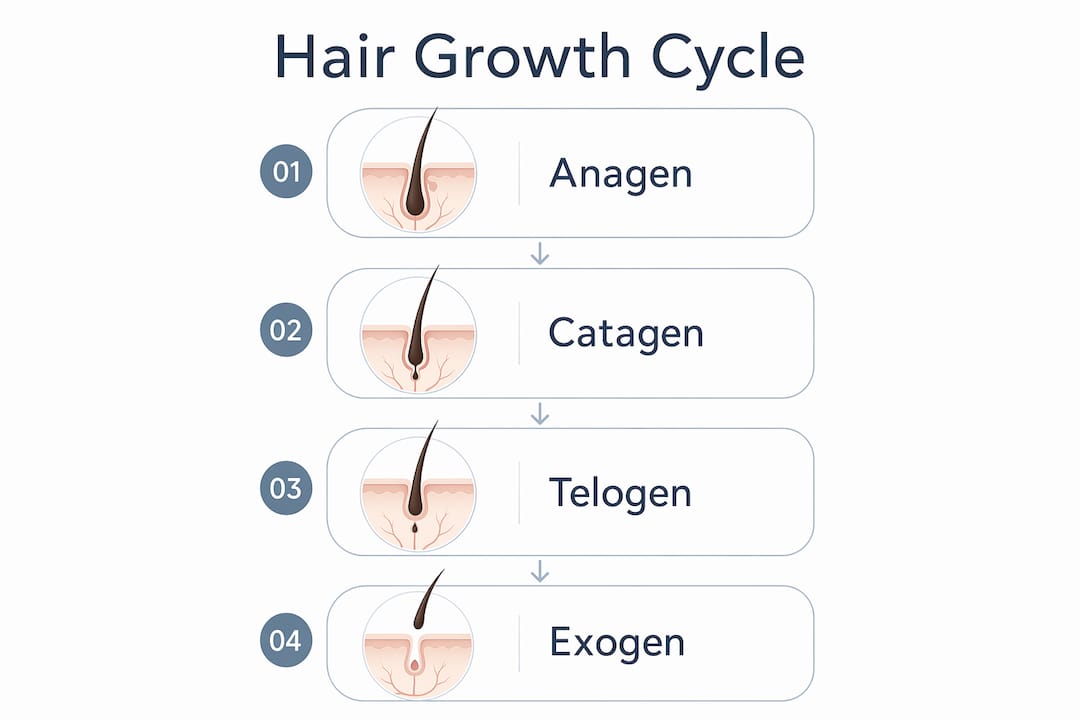
The follicle cycles through three phases: anagen (active growth, lasting two to seven years), catagen (transition, lasting two to three weeks), and telogen (resting, lasting two to four months). At any given time, roughly 85 to 90 per cent of your scalp follicles are in the anagen phase.
| Growth phase | Duration | Activity |
|---|---|---|
| Anagen | 2 to 7 years | Active hair production |
| Catagen | 2 to 3 weeks | Follicle shrinks, growth stops |
| Telogen | 2 to 4 months | Hair rests, then sheds |
Pro Tip: Scalp health directly affects follicle performance. Nutrient deficiencies, hormonal imbalances, and chronic stress can shorten the anagen phase, leading to thinner, slower-growing hair long before you notice visible shedding.
The living follicle and its matrix regulate the quality of new growth, even when the visible hair strand appears unchanged. This is why scalp care is not cosmetic. It is biological maintenance.
What are the origins of hair types and textures?
Hair type origins are rooted in follicle geometry and keratin microstructure. The shape of the follicle opening determines whether hair grows straight, wavy, curly, or coily. A round follicle produces straight hair; an oval or asymmetrical follicle produces curl. The degree of asymmetry corresponds broadly to the degree of curl.

The most widely known classification system is the Andre Walker hair typing system, which organises hair into four main categories (Types 1 through 4) with subcategories A, B, and C within each. Type 1 covers straight hair, Type 2 wavy, Type 3 curly, and Type 4 coily or kinky. This system is widely used in the hair care industry and by consumers seeking product guidance.
However, hair typing categories have faced significant criticism for several reasons:
- They are observational, not biological. The categories describe appearance, not follicle geometry or keratin microstructure.
- Hair can vary across different areas of the same person’s scalp, making a single type label inaccurate.
- The system has been criticised for oversimplifying the biology of hair and, more seriously, for carrying racial hierarchy implications that privilege straighter hair textures.
- Historical classifications of hair are entangled with pseudoscience and racial bias, which explains ongoing social tensions around hair texture and the language used to describe it.
| Classification system | Basis | Limitation |
|---|---|---|
| Andre Walker (Types 1 to 4) | Visual appearance of curl pattern | Does not reflect follicle biology or genetics |
| Porosity scale (low/medium/high) | Cuticle structure and moisture absorption | Varies with damage and treatment history |
| Density scale (fine/medium/coarse) | Strand diameter | Conflates strand width with follicle count |
Pro Tip: Rather than relying solely on a type number, assess your hair by porosity and density as well. These two factors are more useful for choosing the right products and care routine than curl pattern alone.
Understanding hair type origins at this level helps you move beyond surface labels and make genuinely informed decisions about care, styling, and product selection.
What cultural meanings are tied to hair origin and type?
Hair carries deep cultural significance linked to identity, social status, and beauty standards across virtually every human society. The University of Oxford’s Pitt Rivers Museum documents hair practices across cultures as a primary form of body art and social communication, noting that hair has historically symbolised strength, mourning, religious devotion, and community belonging.
The cultural meanings associated with hair type and origin are particularly significant in several contexts:
- Identity and heritage: In many African, South Asian, and Indigenous communities, natural hair texture is a direct expression of cultural identity and ancestral connection. Styles such as locs, braids, and twists carry specific social and spiritual meanings that predate modern beauty standards.
- Social justice: The natural hair movement, which gained momentum in the United States and the United Kingdom from the 2010s onwards, challenged workplace and school policies that penalised natural Afro-textured hair. The UK’s Halo Code, adopted by schools and employers, directly addresses this discrimination.
- Beauty standards and pressure: Eurocentric beauty standards historically positioned straight hair as the professional or desirable norm, creating pressure on individuals with coily or curly hair to chemically alter their texture. Recognising this history is part of understanding what hair origin meaning carries for different communities.
- Ritual and ceremony: Across cultures from ancient Egypt to contemporary South Asian weddings, hair cutting, covering, or styling marks significant life transitions and social roles.
Appreciating the cultural dimension of hair origin is not separate from the biological one. The two are connected. The diversity of hair textures across human populations reflects genuine biological variation, and the social meanings attached to that variation have real consequences for how people experience their hair every day.
How does hair origin inform ethical sourcing and hair care?
Knowing where hair comes from, biologically and materially, has direct practical implications for how you care for your own hair and how you choose hair products, including extensions. Follicle health determines hair quality at the source, which means that the condition of hair before it is harvested for extensions matters enormously.
When it comes to hair care informed by origin knowledge, consider the following:
- Match products to your follicle type. Coily hair types typically have fewer sebaceous glands per follicle and benefit from richer, more occlusive moisturisers. Straight hair types are more prone to sebum build-up and may need lighter formulations.
- Understand porosity before purchasing products. High-porosity hair, which has a raised or damaged cuticle, absorbs moisture quickly but loses it just as fast. Low-porosity hair resists moisture absorption and benefits from heat-assisted conditioning.
- Prioritise scalp health. Since the follicle is the living organ responsible for hair quality, scalp treatments, balanced nutrition, and reduced mechanical stress all contribute to stronger, healthier growth over time.
For hair extensions specifically, understanding hair origin is the foundation of ethical sourcing. Remy human hair, where the cuticle is kept intact and aligned in one direction, is the gold standard because it most closely replicates the structure of hair as it naturally grows from the follicle. Non-Remy hair, where cuticles are stripped or misaligned, degrades faster and tangles more readily because it lacks the structural integrity of its biological origin. When comparing your options, the difference between synthetic and human hair comes down to exactly this: biological origin determines behaviour, longevity, and how naturally the extension blends with your own hair.
Key takeaways
Hair origin spans three interconnected levels: evolutionary biology, follicle development, and cultural meaning, and understanding all three informs better hair care and more ethical sourcing decisions.
| Point | Details |
|---|---|
| Evolutionary origin | Hair evolved from synapsid ancestors around 300 million years ago, repurposing existing keratin proteins. |
| Biological formation | The follicle is the living organ; the visible hair shaft is dead keratinised cells produced during the anagen phase. |
| Hair type classification | Systems like the Andre Walker typing system describe appearance, not follicle biology, and carry social limitations. |
| Cultural significance | Hair texture and style carry identity, heritage, and social justice meanings across communities worldwide. |
| Ethical sourcing | Remy human hair preserves cuticle alignment from the biological source, making it the most durable and natural-looking extension option. |
Why I think most people underestimate what hair actually is
I have spent a lot of time reading about hair, talking to people who wear extensions, and thinking about why so many hair care decisions go wrong. The most common mistake I see is treating hair as purely cosmetic. People invest in products, treatments, and extensions based on how something looks in a photograph, with no thought given to what the hair actually is at a biological level.
Once you understand that the visible strand is dead material and that everything meaningful happens inside the follicle, your entire approach to hair care shifts. You stop trying to fix the strand and start supporting the follicle. That is a genuinely different way of thinking, and it produces better results.
The cultural dimension matters just as much. Hair type origins are not neutral categories. They carry histories of bias, pride, and identity that deserve respect and awareness. When you understand that classification systems like the Andre Walker system were built on observation rather than biology, and that they have been used to rank hair textures in ways that caused real harm, you become a more thoughtful consumer and a more considerate person in conversations about hair.
For anyone considering extensions, this knowledge is especially relevant. Choosing ethically sourced extensions is not just a values statement. It is a practical decision rooted in understanding that hair quality begins at the follicle, long before it reaches you.
— Sam
Explore Naturylextensions’ ethically sourced hair extensions
At Naturylextensions, every product starts with an understanding of where hair comes from. The range of Remy human hair extensions is built on ethically sourced hair that preserves the natural cuticle alignment, giving you extensions that behave like your own hair because they are structurally closest to it. Whether you are drawn to invisible wire extensions for a quick, damage-free transformation or ponytail extensions for added volume, the biological origin of the hair is never an afterthought. Naturylextensions offers fast UK delivery, a free exchange policy, and a commitment to quality that begins at the source. Explore the full collection and find the right match for your hair type and texture.
FAQ
What is hair origin in simple terms?
Hair origin refers to the biological, evolutionary, and cultural sources of hair as a physical structure. Biologically, hair originates from follicles in the skin that produce keratin-based filaments through a process of cell division and keratinisation.
Where does hair come from evolutionarily?
Hair evolved from synapsid ancestors approximately 300 million years ago, with fossil evidence confirming its presence in late Middle Jurassic cynodonts around 220 million years ago. The keratin proteins that form hair predate hair itself, existing in non-mammals such as lizards and birds.
How is hair formed inside the body?
Hair is formed when living matrix cells at the base of the hair follicle divide and move upward, filling with keratin protein and losing their nuclei to become the dead, keratinised cells that make up the visible hair shaft.
What do hair type origins mean for hair care?
Hair type origins, rooted in follicle shape and keratin microstructure, determine how your hair absorbs moisture, responds to products, and behaves under styling. Understanding your hair’s biological origin helps you select products and routines that work with your follicle type rather than against it.
What is Remy hair and why does origin matter for extensions?
Remy hair is human hair collected with the cuticle intact and aligned in one direction, replicating the natural structure of hair as it grows from the follicle. This origin-based quality standard makes Remy extensions more durable, tangle-resistant, and natural-looking than non-Remy alternatives.