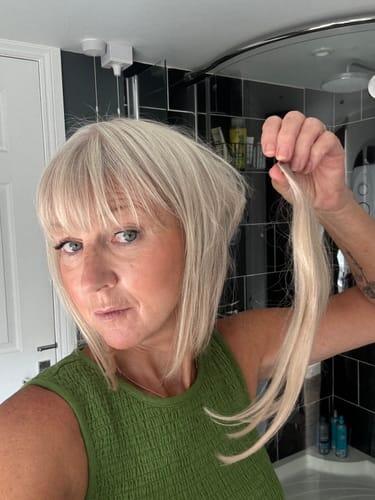
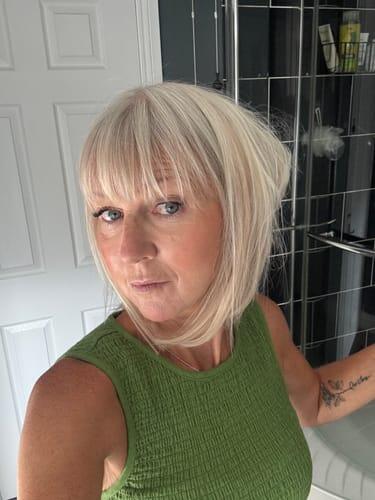
Published September 2026. Draws on 487 verified Naturyl customer reviews, 28 of them from women who switched from another extension method and 23 of which describe damage from it.
The least damaging hair extensions are the ones that attach to nothing: a single-piece extension on a clear wire, followed by small clip-in pieces. Neither puts tension on your roots, neither needs heat, glue or clamps to fit or remove, and both come off at night. Full clip-in sets come next, then tape-ins. Micro rings, nano rings, keratin bonds and sew-in weaves carry the highest risk, because they hang weight from your own strands for weeks at a time and are removed with solvent, heat or force. The ranking below explains why, method by method, using what our own customers reported after switching.
Hair extensions ranked from least to most damaging
| # | Method | What holds it on | How it can damage your hair | Risk |
|---|---|---|---|---|
| 1 | Invisible wire extension | A clear wire resting on the head, hidden under your top layer | Only if the wire is sized too tight (pressure headaches), or the piece is far too heavy for your hair | Very low |
| 2 | Face-framing and fill-in clip-in pieces | Two to four small clips | Clipping the same spot daily on very fine hair; sleeping in them | Low |
| 3 | Clip-in ponytail | A comb into the bobble plus a wrap | A tight base ponytail worn daily can pull at the hairline | Low |
| 4 | Full clip-in sets (6 to 8 wefts) | Many clips across the head | Weight on the same strands every day; bald patches at clip points are a known outcome on fine hair | Low to moderate |
| 5 | Tape-ins | Adhesive tabs sandwiching your hair | Solvent at removal, traction if tabs are over-loaded, breakage if left past 8 weeks | Moderate |
| 6 | Micro rings and nano rings | Metal rings clamped onto sections of your hair | Constant tension on each section; rings slide and snap hair; discomfort is common | Moderate to high |
| 7 | Keratin bonds (fusion) | Heat-melted keratin glued to your strands | Heat at fitting, solvent and scraping at removal, traction for months; not reusable | High |
| 8 | Sew-in weave | Wefts sewn onto tight cornrow braids | Traction from the braids themselves; the classic cause of traction alopecia at the hairline | High |
| 9 | Glue-in wefts | Bonding glue on the scalp | Glue on skin and hair, harsh removal; not recommended by any trichologist | Highest |
How extensions actually damage hair
Four mechanisms account for almost all of it. Traction: weight hanging from a small group of strands for weeks pulls at the follicle, and over time the follicle gives up; that is traction alopecia, and if it has already started the NHS advice is to see a GP before spending money on a commercial hair clinic. Fitting and removal: heat, keratin, adhesive, solvent and clamps each take a little from the hair every 6 to 8 weeks. Repetition: even a gentle clip becomes a problem if it lands on the same fine strands every single day. Sleeping in them: overnight friction and tension do more harm than a day's wear.
Look at the ranking again with those four in mind. A wire piece triggers none of them: nothing hangs from your hair, nothing is fitted or removed with heat or chemicals, and it comes off at night. Small clip-in pieces trigger only the third, and only if you clip the same spot daily. Everything from tape-ins downward triggers at least two.

Ranked #1 for a reason
Invisible Wire Extensions
Nothing glued, clamped or clipped to your own hair. On in under a minute, off at night, so your hair keeps growing underneath.
100% Remy human hair · 28 shades · from £89 · Rated 4.7 "Excellent" on Trustpilot · Free UK delivery · Free colour exchanges
Shop invisible wire extensions → Free colour match from a photoWhat women who switched told us
We sell wire and clip-in pieces, so read the following with that in mind. But these are verbatim, verified reviews, and the pattern is the same one trichologists describe.
"After wrecking my hair wearing nano bond extensions for over 6 months, I had no choice but think of something more suitable for delicate hair. This option is perfect for anybody with fine, delicate, lightened hair as these extensions don't pull on your hair follicles."Kasia, verified buyer
"I've had nano extensions for a couple of years now but found them very time consuming in drying and at times they felt painful and uncomfortable… no damage to your own hair and scalp but with the nice look of having thick healthy hair."Karen L., verified buyer
"I used to wear clip ins but I started to get a bald patch on the side of my head due to the weight so I needed something to change."Julie M., verified buyer
"I was using clip in hair extensions before I found these and it was making my natural hair very thin. So happy I've found an alternative."Elena C., verified buyer
"I've worn individual bonded hair extensions for the last 7 years and needed to give my hair a break as well as being fed up of the maintenance."Emma W., verified buyer
Two things stand out. The damage stories come from every attached method, including full clip-in sets, which most guides treat as harmless. And nobody in our reviews describes damage from a wire piece; the complaints about wire pieces are about fit (a wire sized too tight, or a piece too heavy for very fine hair), both of which are fixable.
The honest limits of "damage-free"
No extension is damage-proof if it's misused. A wire cranked tight enough to hurt will leave a pressure line and a headache; size it snug and swap to a longer wire if it pinches. A 120g piece on very fine hair is more weight than the hair on top should carry; that is what the 45g Lightweight is for. Sleeping in any piece, wire included, mats the hair and drags at the roots. And extensions of any kind cover thinning without treating it: if your own hair is shedding more than usual, a GP or trichologist is the first call, not a longer piece.
A damage-free checklist, whichever method you choose
- Match the weight to your hair. Fine hair: under 100g total, or a 45g piece. Never "thick hair" sets on fine hair.
- Nothing on the roots. If a method attaches to your own strands, make sure your stylist checks the sections aren't over-loaded and books refits on time.
- Off at night, every night. Removable pieces only; and if you wear a fitted method, a loose plait and a silk pillowcase.
- Rotate clip positions by a centimetre or two each day.
- No heat above 180°C, and none on your own roots.
- Rest days. The advantage of a removable piece is that your hair gets days off. Use them.
- Stop if it hurts. Pain, tenderness or a tingling scalp is traction. Loosen, lighten or remove.

Two clips, not eight wefts
Face-Framing Layers
Small Remy pieces for a thinning front. Light enough for fine hair, hidden under your parting.
Front clip-in extensions · 100% Remy · £39.95 · Rated 4.7 "Excellent" on Trustpilot · Free UK delivery · Free colour exchanges
Shop Face-Framing Layers → Free colour match from a photoHair extension damage: your questions
Which hair extensions are least damaging?
A single-piece extension on a clear wire, because nothing attaches to your own hair. Small clip-in pieces come next. Tape-ins are the gentlest of the fitted methods; rings, bonds, weaves and glue carry the most risk.
Do clip-in hair extensions damage your hair?
Small pieces with two or three clips rarely do. Full sets with six to eight wefts can, because the same strands carry the weight every day; several of our customers switched after developing thin patches at clip points.
Are tape-in extensions bad for your hair?
They are the least damaging of the fitted methods when the tabs aren't over-loaded and they're refitted on time. The risks are solvent at removal and traction if they're left in too long.
Which hair extensions cause the least damage to thin hair?
A lightweight wire piece (45g) or small clip-in pieces. Anything that hangs weight from fine strands, or clips many wefts to them daily, should be avoided while the hair is thin.
Can hair grow back after extension damage?
Usually, if the follicle isn't scarred. Traction alopecia caught early recovers once the tension stops, which is why switching to a removable piece is the usual first step. Long-standing traction can be permanent; see a GP or trichologist if the loss doesn't improve within a few months.
Can an invisible wire extension damage your hair?
Not by the mechanisms that damage hair with other methods: nothing is attached to your strands. The only issues reported are a wire fitted too tight, which is a sizing fix, or a heavy piece on very fine hair, which the Lightweight version solves.