Choosing hair extensions often feels overwhelming, especially when you’re drawn to dramatic length but end up with extensions that look obvious rather than seamless. The most frequent mistake women make is prioritising length over the natural finish, the texture, movement, and light reflection that determines whether extensions blend invisibly with your own hair. A natural finish is the single most important factor in achieving undetectable, beautiful extensions that enhance rather than advertise your transformation. This guide reveals exactly how to recognise, achieve, and maintain a natural finish for extensions that look genuinely yours.
Table of Contents
- Why The Natural Finish Is Essential For Seamless Hair Extensions
- Matching Texture, Colour, And Density For Convincing Extensions
- Choosing The Right Human Hair Extensions For Natural Results
- Professional Application And Blending Techniques For Natural Finish
- Explore Premium Natural Finish Hair Extensions In The UK
Key takeaways
| Point | Details |
|---|---|
| Texture matching prevents detection | Extensions must mirror your natural wave pattern and strand thickness to blend seamlessly without visible differences |
| Human hair offers superior realism | Cuticle alignment in Remy hair mimics natural light reflection, achieving a 90% satisfaction rate compared to synthetic alternatives |
| Density transitions matter critically | Gradual layering prevents the visible shelf effect that exposes extensions at the crown or sides |
| Professional application mimics growth | Flat wefts and directional placement follow your natural hair growth patterns for invisible integration |
| Natural finish elevates confidence | Undetectable extensions enhance your beauty routine without the anxiety of visible tracks or unnatural shine |
Why the natural finish is essential for seamless hair extensions
The natural finish refers to how closely extensions replicate the texture, movement, and light behaviour of your biological hair. When extensions possess a cuticle structure that mimics natural hair, they reduce light reflection differences, creating a realistic appearance that studies show leads to 90% client satisfaction. This isn’t merely about aesthetics; it’s about confidence. Poor blending creates visible tracks, excess shine that catches light differently from your natural hair, and an artificial texture that announces itself in photographs and movement.
The science behind natural finish involves cuticle alignment. Your biological hair has overlapping cuticles that lie in one direction, affecting how light bounces off each strand. Quality extensions preserve this structure, allowing them to reflect light identically to your own hair. When manufacturers strip or reverse cuticles during processing, extensions develop an unnatural sheen that betrays their presence. You’ve likely noticed this on someone else: extensions that look perfect indoors but turn brassy or overly glossy in sunlight.
“Extensions with properly aligned cuticles don’t just look natural; they behave naturally, moving and catching light exactly as your biological hair does throughout the day.”
The impact extends beyond appearance. Women report feeling self-conscious when extensions are detectable, constantly adjusting their hair or avoiding certain hairstyles. Natural finish eliminates this anxiety. You can wear your hair up, let wind blow through it, or stand in bright lighting without worry. The natural appearance in extensions becomes an invisible enhancement rather than an obvious addition.
Consider the alternative: extensions that shimmer differently, creating a two-toned effect where your natural hair looks dull beside overly processed wefts. This mismatch forces you into specific styling choices to hide the difference, limiting rather than expanding your options. Natural finish, by contrast, opens possibilities. You achieve the volume and length you desire whilst maintaining the authentic look that makes people wonder if you’ve simply had an amazing hair day.
Matching texture, colour, and density for convincing extensions
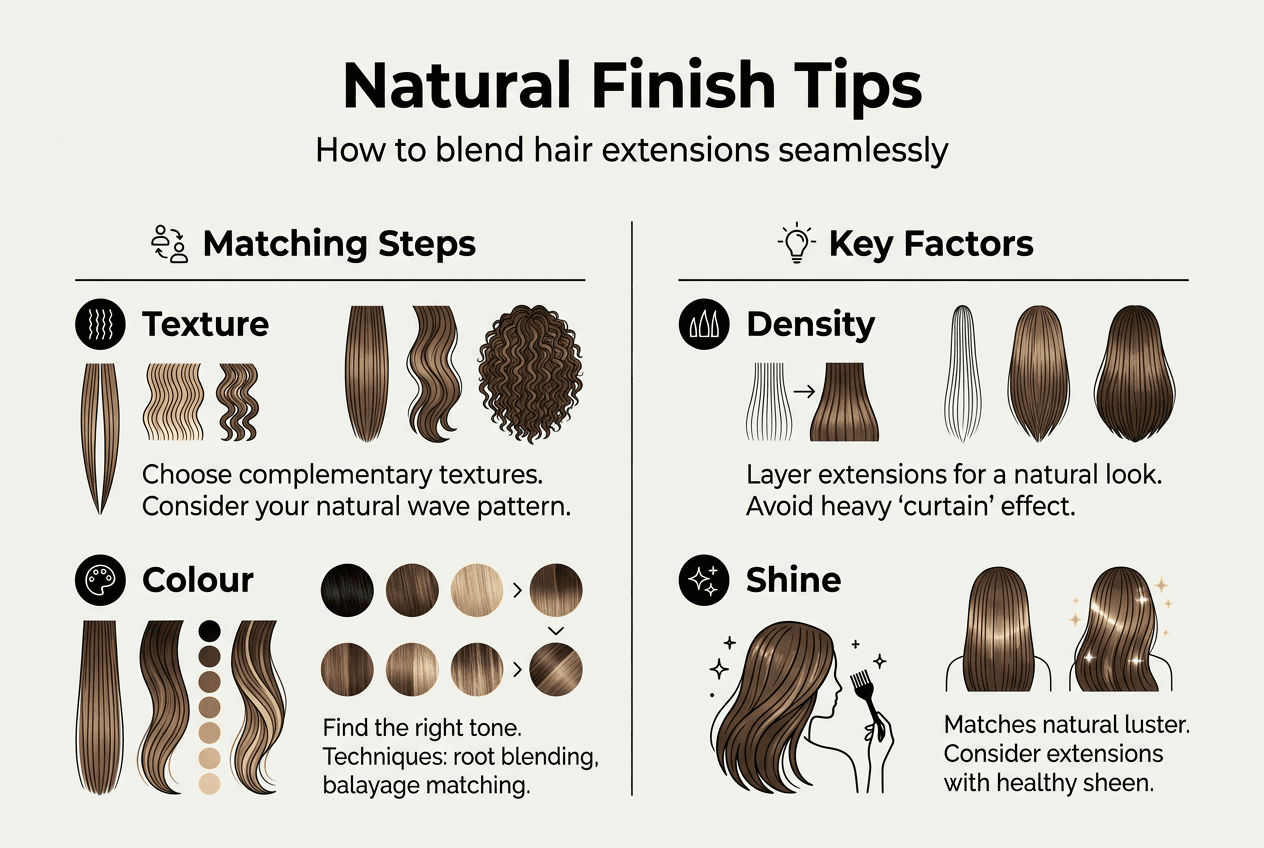
Achieving seamless integration requires precision across multiple dimensions. Texture matching forms the foundation. Your natural wave pattern, whether straight, wavy, or curly, must find its mirror in your extensions. Matching the texture significantly reduces visibility and blending issues, yet many women overlook subtle differences. A 2A wave differs noticeably from 2C, and mixing them creates an obvious demarcation line where textures clash.
Colour presents a more complex challenge than most anticipate. Matching isn’t about finding one identical shade; it’s about replicating the multi-dimensional tones in your natural hair. Your hair contains base colour, highlights, lowlights, and undertones that shift in different lighting. Extensions with flat, single-dimension colour look artificial even when the base matches. Undertone differences become particularly visible outdoors; extensions might match perfectly under indoor lighting but reveal warm or cool discrepancies in sunlight.
Pro Tip: Test extension colour matches in natural daylight and photograph them against your hair. Cameras often reveal undertone mismatches invisible to the naked eye indoors.
Density matching prevents the telltale shelf effect, where extensions create visible bulk or an abrupt thickness change. Your natural hair has varying density from roots to ends, typically fuller near the scalp and finer towards tips. Extensions applied without considering this gradation create an unnatural shelf where your hair suddenly becomes dramatically thicker. Seamless blending requires matching colour, density, texture, and movement to achieve invisible integration.

| Hair texture type | Natural characteristics | Ideal extension match |
|---|---|---|
| Type 1 (Straight) | Smooth, no curl pattern, reflects light evenly | Silky straight with similar shine level, avoid overly glossy |
| Type 2 (Wavy) | S-shaped waves, moderate volume | Match wave depth and spacing, consider 2A vs 2C differences |
| Type 3 (Curly) | Defined curls, springy texture | Replicate curl diameter and bounce, avoid looser patterns |
| Type 4 (Coily) | Tight coils, dense texture | Match coil tightness and density, preserve natural shrinkage |
The role of hair texture in extensions extends beyond visual matching. Different textures behave differently when styled. Straight extensions won’t hold curl as long as wavy ones, whilst curly extensions resist straightening. Mismatched textures limit your styling versatility, forcing you to either straighten everything or curl everything to achieve uniformity. This daily styling requirement damages both your natural hair and extensions, shortening their lifespan.
Consider hair density in extensions as the final piece. If your natural hair is fine, heavy, dense extensions pull and create visible bulk. If your hair is thick, sparse extensions disappear beneath your natural volume, providing no enhancement. Professional assessment determines optimal density, but general guidance suggests matching or going slightly less dense than your natural hair, then building gradually if more volume is desired. This approach maintains matching hair colour extensions naturally whilst allowing adjustment.
Choosing the right human hair extensions for natural results
Human hair extensions, particularly Remy varieties, provide the most realistic finish because their cuticle alignment and structure mirror biological hair. Remy hair maintains all cuticles facing the same direction, root to tip, exactly as hair grows naturally. This alignment allows extensions to respond naturally to heat and styling, moving and reflecting light identically to your own hair. The difference becomes immediately apparent when you run your fingers through properly aligned Remy hair versus processed alternatives; Remy feels silky in both directions, whilst reversed cuticles catch and tangle.
Synthetic alternatives, despite technological improvements, fail to replicate natural finish convincingly. Synthetic fibres lack cuticles entirely, creating uniform surface texture that reflects light differently from human hair. They cannot be heat styled effectively, limiting your ability to blend them with your natural texture. More critically, synthetic extensions maintain their manufactured texture regardless of humidity, weather, or styling, whilst your natural hair responds to environmental conditions. This creates an obvious mismatch when your hair goes wavy in humidity but your extensions remain artificially straight.
Pro Tip: When selecting Remy extensions, verify the cuticle direction by running damp fingers from root to tip, then tip to root. Genuine Remy should feel smooth downward and slightly resistant upward.
The benefits of remy hair extensions extend beyond initial appearance to long term performance:
- Durability: Properly maintained Remy hair lasts 12 to 18 months, whilst synthetic alternatives degrade within months
- Natural texture retention: Human hair maintains its texture through washing and styling without becoming frizzy or matted
- Colour stability: Remy hair holds colour treatments and natural tones without fading to unnatural shades
- Heat styling capability: You can straighten, curl, or blow dry human hair extensions exactly as you would your natural hair
- Movement authenticity: Human hair moves, bounces, and falls naturally rather than maintaining stiff, artificial shape
Understanding what is remy hair helps you evaluate quality. True Remy hair is collected from single donors with cuticles intact and aligned. Lower quality human hair might mix sources, strip cuticles, or reverse direction during processing, compromising the natural finish. When purchasing, ask specifically about cuticle alignment and single donor sourcing. Reputable suppliers provide this information transparently, whilst vague descriptions often indicate compromised quality.
The investment in quality human hair pays dividends in natural appearance and longevity. Whilst synthetic or low quality human hair might cost less initially, frequent replacement and the inability to achieve seamless blending make them more expensive long term. Quality Remy extensions blend invisibly, require less daily maintenance, and preserve your natural hair health by eliminating the need for excessive heat styling to force blending.
Professional application and blending techniques for natural finish
Application method determines whether even the highest quality extensions achieve natural finish. Flat wefts revolutionised blending by sitting close to the scalp without bulk, creating seamless integration that traditional bulky wefts cannot match. The difference lies in construction: flat wefts use thin, flexible bases that conform to your head shape, whilst traditional wefts create rigid lines that show through fine hair or when worn up.
| Application method | Blending capability | Visibility risk | Best for |
|---|---|---|---|
| Flat wefts | Excellent, lies flush | Minimal when properly placed | Fine to medium hair, updos |
| Traditional wefts | Moderate, creates some bulk | Higher at parting and crown | Thick hair, always worn down |
| Tape extensions | Good for length, less for volume | Moderate, can show at roots | Adding length without bulk |
| Micro rings | Excellent for targeted placement | Low with proper colour match | Highlighting, face framing |
Professional blending follows a systematic approach that mimics natural hair growth:
- Assess natural hair growth patterns, noting direction changes at crown, temples, and nape
- Section hair horizontally, creating clean partings that follow natural fall
- Place extensions following growth direction, ensuring wefts angle correctly at sides and back
- Build density gradually from nape upward, avoiding abrupt thickness changes
- Blend edges by leaving natural hair out around hairline and parting
- Customize length by point cutting extension ends to match natural taper
The importance of mimicking natural growth patterns cannot be overstated. Your hair doesn’t grow uniformly; it radiates from crown whorls, angles forward at temples, and changes direction at the nape. Application techniques that mimic these patterns ensure seamless blending. Extensions placed against the grain create visible bumps and prevent natural styling. You’ll find yourself unable to part your hair naturally or style it in your usual direction.
Pro Tip: Avoid visible tracks by ensuring at least one centimetre of natural hair covers the highest extension placement. This buffer zone prevents exposure when you move or style your hair.
Abrupt density transitions cause the shelf effect, where extensions create an obvious line of thickness. Professional application prevents this by gradually increasing density. The first row near the nape might use a single weft, the second row adds slightly more, and subsequent rows build volume progressively. This gradation mirrors how your natural hair thickens from ends to roots, creating an invisible transition.
Avoiding visible tracks requires strategic placement away from natural parting lines and areas where hair naturally separates. The crown, sides above ears, and front hairline demand particular attention. Placing extensions too high in these areas guarantees exposure. Instead, professionals create a perimeter of natural hair that conceals all attachment points. This technique allows you to achieve a natural hairline in extensions whilst gaining the volume and length you desire.
Explore premium natural finish hair extensions in the UK
Achieving the seamless, natural finish you’ve learned about requires starting with premium quality extensions designed for invisible integration. Naturyl Extensions specialises in Remy human hair products that prioritise natural appearance through cuticle alignment and texture authenticity. Their invisible wire extensions offer particularly discreet wear, utilising flat weft technology that sits flush against your scalp for undetectable blending.
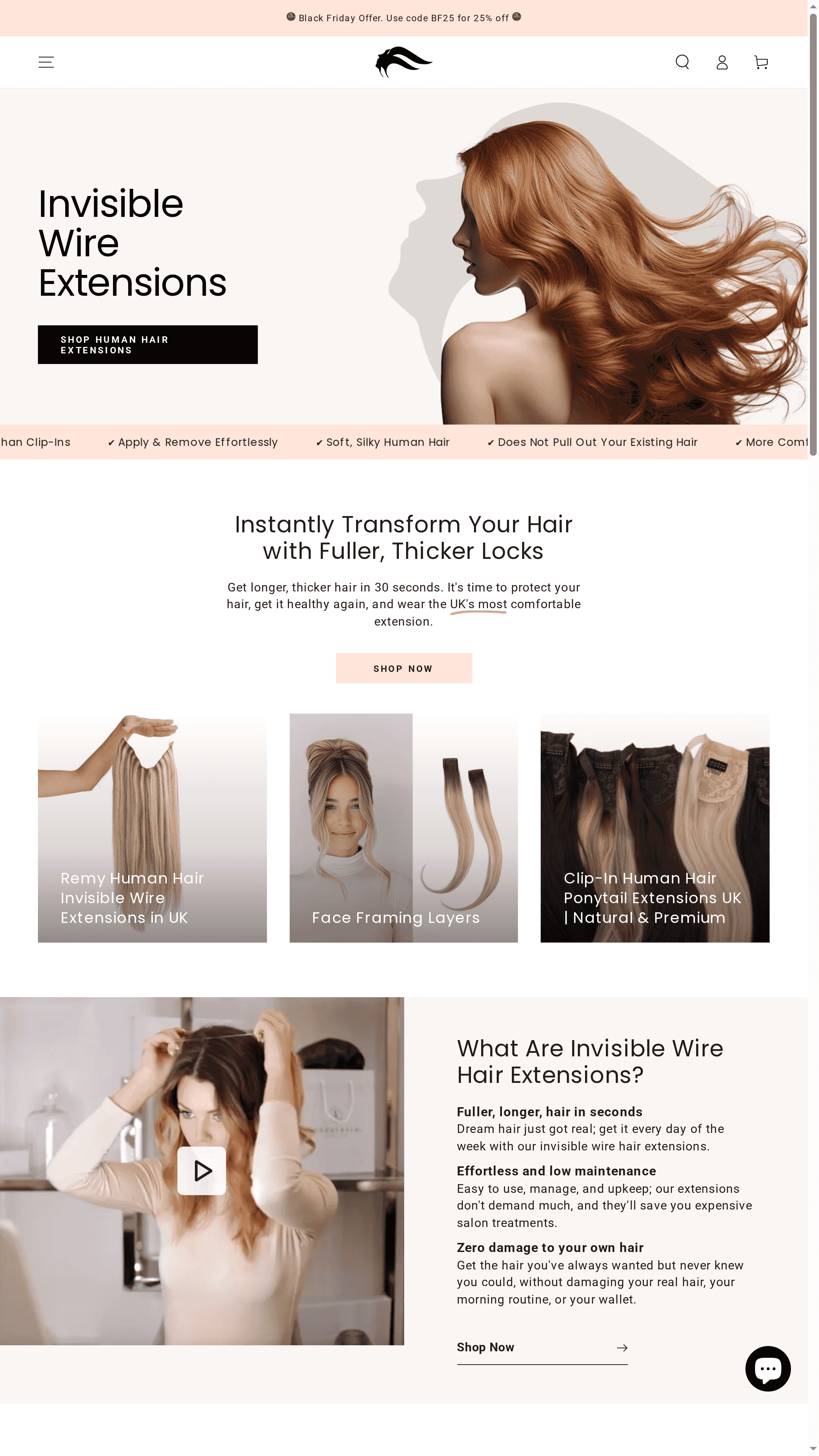
The range includes carefully curated lengths to suit different styling preferences and natural hair lengths. Whether you’re seeking subtle enhancement or dramatic transformation, options like 16 inch human hair extensions provide versatile length that blends naturally with shoulder to mid back hair. The invisible extension wires system ensures comfortable, damage free wear whilst maintaining the seamless finish that makes extensions undetectable. Fast UK delivery and exchange policies remove the risk from trying premium extensions that transform your look whilst preserving natural authenticity.
FAQ
How do natural finishes improve hair extension blends?
Natural finishes reduce shine and texture mismatches that make extensions visible against your biological hair. They mimic natural cuticle alignment, allowing extensions to reflect light identically to your own hair. This creates seamless integration where extensions move and behave exactly as natural hair would.
Can synthetic extensions achieve a natural finish?
Synthetic extensions typically lack cuticle alignment and natural movement, making them more detectable than human hair alternatives. They reflect light uniformly rather than with the subtle variation of natural hair. Additionally, synthetic fibres cannot respond to humidity or styling the way human hair does, creating obvious mismatches in different conditions.
What role does hair texture play in extension blending?
Matching curl pattern, wave depth, and strand thickness prevents visible differences between your natural hair and extensions. The hair texture in extensions must mirror your own for seamless integration. Failure to match texture creates obvious demarcation lines where different textures meet, immediately exposing the extensions.
How can I maintain the natural finish after extension application?
Use gentle, sulphate free products that protect cuticle alignment and prevent tangling or matting. Avoid excessive heat styling that can damage the cuticle structure responsible for natural light reflection. Schedule regular professional adjustments every six to eight weeks to prevent visible growth lines and maintain proper density distribution as your natural hair grows.
Recommended
- Natural Appearance in Extensions – Why It Matters
- Expert Guide to Natural-Looking Hair Extensions UK
- Complete guide to choosing hair extensions for natural look
- Easy Hair Extension Tutorial for Effortless Transformation
- Anti Hair Fall Oil | (Sesame & Herbs With Basil) - Nourishing & – naturessoulshop