TL;DR:
- Coverage area in extensions refers to the specific scalp zones where extensions are placed to add volume and length. Choosing the appropriate method and placement based on thinning patterns ensures natural results and protects natural hair health. Proper assessment, placement, and maintenance are essential for effective coverage and minimal damage.
Coverage area in extensions refers to the specific zones of the scalp where hair extensions are placed to add volume, density, or length, whether that means targeting a single thinning patch or covering the full head. The most common target zones are the hairline, crown, part line, and temples. Methods such as V-Light and Combline, tape-in wefts, and hand-tied wefts each serve different coverage needs, and application time ranges from around 30 minutes to 2 hours depending on how many zones are treated. Understanding your own coverage requirements before choosing a method saves both money and unnecessary stress on your natural hair.
How to determine the right coverage area in extensions for your hair
The first step in understanding extension coverage limits is identifying exactly where your hair needs support. Thinning does not follow a single pattern. Some people lose density along the part line, others notice a receding hairline or sparse temples, and others experience diffuse thinning across the crown. Pinpointing your specific zones before any consultation means you arrive with clear information rather than a vague sense that your hair “looks flat.”
Consider these common scenarios and the coverage zones they typically involve:
- Postpartum shedding tends to affect the hairline and temples most visibly, often requiring targeted partial coverage rather than a full head set.
- Menopausal thinning frequently presents as diffuse crown density loss, where precise strand-by-strand coverage using methods like V-Light and Combline can restore volume without over-extending the application.
- Chemotherapy regrowth involves fragile, short regrowth across multiple zones, making individual strand methods more appropriate than wide wefts that require a minimum hair length.
- Genetic thinning (such as androgenetic alopecia) often concentrates at the crown and part line, where two or three targeted rows of extensions can deliver a significant visual difference.
- General fine hair with no specific loss pattern may benefit from full coverage with lighter-weight methods to add overall body.
The number of zones you treat directly affects both pricing and application time. A single targeted zone using V-Light or Combline can cost as little as £50, while multi-zone or full coverage sessions can reach £500 or more. Expanding coverage area for extensions beyond what your hair genuinely needs adds cost and weight without proportional visual benefit. A good specialist will assess your hair density, length, and scalp condition before recommending how many zones to address.
Which extension method suits your coverage needs?
Choosing the right attachment method is as important as choosing the right coverage zone. Different methods distribute weight differently, and that distinction matters enormously for fine or thinning hair.
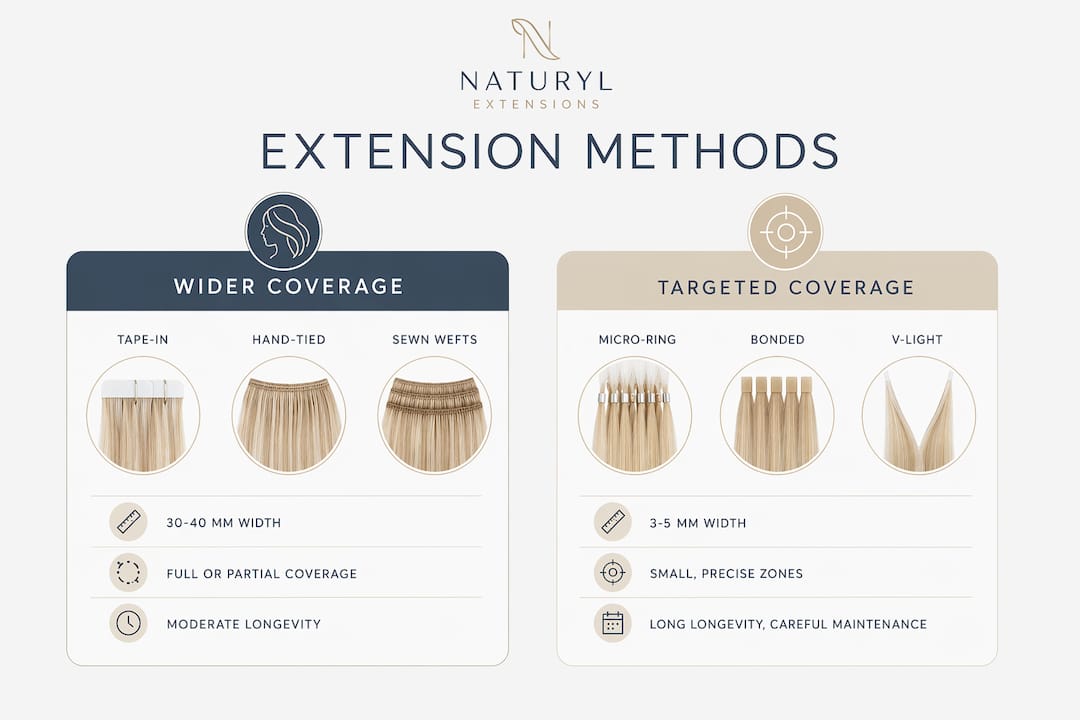

| Method | Attachment width | Best for | Longevity | Damage risk |
|---|---|---|---|---|
| Tape-in wefts | 30–40 mm | Fine or thinning hair, full or partial coverage | 6–8 weeks per refit | Low |
| Clip-in wefts | 30–40 mm | Temporary coverage, events, testing | Removed daily | Very low |
| Hand-tied/sewn wefts | 40+ mm per section | Full or partial coverage, medium to thick hair | 6–10 weeks | Low to medium |
| V-Light and Combline | Individual strands | Targeted thinning zones, short hair, fragile hair | 3–4 months | Very low |
| Micro-ring bonds | 3–5 mm | Thicker hair with no thinning concerns | 3–4 months | Medium to high |
| Keratin-bonded extensions | 3–5 mm | Thicker hair, full coverage | 3–4 months | Medium |
Tape-in and clip-in extensions are widely recommended for fine or thinning hair because their 30–40 mm weft width spreads weight across a larger section of natural hair. This reduces the risk of breakage at any single attachment point. Tape-ins sit flush to the scalp, require no heat or metal during application, and can be refitted every six to eight weeks with minimal disruption to your natural hair.
Micro-ring and bonded extensions attach to sections of only 3–5 mm, concentrating weight on very small points. For anyone with fine or thinning hair, this concentration of weight increases the risk of traction and breakage over time. These methods work well for clients with thicker hair who want precise placement, but they are not the safest choice when coverage area concerns involve fragile or sparse hair.
Hand-tied and sewn wefts offer excellent full or partial coverage. Each weft section requires a minimum of 4 inches (approximately 10 cm) of natural hair width for structural durability, and medium density sets typically use two rows to achieve volume and length. This makes hand-tied wefts less suitable for very localised thinning but highly effective for broader coverage across the crown or back of the head.
Pro Tip: If you are unsure whether to choose tape-in or hand-tied wefts for your coverage needs, ask your stylist to assess your hair’s tensile strength first. Fine hair that breaks easily under light tension is almost always better served by tape-ins or individual strand methods.
Professional techniques to optimise natural look and comfort
Knowing which zones to cover and which method to use is only part of the picture. How extensions are placed within those zones determines whether the result looks natural or obvious.
Skilled stylists follow a set of placement principles that protect hair health while maximising visual impact:
- Place extensions slightly behind and below thinning zones. This allows your natural hair to fall over the bonds or wefts, concealing attachment points and creating the appearance of density growing from the scalp. Extensions placed this way add volume under thinning hair without direct attachment to fragile scalp areas.
- Avoid attaching directly to the hairline. The hairline contains some of the finest, most delicate hairs on the head. Attaching extensions here, even with gentle methods, increases tension risk. Instead, place extensions one to two centimetres behind the hairline and allow natural hair to blend over them.
- Use your natural hair as a concealment layer. At the crown and part line, leaving a thin layer of natural hair free above the extension row creates a seamless blend. This technique works particularly well with tape-ins and hand-tied wefts.
- Blend at the ends with thinning scissors or a razor. Even perfectly placed extensions can look blunt at the tips if the weight line is too uniform. A stylist who understands area coverage in extensions will always blend the ends to match your natural hair’s texture and movement.
- Schedule refits before extensions become loose. Tape-ins need refitting every six to eight weeks. Leaving them longer allows the bond to migrate down the hair shaft, increasing the risk of tangling and breakage.
Pro Tip: Between salon visits, use a hair extension guide to learn how to style your extensions at home without disrupting the bonds or wefts. Brushing from the ends upward with a loop brush is the single most effective habit for preserving both extension longevity and your natural hair’s condition.
Regular maintenance is not optional when extensions are covering thinning zones. Fragile hair that is already under stress needs consistent care to avoid compounding the original problem. Specialist consultations every six to eight weeks allow your stylist to reassess coverage needs as your natural hair changes, particularly if you are recovering from postpartum shedding or a medical hair loss event.
Addressing special circumstances and coverage limits for extensions
Not every hair situation fits neatly into a standard extension plan. Several common circumstances require a more considered approach to coverage area selection.
Short hair presents one of the most frequent challenges. Wide wefts, whether tape-in or hand-tied, require sufficient hair length to attach securely and blend naturally. Clients with hair shorter than approximately 10 cm often find that individual strand methods like V-Light are the only realistic option. These bond to small sections without needing the length that wefts require, making them well suited to clients who want integrated, natural results at an earlier stage of growth.
Recovering from hair loss treatments requires patience alongside the right method. Hair regrowth after chemotherapy is typically fine, fragile, and uneven across the scalp. Applying heavy wefts too early can stress new growth. Individual strand methods applied only to the most visible thinning zones allow coverage without compromising the recovery process.
For those simply wanting to test extensions before committing to a salon application, clip-in wefts offer a practical starting point. They require no adhesive, no heat, and no professional fitting, and they can be removed at the end of the day. Clip-ins do not provide the same seamless coverage as tape-ins or hand-tied wefts, but they give you a clear sense of how much density you actually need and in which zones.
Managing expectations around coverage limits is equally important. Extensions add density and length to existing hair. They do not replace hair that has been lost entirely from a zone, and they cannot attach to areas with no natural hair at all. If thinning has progressed to significant baldness in a specific zone, a consultation with a trichologist alongside an extension specialist will give you the most realistic picture of your options. You can find more detailed guidance on extensions for thin hair to understand what results are genuinely achievable.
Key takeaways
Matching your extension method to your specific coverage zones is the single most reliable way to achieve natural-looking results while protecting your hair’s health.
| Point | Details |
|---|---|
| Define your coverage zones first | Identify whether thinning affects your hairline, crown, part line, or temples before choosing a method. |
| Match method to attachment width | Tape-in and clip-in wefts distribute weight over 30–40 mm, making them safer for fine or thinning hair than micro-ring bonds. |
| Place extensions behind thinning areas | Positioning extensions slightly below and behind sparse zones allows natural hair to conceal bonds and create seamless volume. |
| Short hair needs individual strand methods | V-Light and Combline work for clients whose hair is too short for wefts, bonding to small sections without requiring length. |
| Refit on schedule | Tape-in extensions need refitting every six to eight weeks to prevent bond migration and protect natural hair. |
What I have learned about coverage area decisions
By Sam
After working with clients across a wide range of hair loss patterns and extension methods, the most consistent mistake I see is choosing a method based on aesthetics alone rather than on where the hair actually needs support. Someone will come in wanting a full head of tape-ins because they look beautiful in photos, but their thinning is concentrated entirely at the part line. A targeted two-row application using a lighter method would give them a better result at lower cost and with less stress on their hair.
The trend I find genuinely encouraging is the shift toward partial, targeted coverage rather than automatic full-head applications. Hair extensions applied only to thinning zones can look more natural and cost less than full sets, because the coverage aligns with the actual hair loss pattern rather than covering everything uniformly. When extensions blend with healthy hair rather than sitting alongside it, the result is almost always more convincing.
I also think the conversation about combining methods is underrated. There is no rule that says you must choose one approach exclusively. A client with diffuse crown thinning and a sparse hairline might benefit from hand-tied wefts at the crown for volume and individual V-Light strands at the hairline for precision. This kind of custom mapping is what separates a genuinely skilled extension specialist from someone who applies the same method to every client.
The one piece of advice I give to everyone, regardless of their coverage needs: protect the hair you have. Extensions work best as a complement to healthy natural hair, not as a substitute for addressing the underlying cause of thinning. If your hair is shedding heavily, get a blood panel done before committing to any extension method. Your extensions will last longer, look better, and cause far less damage when your natural hair is in good condition.
— Sam
Find the right extensions for your coverage needs
At Naturylextensions, the focus is on extensions that work with your natural hair rather than against it. The Remy Human Hair Invisible Wire Extensions are particularly well suited to partial coverage needs and fine or thinning hair, sitting comfortably without clips, glue, or heat. For those who already own a wire extension and want to expand their coverage area, additional length wires allow you to increase density and reach without starting from scratch. All products use ethically sourced Remy human hair, with fast UK delivery and a free exchange policy so you can find the right fit with confidence.
FAQ
What is coverage area in extensions?
Coverage area in extensions refers to the specific zones of the scalp and hair where extensions are applied to add volume, density, or length. Common target zones include the hairline, crown, part line, and temples.
Which extension method is best for fine or thinning hair?
Tape-in and clip-in extensions are the safest options for fine or thinning hair because their 30–40 mm weft width distributes weight evenly, reducing the risk of breakage compared to micro-ring bonds that attach to only 3–5 mm sections.
How long does a coverage area extension application take?
Application time ranges from approximately 30 minutes for a single targeted zone to around 2 hours for multi-zone or fuller coverage, depending on the method used and the number of areas treated.
Can extensions be applied to short hair?
Yes. Individual strand methods such as V-Light and Combline bond to small sections of hair without requiring the length needed for wefts, making them suitable for clients with shorter hair who want natural, integrated results.
How often do coverage area extensions need to be refitted?
Tape-in extensions require refitting every six to eight weeks to prevent the bond from migrating down the hair shaft. Hand-tied wefts typically last six to ten weeks before a refit is needed, depending on hair growth rate and care routine.