TL;DR:
- Salon hair extensions are professionally applied, semi-permanent methods tailored to natural hair, offering customization and longevity. Home extensions are temporary, self-applied options providing convenience, with fewer customization possibilities and shorter lifespan. Proper maintenance and professional installation are crucial to prevent damage, regardless of the chosen method.
Salon hair extensions are professionally applied, semi-permanent methods tailored to your natural hair texture, density, and colour. Home extensions, by contrast, are temporary or daily-wear options you apply yourself, without professional tools or training. Explaining salon vs home extensions comes down to one core trade-off: customisation and longevity on one side, convenience and flexibility on the other. Methods like tape-ins, keratin bonds, and hand-tied wefts sit firmly in the salon category, while clip-ins and invisible wire extensions represent the home extension approach. Understanding where each method excels helps you choose the right fit for your hair goals and lifestyle.
How do salon and home extension methods differ?
The application process is where salon and home extensions diverge most sharply. Salon installation typically takes one to four hours depending on the method, and requires a trained stylist with specialist tools. Tape-ins use keratin-based adhesive strips pressed close to the root. Keratin bonds are fused strand by strand using a heat connector. Hand-tied wefts are sewn onto micro-rings or beads anchored to your natural hair. None of these are realistic DIY options.
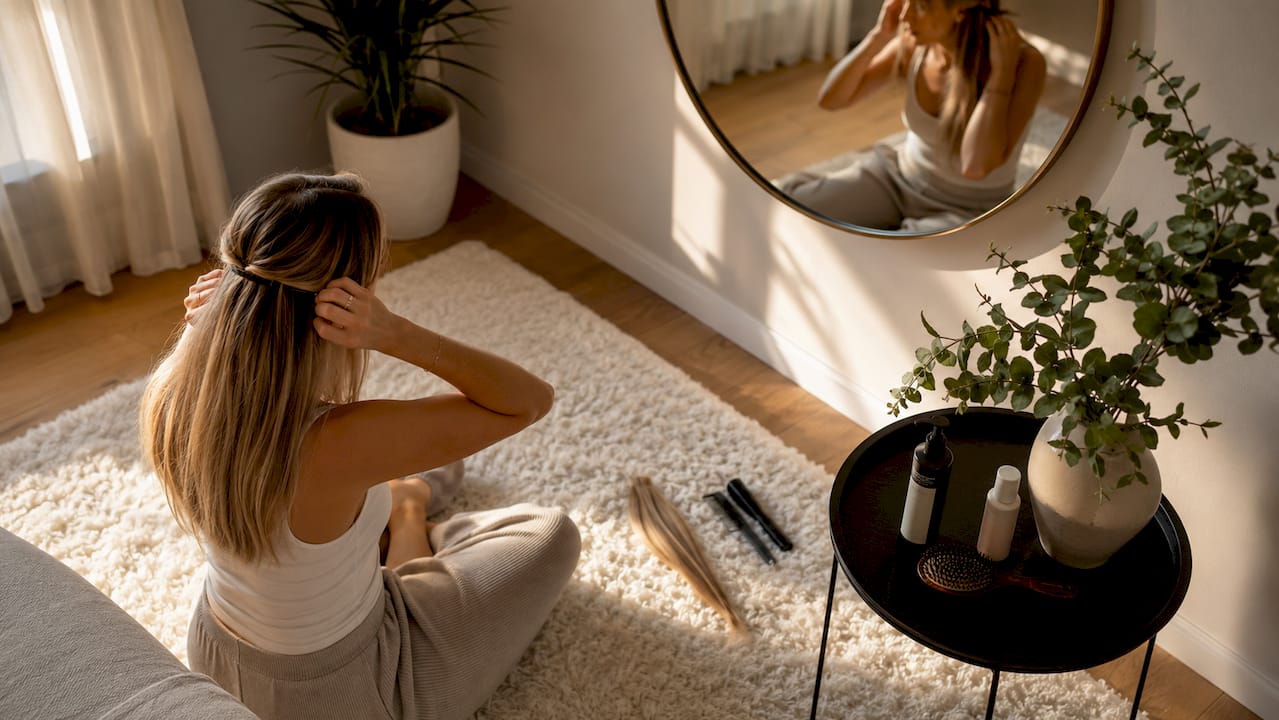
Home extensions work on an entirely different principle. Clip-ins use pressure-grip wefts you snap into sections of your hair in under ten minutes. Invisible wire extensions sit on a near-invisible nylon wire that rests on the crown of your head, requiring no clips, glue, or heat. Both are designed for daily insertion and removal, which means no long-term commitment and no salon appointment needed.
The maintenance cycles are just as different as the application. Salon methods require move-up appointments every six to twelve weeks as your natural hair grows, to reposition the extensions and maintain blending. Home extensions need no professional upkeep, but they do require consistent daily care: proper removal before sleep, gentle brushing, and correct storage.
- Salon methods: tape-ins, keratin bonds, hand-tied wefts, micro-ring extensions
- Home methods: clip-ins, invisible wire extensions, halo-style extensions
- Salon installation time: one to four hours per session
- Home application time: five to fifteen minutes
Pro Tip: If you are new to home extensions, invisible wire styles are the most beginner-friendly option. There is no learning curve with clips or adhesive, and the wire sits comfortably without pulling on your scalp.
Quality, durability, and longevity: salon vs home extensions
Salon tape-ins and hand-tied wefts use 100% human hair, custom-ordered to match your precise colour, texture, and thickness. This level of customisation is the single biggest quality advantage salons hold. Stylist Jen Atkin points out that colour matching over time is a professional skill, because your natural hair colour shifts with sun exposure, toning treatments, and seasonal changes. A salon can adjust the extension shade at each move-up appointment to keep the blend seamless.
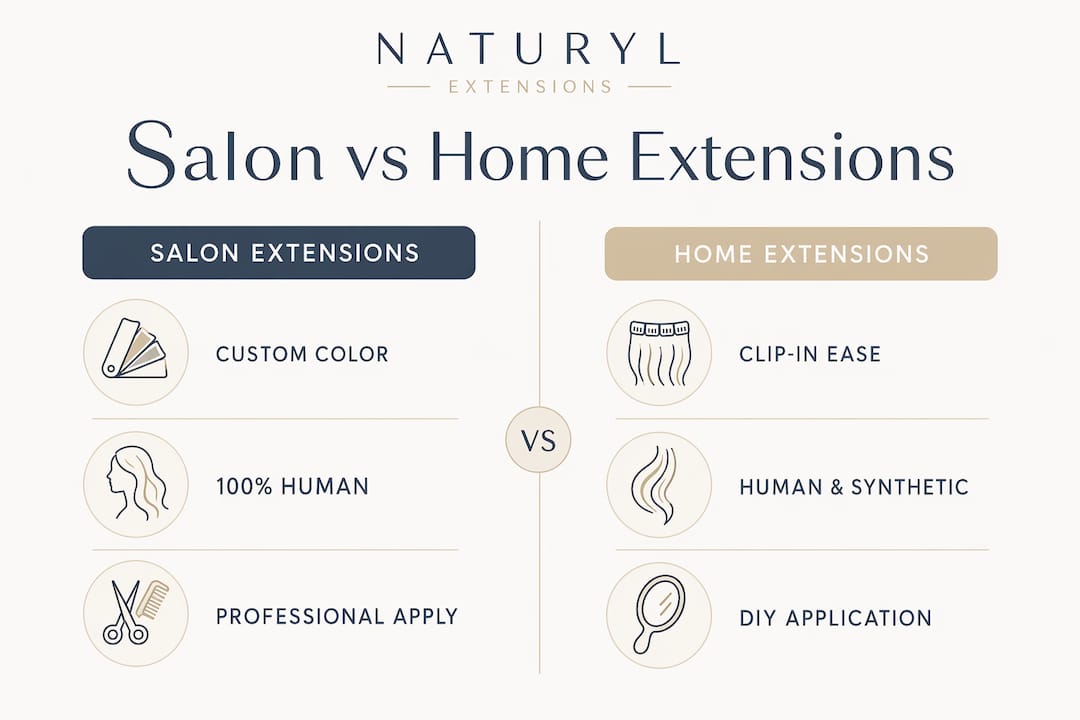
Home extensions are available in both human hair and synthetic options. Premium human hair clip-ins and invisible wire sets, such as those made with Remy human hair, offer a natural appearance and can be heat-styled just like your own hair. Synthetic options are cheaper but cannot be heat-styled and tend to look less natural under close inspection.
| Feature | Salon extensions | Home extensions |
|---|---|---|
| Hair type | 100% human hair, custom-ordered | Human hair or synthetic |
| Colour matching | Professional, personalised | Self-matched from available shades |
| Wear duration | Three to seven months with maintenance | Temporary; clip-ins last six to twelve months with care |
| Application | Stylist required | Self-applied in minutes |
| Styling flexibility | Full heat styling | Full heat styling (human hair only) |
Durability follows a similar pattern. Keratin bonds are the longest-lasting professional method, typically worn for three to five months before a full removal and reapplication. Tape-ins and hand-tied wefts fall in a similar range with regular maintenance. Clip-ins last six to twelve months with proper care, which is a respectable lifespan for a temporary method.
Pro Tip: When buying home extensions, always check whether the hair is Remy grade. Remy hair keeps the cuticles aligned in one direction, which prevents tangling and maintains a natural sheen far longer than non-Remy alternatives.
How do extensions affect your natural hair health?
Hair health is the area where the salon versus home debate gets most serious. Professional installation prioritises even weight distribution and minimal scalp tension, two factors that directly protect your natural hair from traction damage. A skilled stylist assesses your hair density before placing any extension, ensuring no single section carries too much weight.
Improper DIY application of permanent methods, such as attempting keratin bonds or tape-ins at home, causes damage primarily through uneven weight and poor placement. This can lead to traction alopecia over time, a form of hair loss caused by repeated pulling at the root. Extension specialists consider professional installation non-negotiable for any method that stays in your hair continuously.
Home extensions, when used correctly, carry a much lower risk profile. The key word is correctly. Here are the most important care steps for both approaches:
- Brush before washing. Use a soft-bristle or loop brush to detangle from ends to roots before any water contact, whether you wear salon or home extensions.
- Avoid oil-based products near roots. Oil-based styling products dissolve the adhesive on tape-in extensions, causing slippage and matting. Keep serums and oils away from the attachment points.
- Remove home extensions before sleep. Clip-ins and invisible wire extensions should never be worn to bed. Sleeping in them creates friction tangles and puts unnecessary stress on your natural hair.
- Follow a consistent maintenance schedule. For salon extensions, attend every move-up appointment without delay. Overgrown extensions pull unevenly and increase breakage risk. For home extensions, follow a maintenance checklist to keep both your extensions and natural hair in good condition.
- Use sulphate-free shampoo. Sulphates strip moisture from both the extensions and your natural hair, shortening the lifespan of any extension type.
Pro Tip: Fine hair is particularly vulnerable to traction damage from heavy clip-in sets. If your natural hair is fine or thin, opt for lightweight wefts or an invisible wire style, which distributes weight across the crown rather than at individual clip points.
How do the costs of salon and home extensions compare?
Cost is often the deciding factor, and the difference between salon and home extensions is significant. Salon installation typically exceeds £800 to £1,000 when you factor in the cost of the hair itself, the installation fee, and the first maintenance appointment. Ongoing move-up sessions every six to twelve weeks add to that total across the year.
Home extensions have a much lower entry point. A quality set of Remy human hair clip-ins or invisible wire extensions typically costs between £80 and £250 in the UK, with no installation fee. The trade-off is that home extensions require more frequent replacement if used daily, and they do not offer the same level of customisation.
- Salon extensions: high upfront cost, ongoing maintenance fees, longest wear duration
- Home extensions: lower upfront cost, no professional fees, shorter individual lifespan
- Best value for occasional wear: home extensions, particularly clip-ins or invisible wire
- Best value for continuous wear: salon extensions, where cost per day of wear becomes competitive over months
The value calculation depends entirely on how often you want to wear extensions. If you want fuller hair every day for six months, salon extensions can work out cost-effective per wear. If you want extensions for events, weekends, or occasional use, home extensions deliver far better value without the commitment.
Which option suits your hair type and lifestyle?
Selecting the right extension type according to your hair texture is critical to both appearance and hair health. Fine hair benefits most from tape-ins in a salon setting, or lightweight invisible wire extensions at home. Thicker or curly hair holds hand-tied wefts and sew-ins more securely, as the natural texture grips the attachment points. Choosing the wrong method for your hair type can lead to slippage, unnatural blending, or damage.
Lifestyle is equally important. Consider the following when making your decision:
- Active lifestyle: Salon extensions, particularly tape-ins and hand-tied wefts, stay secure during exercise, swimming, and daily activity. Home extensions may shift during high-movement activities.
- Flexibility seekers: Home extensions are ideal if you want to change your look frequently, wear extensions only on certain days, or avoid long-term commitment.
- Event wear: Clip-ins and invisible wire extensions are the go-to for weddings, parties, or photoshoots where you want a transformed look for a single occasion.
- First-time extension users: Home extensions let you test length, volume, and colour before committing to a salon investment.
- Colour-treated or chemically processed hair: Always consult a professional before applying any extension type to compromised hair. A stylist evaluation covers hair density, style goals, and lifestyle to determine the safest method.
The honest answer is that neither option is universally better. Salon extensions suit women who want a continuous, natural transformation with professional support. Home extensions suit women who want control, flexibility, and a lower financial commitment.
Key takeaways
Salon extensions deliver the most natural, long-lasting results through professional customisation, while home extensions offer unmatched flexibility and accessibility for everyday women.
| Point | Details |
|---|---|
| Application method | Salon methods require a stylist and one to four hours; home extensions take minutes with no tools. |
| Quality and colour matching | Salon extensions use custom-ordered human hair; home options rely on self-matching from available shades. |
| Hair health risk | Professional installation protects against traction damage; improper DIY technique is the primary risk factor. |
| Cost comparison | Salon extensions exceed £800 to £1,000 upfront; quality home sets cost £80 to £250 with no ongoing fees. |
| Best fit by lifestyle | Active or continuous wearers suit salon methods; flexibility seekers and event users suit home extensions. |
What I have learned from comparing both options
Having spent years looking at how women experience hair extensions, the pattern I see most often is this: women choose salon extensions for the result, and home extensions for the reality of their daily life. Those two things are not always the same, and that gap is where most disappointment comes from.
The biggest misconception I encounter is that home extensions are a compromise. They are not, provided you choose the right type and quality. A well-made invisible wire set in Remy human hair, properly colour-matched, looks genuinely natural. The colour matching process matters enormously here, and it is something many women underestimate when buying at home.
What I would tell anyone weighing this decision is to be honest about your maintenance commitment. Salon extensions are only worth the investment if you attend every move-up appointment on schedule. Skipping them does not save money. It causes damage that costs more to repair. If your schedule does not allow for that consistency, a premium home extension set is the more responsible choice, not the lesser one.
I also think the professional consultation is underused by home extension buyers. Many salons will assess your hair and recommend a home method if that suits you better. That conversation costs nothing and could save you from a costly mistake.
— Sam
Find your perfect match with Naturylextensions
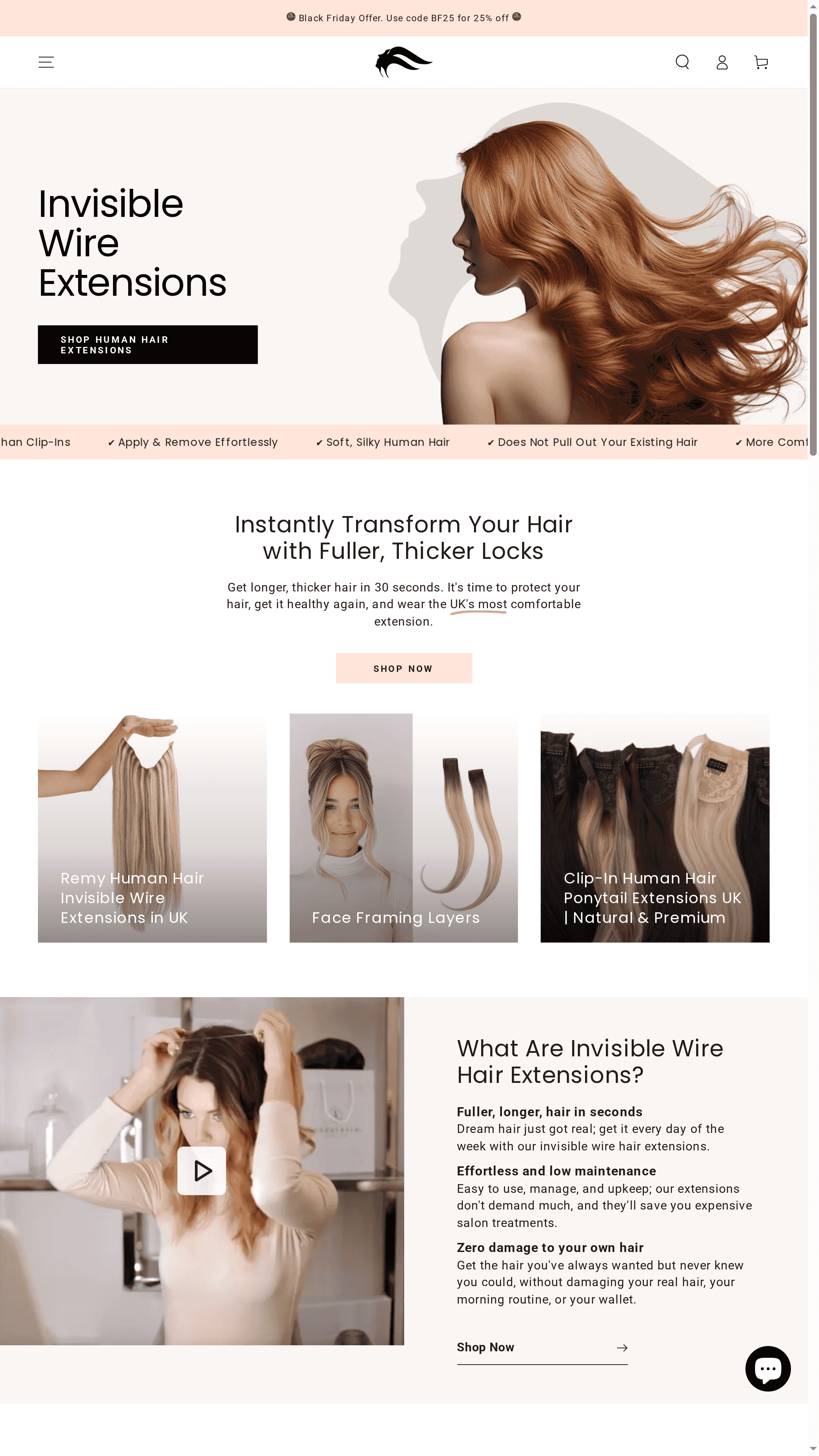
Naturylextensions specialises in premium Remy human hair extensions designed for effortless at-home wear. The invisible wire extensions range offers a genuinely damage-free alternative to salon methods, with the same quality of ethically sourced human hair used by professionals. Each set is available in a wide range of shades to support accurate colour matching, and the free exchange policy means you can get the colour right without risk. If you are ready to explore at-home extension options that deliver salon-quality results without the appointment, Naturylextensions is the place to start.
FAQ
What is the main difference between salon and home extensions?
Salon extensions are professionally applied semi-permanent methods, such as tape-ins or keratin bonds, designed for continuous wear over months. Home extensions, including clip-ins and invisible wire styles, are temporary and self-applied without professional tools.
Do salon hair extensions damage your natural hair?
Professionally installed extensions carry minimal risk when placed correctly, as stylists distribute weight evenly and avoid scalp tension. The primary damage risk comes from improper DIY application of permanent methods or skipping maintenance appointments.
How long do home extensions last compared to salon extensions?
Salon methods such as keratin bonds last three to five months with maintenance every six to twelve weeks. Quality clip-in extensions last six to twelve months with proper daily care, though they are removed and reinserted each day.
Which extension type suits fine hair best?
Fine hair benefits most from tape-in extensions in a salon setting, or lightweight invisible wire extensions at home. Heavy clip-in sets can cause traction on fine hair, so lower-weight options are always the safer choice.
Are home extensions worth buying before trying salon extensions?
Home extensions are an excellent way to test length, volume, and colour before committing to a salon investment. They also suit women who want flexibility or occasional wear without the ongoing cost of professional maintenance.