Invisible wire extensions give you a quick, low-damage way to add natural-looking length and volume without glue, tape, or heat bonds, and they suit fine, short, or thinning hair particularly well. This guide covers everything you need to choose the right accessories, size the wire correctly, fit it step by step, and blend and care for the weft so it looks seamless every time you wear it.
TL;DR:
- Proper sizing involves measuring head circumference and threading the wire through adjustment bands on both ends to ensure even, comfortable fit.
- Lightweight, Remy human hair extensions reduce matting and require gentle washing every 8 to 10 wears, with careful storage and detangling.
- Accessories like spare wires, spare fishing lines, and clips are essential for adjusting fit and avoiding slippage or damage during wear.
- Correct parting, trimming, and styling techniques help conceal the wire line to achieve a seamless, natural look.
- Regular maintenance of fishing lines, clips, and the weft extends the lifespan of extensions and minimizes tangling or fraying.
Table of Contents
- What is a invisible wire extension accessories guide designed to cover?
- Sizing, length and weight: choosing the right set for your goals
- Essential accessories and what each one does
- How do you fit and adjust invisible wire extensions?
- Blending and styling for a seamless finish
- Care, washing and storage best practice
- Common problems and quick fixes
- Naturyl’s approach to invisible wire extensions and accessories
- What invisible wire extension accessory maintenance actually looks like week to week
- Why do invisible wire extension accessories tangle or fray, and how do you stop it?
- What makes a quality invisible wire extension accessory worth buying?
- Why we recommend a minimal starter kit first
- Get the exact accessories this guide recommends
- Sources
- FAQ
What is a invisible wire extension accessories guide designed to cover?
A proper invisible wire extension accessories guide starts with understanding what you are actually wearing, because the accessories only make sense once you know how the base system works. Invisible wire extensions (sometimes called wire hair extensions or invisible wire extensions) are built around a few core components: a clear wire or fishing line that sits across the crown, a single weft of hair attached to that wire, and often a set of removable clips or velcro tabs for extra security underneath.
The wire method sits over your crown rather than being glued, taped, or heat-bonded to individual strands, which is what makes it gentler on natural hair than bonded methods. There is no adhesive residue to strip out later and no heat tool needed at the root, so your own hair is left largely untouched.
Before you buy accessories, run through three quick checks:
- Fit: does the wire sit flat against your head without pinching at the temples?
- Comfort: can you wear it for a full day without pressure building at the crown?
- Concealment: does your natural hair fall over the wire cleanly on both sides?
Get these three right and the accessories you choose next—spare wires, clips, sectioning tools—will simply reinforce a fit that already works.
Sizing, length and weight: choosing the right set for your goals
Getting the length right matters more than most buyers expect, because a set that is too heavy for your hair density will slip, however well you fit it. Brands commonly use a rough length guide where shorter lengths typically sit around the shoulders, medium lengths reach around mid-back, and longer lengths fall near the waist, though exact placement varies by individual. Treat this as a useful starting point rather than a fixed industry standard, since actual placement varies with your height and where your hair naturally falls.
Pro Tip: If you’re between two lengths, size down. A slightly shorter set that blends invisibly beats a longer one that shows a visible line at the weft.
Weight is the second decision, and it comes down to density rather than length alone. A single weft set suits fine to medium hair that just needs a length or volume boost. A double weft set adds noticeably more fullness and works better on thicker hair that would otherwise “swallow” a thin single weft, though it does sit heavier on the crown and needs a securely fitted wire to avoid slippage.
To size the wire itself, follow this sequence:
- Measure your head circumference by running a soft tape measure from ear to ear across the crown, following the natural parting line.
- Compare that figure to the product’s adjustment range, most invisible wire extensions include flexible sizing built into the wire itself rather than a fixed loop.
- Locate both adjustment bands, usually small sliders or loops near each end of the wire.
- Thread the fishing line through both bands, not just one, since most adjustable mechanisms rely on both ends moving together for an even, symmetrical fit.
- Tighten gradually, testing comfort at each stage rather than pulling straight to the tightest setting.
Skipping either adjustment band is the single most common sizing mistake, and it is the reason a wire that felt fine in the packet suddenly digs in once it is worn.
Essential accessories and what each one does
Every invisible wire set arrives with a handful of extras, but not all of them earn a permanent place in your kit. Here is what typically comes in an accessory pack, and what each piece is actually for:
- Additional length wires: a spare wire for a different length or occasion set, letting you switch between a shoulder-length everyday look and a waist-length event style without buying a whole new weft.
- Spare fishing lines: thin replacement lines for the adjustment mechanism, essential because lines wear thin with repeated tightening and stretching.
- Removable clips or velcro tabs: small secondary anchors that clip beneath the wire, recommended for extra hold if you have particularly fine or slippery hair.
- Sectioning combs or clips: used during fitting to hold your top section out of the way while you place the weft.
- Colour tester swatches: small hair samples you hold against your own hair in daylight before committing to a full set.
- A breathable storage bag: keeps the weft protected and untangled between wears.
- Heat-protectant spray: a non-negotiable if you plan to style the extensions with hot tools.
For a first-time buyer, three items matter more than the rest: an additional wire, a couple of spare fishing lines, and a colour tester swatch. The wire and lines are cheap insurance against the two failure points that actually happen (a snapped line or a length that does not suit an occasion), while a tester swatch avoids the far more expensive mistake of ordering the wrong shade outright.
Pro Tip: Order your colour tester swatch a week before any event you’re wearing extensions for. Hair colour shifts slightly depending on season and recent colouring, and daylight is the only honest way to check a match.
Each accessory earns its place through a specific mechanical job. Clips distribute weight across more contact points, easing pressure on the crown. Spare lines let you fine-tune fit on the day rather than living with a slightly-off adjustment until a replacement arrives. Sectioning tools simply make the fitting process below faster and cleaner.
How do you fit and adjust invisible wire extensions?
A clean fit comes down to sequence, not skill. Rushing the order of operations is what causes most of the visible bumps and pressure points people complain about.
Before you start, gather a wide-tooth comb, two or three sectioning clips, a hair tie, and a mirror you can see the back of your head in (a second handheld mirror or your phone’s camera helps enormously).
- Part your hair roughly 2cm behind your natural hairline, running the parting from ear to ear across the crown.
- Gather everything above that parting into a low, tight bun, clipped or tied out of the way so it cannot fall forward during fitting.
- Position the weft starting back-to-front, laying it against your scalp just behind the parting rather than trying to drop it straight down from above. Beginning at the back and working forward gives a more even, secure placement than dropping the wire down from the crown.
- Pull the wire snugly into position, following the curve of your head rather than sitting it in a straight line.
- Route the fishing line through both adjustment bands, checking each side pulls evenly. Missing one band is the single most common cause of a lopsided or loose fit.
- Test for comfort before releasing your top section: shake your head gently, check for pinching at the temples, and adjust the tension while you still have full access to the wire.
- Release your top section and comb it down over the weft to check coverage.
If your hair is particularly fine or the wire still feels loose once fitted, this is where removable clips or velcro tabs come in. Slide them in just beneath the wire on each side, angled slightly downward into your natural hair, then press your top section back down over them. Because they sit under a layer of your own hair, they stay completely hidden.
Pro Tip: Fit your wire in front of a mirror with the light behind you, not in front. Backlighting shows up any gap between the weft and your parting far more clearly than overhead light.
Quick troubleshooting checklist while fitting:
- Wire visible at the crown? Move the parting back another centimetre.
- One side tighter than the other? Recheck both adjustment bands are threaded correctly.
- Weft sitting too high? Lower your top section bun and refit.
- Pressure at the temples within minutes? Loosen the wire slightly rather than pushing through discomfort.
Blending and styling for a seamless finish
The line between “wearing extensions” and “just having great hair” is almost entirely down to blending, and it is worth doing properly rather than skipping to styling.
If your natural hair is one length, a few soft face-framing layers cut into the front section help disguise the weft far more effectively than leaving hair blunt, and this is a technique worth exploring in more detail through Naturylextensions’s ways to blend hair extensions naturally. A light trim to match your extension ends to your natural layers also stops the classic “two textures” look.
For styling, treat Remy human hair extensions the same way you would treat your own healthy hair, with one caveat: always use a heat-protectant spray first, and keep hot tools around 180°C rather than pushing to the maximum setting most straighteners and curlers offer.
Some styles conceal the weft naturally and some fight against it:
- Half-up styles work well because the top section falls forward over the crown, hiding the wire completely.
- Low ponytails are safer than high ones, which pull hair back and can expose the wire line at the nape.
- Buns need a slightly lower placement than you might default to, positioned just below where the weft sits rather than directly over it.
- Sleek, centre-parted looks are the hardest to pull off invisibly and usually need the wire positioned a touch further back than usual.
A quick sweep of your fingers through the crown after styling, checking for any glint of clear wire in strong light, takes ten seconds and saves an entire look.
Care, washing and storage best practice
Remy human hair extensions last considerably longer when they are treated as a separate item from your own hair, not washed, dried, or stored the same way by default.
Wash them roughly every 8 to 10 wears rather than after every single use, using a gentle, sulphate-free shampoo and a lightweight conditioner focused on the mid-lengths and ends, never the wire or weft itself.
For drying and storage:
- Air-dry laid flat on a towel rather than hanging, which stops the weft stretching.
- Never sleep in the wire, weight resting unevenly overnight is one of the fastest ways to loosen the fit and stress the weft.
- Store in a breathable bag rather than a sealed plastic pouch, which traps moisture and encourages tangling.
- Brush gently from the ends upward before storing, never from root to tip.
Accessory maintenance matters just as much as hair care. Fishing lines wear thin with repeated tightening, so check the line for fraying before every wear rather than waiting for it to snap mid-day. Velcro tabs lose grip after heavy use and are worth replacing once you notice them slipping rather than compensating with a tighter wire fit.
Common problems and quick fixes
Most fit complaints trace back to one of three causes, and all three have a straightforward fix.
- Pressure or headaches: loosen the wire slightly, reduce overall weight by removing a clip-in wire if you are doubling up, or reposition the parting a centimetre further back.
- Slippage during the day: retighten the fishing line through both adjustment bands, or add a removable clip on each side for extra hold if you have fine, slippery hair.
- Visible wire or a noticeable bump: re-section your top layer and pull a few thin strands through by hand to break up the line, or shift the wire position very slightly forward or back until it disappears under your natural fall.
None of these require replacing the whole set, just a small adjustment to how it is fitted or supported.
Naturyl’s approach to invisible wire extensions and accessories
Naturylextensions specialises in Remy human hair invisible wire extensions and the accessories that keep them fitting well over time, including additional length wires for readers who want a spare or a different length option on hand.
- Fit and safety advice throughout this guide draws on the same principles used across similar tutorials and support articles.
- Every set uses Remy human hair, which behaves and styles the same way your own hair does.
- Colour matching is handled through an AI colour-match service rather than guesswork against a screen.
If you want to see the sizing and blending techniques above in more visual form, Naturylextensions’s step-by-step guide to flawless natural extensions walks through the same fitting sequence with photographed steps.
What invisible wire extension accessory maintenance actually looks like week to week
Maintenance is less about a big monthly routine and more about small checks built into how you wear and store the set. Before each wear, run a finger along the fishing line to feel for fraying or thinning, particularly near the adjustment bands where tension concentrates. If a line feels rough or has visibly thinned, swap in a spare rather than waiting for it to snap while you’re out.
Velcro tabs and removable clips need a different kind of check. Velcro loses grip gradually rather than failing suddenly, so if you find yourself tightening the wire more than usual to compensate for a tab that used to hold firm, that is your cue to replace it rather than push the wire tighter, which just adds pressure at the crown.
The weft itself needs the least frequent attention but the most care when you do it. A light detangling brush through the ends before storage, done from tip to root rather than root to tip, prevents the small knots that build into matting over several weeks. If you notice shedding at the weft line increasing, it is usually a sign the set needs washing rather than a fault with the hair itself, since product buildup at the base weighs strands down and encourages them to work loose.
Replacing components as they wear, rather than replacing the whole set, is the difference between extensions that last a year or more and ones that get retired after a few months of use.
Why do invisible wire extension accessories tangle or fray, and how do you stop it?
Tangling and fraying are the two complaints that show up most often once fitting itself is no longer the issue, and both usually trace back to friction rather than a faulty product.
Tangling tends to start at the weft’s underside, the part that sits closest to your scalp and gets the most movement throughout the day. Sleeping in the set is the single biggest cause, since hours of movement against a pillow creates the kind of friction that turns smooth hair into knots by morning. Brushing infrequently is the second cause: a quick pass with a soft, wide-tooth brush both morning and evening keeps small tangles from compounding into larger mats.
Fraying on the fishing line itself is a mechanical wear issue rather than a hair care one. Every time you tighten or loosen the adjustment bands, the line flexes slightly at that point, and repeated flexing over weeks eventually weakens the fibre. This is exactly why a spare fishing line belongs in every kit rather than being treated as an optional extra: it is a wear part, not a one-time fitting.
If you notice fraying at the weft edges themselves rather than the line, that is usually product buildup rather than damage, dry shampoo, styling spray, and natural oils accumulate at the base over several wears and make the hair feel rougher than it is. A gentle wash resets this far more often than it signals a genuine quality problem with the extensions.
What makes a quality invisible wire extension accessory worth buying?
Not every accessory pack on the market is built to the same standard, and the difference usually comes down to two things: the hair itself and the mechanical parts around it.
For the hair, Remy human hair is the material worth looking for specifically, since it keeps the cuticle layers aligned in one direction, which is what stops extensions matting and tangling the way non-Remy or synthetic blends often do. Synthetic accessories might look convincing on the shelf, but they cannot be styled with heat tools the same way and tend to lose their shine after just a handful of washes.
For the mechanical parts, wire quality matters more than most buyers expect. A wire that is too rigid will not follow the curve of your head and creates pressure points; one that is too flexible loses tension and slips within hours. Fishing lines should feel smooth rather than gritty between your fingers, gritty or stiff lines are usually the first ones to fray.
Velcro tabs and clips are worth checking for grip strength before you buy rather than after, if a listing does not specify the clip type or material, that is often a sign the accessory pack is generic rather than made to match the specific wire system it is sold alongside. Naturylextensions builds its accessories, including additional length wires, around ethically sourced Remy hair specifically so the wire, weft, and hair quality are matched to work together, rather than assembled from mismatched parts.
Why we recommend a minimal starter kit first
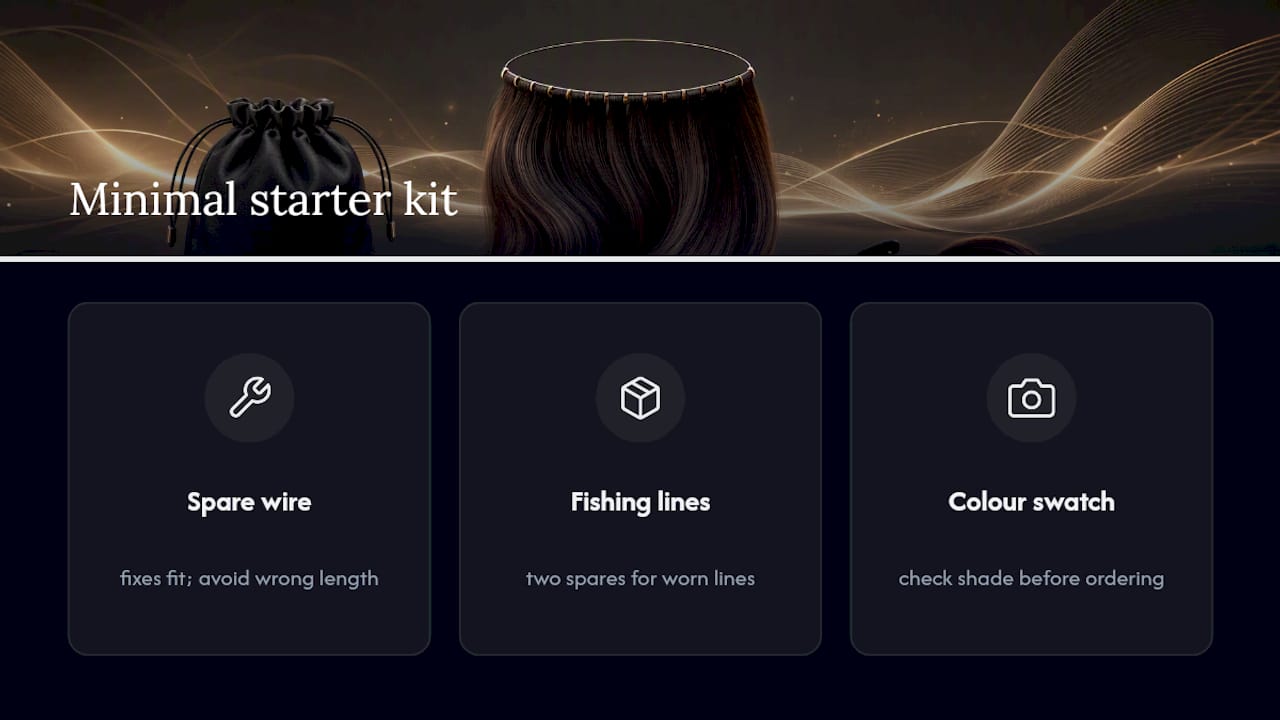
Most people overbuy accessories the first time round, and it rarely improves the result. The kit worth starting with is genuinely small: one additional wire, two spare fishing lines, and a colour tester swatch. That combination covers the two things that actually go wrong (a line wearing out, a length not suiting an occasion) and the one mistake that is expensive to make twice (ordering the wrong shade).
Clips, extra wefts, and a second full set are upgrades worth making once you understand your own hair’s behaviour, not before. If your hair is unusually fine or you are finding the wire slips no matter how carefully you fit it, that is the point to add removable clips rather than tightening the wire further. If you are wearing extensions daily rather than occasionally, a second weft for rotation, so one is always resting while the other is worn, makes more sense than buying premium accessories for a single set.
For anyone still unsure where to start, Naturylextensions’s invisible wire extension tutorial and support pages are built to answer that exact question before you spend anything.
— Sam
Get the exact accessories this guide recommends
Naturylextensions gives you a shortcut past the trial-and-error most beginners go through with wire extensions, an accessory kit and hair quality built to work together from the start, rather than pieced together from separate listings. Every set uses ethically sourced Remy human hair, is colour-matched using an AI colour-match service rather than a guess against a screen, and ships with the fast UK delivery and free exchange policy that make getting the length or shade wrong a non-issue rather than a costly mistake.
If you recognised yourself in the sizing or accessory sections above, the Remy human hair invisible wire extensions page is the natural next step, and the additional length wires page covers the spares this guide recommends keeping on hand. Start with the main set, add a spare wire once you know your fit, and use the free exchange policy if the length or colour needs adjusting after your first wear.
Sources
- How to apply invisible wire hair extensions — USA Hair Support
- Invisible wire hair extensions support — Runature
- Guide to adjust invisible wire hair extensions — Sunny Extensions support
- Choosing the right invisible wire hair extension for your hair type — ISWEET
FAQ
What are the downsides of invisible wire extensions?
The main downsides are potential pressure at the crown if the wire is fitted too tight, some risk of slippage on very fine or freshly washed hair, and a learning curve on parting placement for first-time wearers. All three are fixable with correct sizing and the adjustment technique covered above.
How should beginners wear invisible wire extensions?
Start with a properly measured wire, part your hair around 2cm behind the hairline, secure your top section in a bun, and place the weft back-to-front before threading the fishing line through both adjustment bands. Going slowly through each step matters more than speed on your first few tries.
How do you make invisible wire extensions blend better?
Add soft face-framing layers to disguise the weft line, trim the extension ends to match your natural layers, and choose styles like half-up looks or low ponytails that naturally cover the wire rather than exposing it.
Can you wear invisible wire extensions every day?
Yes, with proper care, though you should avoid sleeping in them and wash them roughly every 8 to 10 wears rather than daily, checking the fishing lines and clips periodically for wear.