TL;DR:
- Ethical hair standards ensure human hair is sourced with donor consent, fair labor, and supply chain transparency. Temple hair sourcing in India exemplifies ethical practices through voluntary donations, documented auctions, and community reinvestment. Supporting verified brands with certifications and transparent practices promotes responsible and sustainable hair care choices.
Ethical hair standards are principles that guarantee human hair and hair care products are sourced and produced with respect for fair labour practices, environmental sustainability, and full supply chain transparency. These standards cover everything from how hair is collected from donors to how finished products are packaged and sold. Understanding what are ethical hair standards matters because the global hair industry has a long history of opaque supply chains, exploitative practices, and misleading marketing. This guide explains the core principles, highlights how temple hair sourcing works in practice, contrasts ethical with unethical methods, and gives you practical tools to make responsible choices.
What are the main principles that define ethical hair standards?
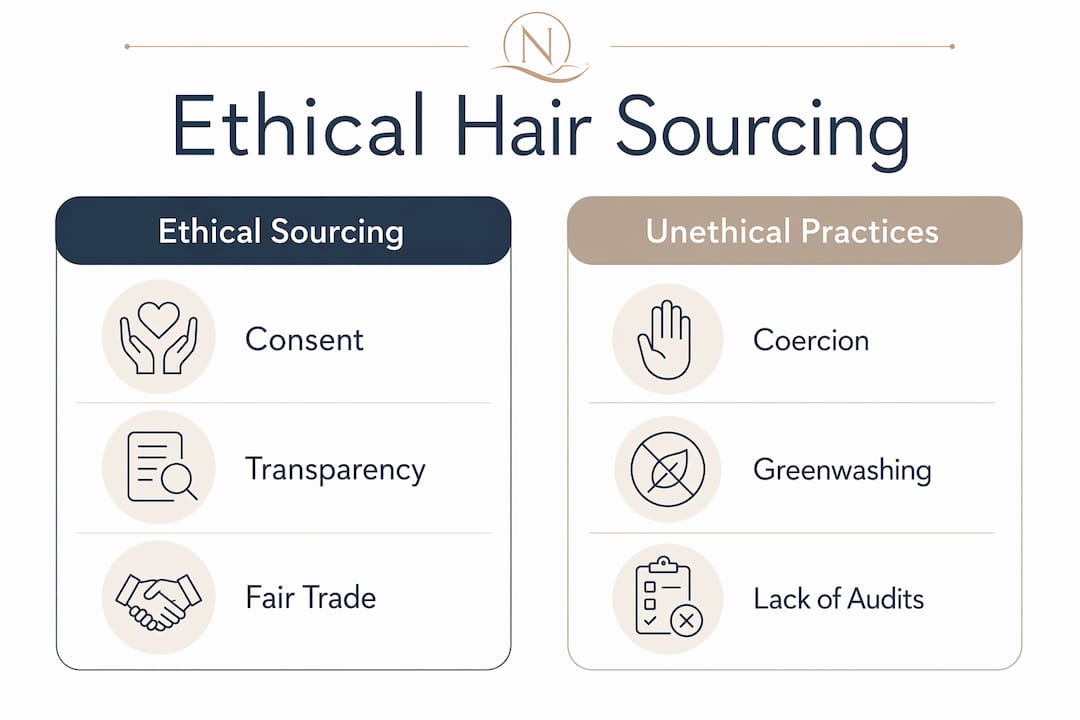
Ethical hair standards rest on six core pillars. Each one addresses a specific point of failure in conventional hair supply chains.
- Voluntary and informed donor consent. Hair must be given freely, without pressure or deception. Donors must understand how their hair will be used and receive fair compensation where applicable.
- Fair labour and fair pay. Workers at every stage, from collection to processing, must receive fair wages and safe working conditions. Verified hair sourcing involves voluntary donations, fair pay, and transparent chain-of-custody tracking from collection to product.
- Full supply chain transparency. Brands must be able to trace hair from its origin to the finished product. This includes batch-level documentation and third-party verification.
- Environmental stewardship. Chemical treatments used in processing must comply with safety standards. Sustainable hair products minimise harmful inputs and prioritise responsible disposal of waste.
- No child labour or coercion. Ethical sourcing explicitly excludes hair collected through exploitation, including from minors or individuals under duress.
- Third-party audits and certifications. Frameworks such as SEDEX and SMETA provide independent verification that a brand’s claims hold up under scrutiny. Ethical hair manufacturers provide supplier declarations and factory audit evidence demonstrating compliance with fair labour and safety conditions.
Pro Tip: Ask any brand you are considering to share its most recent audit summary or supplier declaration. A genuinely ethical brand will have this documentation ready.
Responsible hair branding goes beyond a single certificate. The strongest brands publish their sourcing regions, donor consent processes, and grievance mechanisms openly. Hair product transparency at this level is still rare, which makes it a reliable signal of genuine commitment.
How does temple hair sourcing embody ethical hair standards?
Temple hair sourcing from India is widely recognised as one of the most transparent and ethically sound methods in the global hair industry. The process begins with a voluntary religious practice called tonsuring, in which Hindu devotees shave their heads as a spiritual offering. Temple hair is collected through transparent auctions, supporting health and education programmes sustainably. No donor is coerced. The act is entirely faith-driven.
The ethical integrity of temple hair sourcing is maintained through a documented chain of custody at every stage:
- Tonsuring at the temple. Devotees voluntarily shave their heads as a religious act. Consent is inherent to the ritual.
- Temple auction. Hair lots are sold through public, transparent auctions. Receipts and records are issued, creating the first link in the chain of custody.
- Batch-level tracking. Chain-of-custody logs record each hair lot from temple collection through to processing facilities. These logs are the trade documentation that verifies provenance.
- Processing and quality checks. Hair is sorted, cleaned, and processed under documented conditions. Remy hair, in which the cuticle is kept intact and aligned, is the quality benchmark at this stage.
- Charitable reinvestment. Proceeds from temple auctions fund local health and education programmes. The community benefit is direct and verifiable.
| Stage | Ethical safeguard |
|---|---|
| Tonsuring | Voluntary religious act; no financial coercion |
| Auction | Public process with documented receipts |
| Chain of custody | Batch-level logs track hair to finished product |
| Processing | Supplier declarations and safety compliance |
| Community benefit | Auction proceeds fund charitable programmes |
This model demonstrates that ethical hair care is achievable at scale. It also shows why ethically sourced hair commands a premium. The documentation, auditing, and community reinvestment all carry real costs.
What separates ethical sourcing from unethical or misleading practices?
Unethical hair sourcing takes several forms, and not all of them are obvious. Unethical sourcing includes collection from salon floors, use of child labour, and the absence of fair compensation or informed consent. Hair collected from brushes or salon waste carries no donor consent and no traceability. These practices are prevalent in mass-market supply chains and directly undermine product quality.
Greenwashing is the other major risk. Many products labelled “natural” still use unsustainable palm oil and animal-derived ingredients, misleading consumers about their true ethical credentials. Palm oil derivatives often appear under chemical names such as sodium laureth sulfate or cetearyl alcohol, making them difficult to identify without specialist knowledge. Ethical Consumer advises demanding radical transparency and verifying ingredient sourcing to confirm real compliance.
Pro Tip: Search for palm oil derivatives in a product’s ingredient list using the Ethical Consumer or Soil Association ingredient checkers. “Natural” on the label means nothing without verified sourcing.
| Practice | Ethical sourcing | Unethical sourcing |
|---|---|---|
| Donor consent | Voluntary, documented | Absent or assumed |
| Labour conditions | Audited, fair pay verified | Unverified or exploitative |
| Supply chain records | Chain-of-custody logs | No traceability |
| Chemical compliance | Safety Data Sheets provided | Undisclosed formulations |
| Marketing claims | Backed by third-party audits | Vague terms like “natural” or “clean” |
Due diligence laws such as the EU’s Corporate Sustainability Due Diligence Directive increasingly require businesses to prove ethical supply chain compliance for hair products. This regulatory shift means that documentation is no longer optional for brands selling into European markets. For you as a consumer, it means the legal pressure on brands to be transparent is growing.
How to identify and support ethical hair standards when buying
Knowing how to choose ethical hair products starts with looking beyond the label. Certifications are your most reliable shortcut. Certifications such as Leaping Bunny, B Corp, and USDA Organic provide standardised benchmarks beyond vague marketing claims such as “clean” or “natural.” Each certification has a defined audit process and publicly searchable database, so you can verify a brand’s status independently.

Clean beauty hair standards go further than ingredient safety. Clean haircare is not just free of harmful chemicals. It includes sustainability in ingredient sourcing and packaging. Brands that meet genuine clean beauty standards will disclose their sourcing regions, publish their ingredient origins, and offer refillable or concentrated formats. Replacing single-use plastic packaging with refillable or concentrated haircare products can reduce plastic waste by 70–75%. That figure shows the scale of impact available through packaging choices alone.
When evaluating a brand, work through this checklist:
- Does the brand name the country or region where hair is sourced?
- Is donor consent explicitly described, not just implied?
- Does the brand publish third-party audit results or SEDEX membership?
- Are ingredient lists complete, with no vague collective terms like “fragrance”?
- Does the brand provide a supplier declaration or Safety Data Sheet for chemical treatments?
- Are sustainability claims backed by a named certification rather than self-reported?
Fair trade hair salons and responsible hair branding both depend on the same foundation: published evidence, not promises. If a brand cannot answer these questions directly, treat that as a red flag. The role of ethical sourcing in hair products is not a niche concern. It affects the quality, safety, and social impact of every product you buy.
Eco-friendly hair trends such as waterless formulas, biodegradable packaging, and concentrated shampoo bars are growing in the UK market. These formats reduce environmental load without compromising performance. Brands like Faith in Nature and Ethique have built their entire product ranges around these principles, offering a useful benchmark for what responsible hair branding looks like in practice.
Key takeaways
Ethical hair standards require voluntary donor consent, verified supply chain transparency, and third-party audit evidence at every stage of production.
| Point | Details |
|---|---|
| Consent is non-negotiable | Hair must be given voluntarily, with documented proof of donor agreement. |
| Temple sourcing sets the benchmark | Indian temple hair auctions provide traceable, community-funded, consent-based sourcing. |
| Certifications beat label claims | Leaping Bunny, B Corp, and SEDEX verify standards that “natural” or “clean” labels cannot. |
| Greenwashing is widespread | Palm oil derivatives and vague ingredient terms hide unethical sourcing in many products. |
| Packaging is part of the standard | Refillable formats can cut plastic waste by 70–75%, making packaging a measurable ethical factor. |
Why transparency is the only standard that actually holds up
I have spent years watching the clean beauty conversation shift from a niche interest to a mainstream expectation. What strikes me most is how little has changed at the supply chain level, despite all the noise about sustainability.
The uncomfortable truth is that most brands still treat transparency as a marketing decision rather than an ethical obligation. They publish a sourcing story when it helps sales and go quiet when the details get complicated. The temple hair model is genuinely different. The auction receipts exist. The chain-of-custody logs exist. The charitable programmes are publicly documented. That level of accountability is rare, and it is the standard every brand should be held to.
Consumer pressure works, but only when it is specific. Asking “are you ethical?” gets you a press release. Asking “can I see your most recent SEDEX audit?” gets you a real answer. The UK women’s guide to ethical sourcing is a good starting point if you want a framework for those conversations.
The regulatory environment is also shifting in the right direction. The EU’s Corporate Sustainability Due Diligence Directive will force brands to document their supply chains or face legal consequences. That is progress. But regulation catches up slowly, and the brands doing the right thing now deserve your support before the law requires it of everyone else.
— Sam
Naturylextensions and ethically sourced hair extensions
Naturylextensions sources premium Remy human hair with a commitment to supply chain transparency and responsible production. Every product is designed to give you fuller, longer hair without damage to your natural hair or compromise on ethical standards.
Naturylextensions’ Remy human hair extensions are crafted from ethically sourced hair with the cuticle kept intact and aligned, the quality marker that separates genuine Remy hair from lower-grade alternatives. If you want to understand what makes Remy hair different before you buy, the what is Remy hair page covers the key facts clearly. Fast UK delivery, free exchanges, and a transparent sourcing approach make Naturylextensions a straightforward choice for consumers who take ethical hair care seriously.
FAQ
What are ethical hair standards in simple terms?
Ethical hair standards are principles requiring that human hair is collected with donor consent, produced under fair labour conditions, and sold with full supply chain transparency. They also cover environmental responsibility in processing and packaging.
How can I verify that a hair brand is genuinely ethical?
Look for third-party certifications such as SEDEX, SMETA, Leaping Bunny, or B Corp, and ask the brand directly for supplier declarations or audit reports. Brands that cannot provide documentation are unlikely to meet genuine ethical standards.
Is temple hair sourcing truly ethical?
Temple hair sourcing is considered one of the most ethical methods available because it is based on voluntary religious donation, documented through public auctions, and traceable via chain-of-custody logs. Proceeds also fund community health and education programmes.
What is greenwashing in the hair industry?
Greenwashing occurs when brands use terms like “natural” or “clean” without verified evidence. Many products labelled natural still contain unsustainable palm oil derivatives listed under chemical names, misleading consumers about their true ethical credentials.
Are eco-friendly hair extensions possible?
Yes. Extensions made from ethically sourced Remy human hair, produced under audited conditions and delivered with minimal packaging, meet the core criteria for eco-friendly hair trends. The key is verified sourcing and documented production standards, not just marketing claims.