TL;DR:
- Mastering heat styling for human hair extensions requires controlling temperature and applying protective products to prevent damage. Heat-free methods like roller sets and braiding extend the lifespan of extensions while achieving natural-looking curls. Regular hydration, limited heat exposure, and gentle handling are essential for maintaining healthy, long-lasting curls.
Knowing how to curl human hair extensions without causing damage is something many extension wearers struggle with. The hair behaves differently to your natural locks because it receives no moisture from your scalp, which makes it more susceptible to dryness, frizz, and heat stress. Get the technique wrong and you can shorten the lifespan of extensions that represent a real financial investment. Get it right and you have full, bouncy curls that blend beautifully with your own hair. This guide covers everything from the tools and temperatures you need, to heat-free alternatives that protect your extensions for the long term.
Table of Contents
- Key takeaways
- Preparation and tools for curling extensions
- Step-by-step guide to curling with heat tools
- Heat-free curling methods for longer-lasting extensions
- Maintaining and refreshing curls on extensions
- My honest take on curling extensions well
- Style your extensions with confidence using Naturyl
- FAQ
Key takeaways
| Point | Details |
|---|---|
| Temperature control is non-negotiable | Keep your curling iron between 150°C and 175°C to avoid irreversible cuticle damage. |
| Heat protectant is mandatory | Apply a keratin or argan oil spray before every heat styling session to compensate for the lack of natural scalp oils. |
| Heat-free methods extend extension life | Roller sets and braiding damp extensions overnight deliver lasting curls without any thermal risk. |
| Maintenance locks curls in longer | Water-based leave-ins and curl creams preserve curl shape and keep extensions hydrated between styling sessions. |
| Limit heat styling frequency | Style with heat no more than once every 7 to 10 days to prevent brittleness and premature wear. |
Preparation and tools for curling extensions
The best way to curl hair extensions always starts before you pick up the curling iron. Rushing into styling without the right preparation is the single most common reason people end up with frizzy, damaged results.
What you need before you start
Gather these tools and products before you begin:
- A curling iron with adjustable temperature control. Barrel size determines curl type. A 25mm barrel gives loose waves; a 19mm barrel produces tighter, bouncier curls.
- A quality heat protectant spray. Heat protectant sprays contain keratin or argan oil to compensate for the lack of natural sebum in extensions.
- Sectioning clips. At least six to eight sturdy clips to keep unworked hair out of the way.
- A wide-tooth comb and a loop brush. These detangle without pulling on wefts or bonds.
- A lightweight mousse or curl cream. Applied before styling, these products help define and hold the finished curl.
Your extensions must be completely dry before you apply heat. Styling damp extensions causes the water inside the hair shaft to expand rapidly under heat, which leads to puffiness, frizz, and weakened cuticles. Start with clean, fully dried extensions every time.
Synthetic vs human hair: a critical distinction
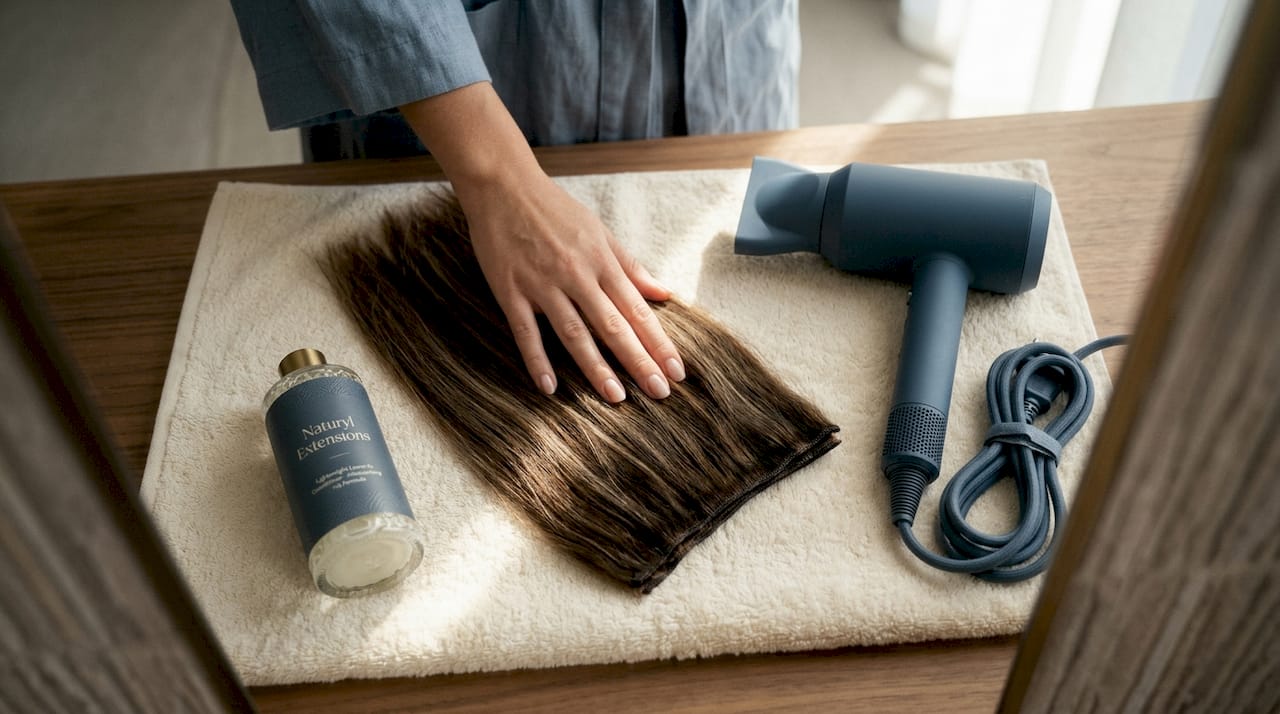
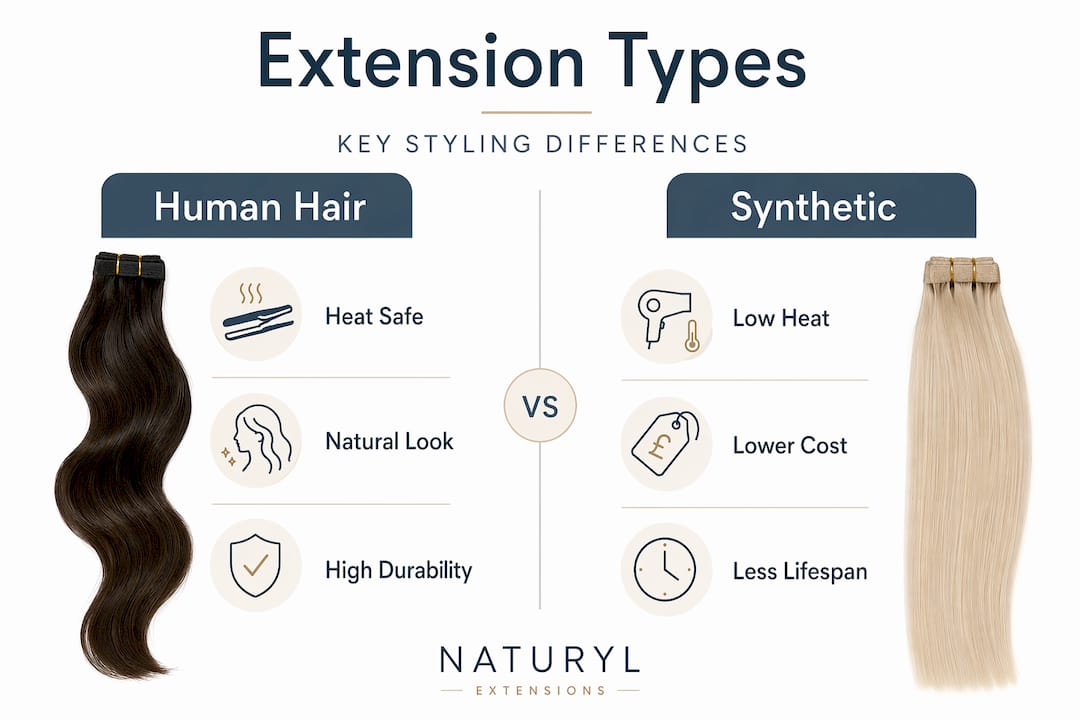
Before anything else, confirm what your extensions are made of. Synthetic extensions melt at temperatures as low as 80°C (180°F), meaning a curling iron set even at a low heat will stick, frizz, or permanently deform the fibres. This guide applies only to 100% human hair extensions. If you are unsure, check the product label or contact your supplier before attempting any heat styling.
| Styling factor | Recommended setting |
|---|---|
| Safe temperature range | 150°C to 175°C (300°F to 350°F) |
| Maximum safe threshold | 190°C (375°F) |
| Heat protectant type | Keratin or argan oil spray |
| Barrel size for loose waves | 25mm to 32mm |
| Barrel size for tight curls | 16mm to 19mm |
Pro Tip: Before styling a full set, test your iron on a small, hidden section of your extensions at your chosen temperature. If the hair looks dry, smells burnt, or loses its smooth finish, lower the heat by 10°C and test again.
Step-by-step guide to curling with heat tools
This curl human hair tutorial is designed to give you consistent results without overworking the hair. Work methodically and avoid the temptation to rush.
-
Clip your extensions in place. Whether you are using clip-in, tape-in, or invisible wire extensions, attach them to your head before curling. Curling installed extensions lets you adjust curl size and direction based on where each section sits, so the finished look blends naturally with your own hair.
-
Divide your hair into horizontal sections. Work from the bottom up. Clip all upper layers away. Each section you work with should be no wider than 2.5cm; thinner sections curl faster and more evenly.
-
Apply heat protectant to each section individually. Spray from about 15cm away and distribute with your fingers. Do not saturate; a light, even coat is all you need.
-
Set your iron to the correct temperature. The safe curling range is 150°C to 175°C. Going above 190°C risks immediate cuticle damage, which shortens extension lifespan significantly.
-
Wrap the hair around the barrel. For loose, natural waves, hold the iron vertically and wrap the hair away from your face. For tighter curls, hold the iron horizontally. Leave the last 2.5cm of the tips unwrapped for a more relaxed, modern finish.
-
Hold for 8 to 10 seconds, then release. Holding any longer increases thermal stress without improving the curl. Release the hair gently rather than pulling it off the barrel.
-
Avoid curling near weft edges or tape bonds. Stay at least 1.5cm away from attachment points. Direct heat on wefts, tape bonds, or micro-rings weakens the adhesive and can cause extensions to slip or shed.
-
Let each curl cool fully before touching it. This is the step most people skip. Releasing and immediately brushing or shaking curls out causes them to drop within hours. Release each curl into the palm of your hand and hold it gently for 10 to 15 seconds, then set it with a clip to maintain the shape while it cools.
Pro Tip: After releasing each curl, pin it back onto your head with a duck-bill clip while it cools completely. Once all sections are done, remove the clips and gently separate the curls with your fingers rather than a brush. The difference in hold is significant.
Heat-free curling methods for longer-lasting extensions
Learning easy methods to curl extensions without heat is one of the most genuinely useful skills for anyone who wears extensions regularly. Heat-free techniques produce softer, more natural texture and put far less stress on the hair. They also let you achieve curls on days when your extensions need a rest from thermal styling.
Roller sets for defined curls
Foam or velcro rollers on lightly damp extensions produce a clean, defined curl that can last several days. The method is straightforward. Mist your extensions with a water and leave-in conditioner mix until they are slightly damp but not wet. Apply a small amount of lightweight mousse from mid-length to ends, then roll each section onto a foam roller, securing it close to the root. Leave the rollers in overnight, or for a minimum of four to five hours if doing this during the day. Once you remove them, separate the curls gently with your fingers and finish with a light-hold hairspray. Non-thermal curling methods such as roller sets are recommended by stylists specifically because they protect the hair and still produce effective, lasting curls.
Braiding for beachy waves
This approach could not be simpler. Work your lightly damp extensions into two or three large, loose plaits. Apply a curl cream from mid-shaft to the ends before plaiting for extra definition. Leave the braids in for several hours or overnight, then unravel them and run your fingers through to loosen the waves. The result is a natural, effortless beach wave texture. Larger plaits give wider, more relaxed waves; smaller plaits give tighter, more textured results.
The twist-and-pinch method
The twist-and-pinch technique works on damp extensions and creates a natural curl texture without any heat at all. Take a small section of lightly damp hair, apply a small amount of curl cream, and twist the section tightly from root to tip. Pin it flat against your head with a bobby pin, then repeat across all sections. Allow the hair to dry completely, then unpin and gently separate the sections.
All three methods benefit from proper moisture preparation. Extensions need hydration through water-based products precisely because they have no scalp connection to supply natural oils.
Maintaining and refreshing curls on extensions
Achieving beautiful curls is only half the task. Keeping them looking good without over-styling is what separates extensions that last a year from those that deteriorate in a few months.
Products that work and products that do not
Water-based leave-in conditioners and lightweight curl creams are your best tools for moisture. Apply a small amount to the mid-lengths and ends after styling to lock in the shape. Avoid heavy oils, thick serums, or alcohol-based sprays. These either weigh the curl down or strip moisture from the hair shaft over time. Regular washing of your extensions with a sulphate-free shampoo removes product build-up that can prevent curls from forming evenly at the next styling session.
Daily habits that protect your curls
- Sleep on a silk or satin pillowcase. Cotton creates friction that roughens the cuticle and causes frizz overnight.
- Loosely plait or twist your extensions before bed to prevent tangling and preserve curl shape.
- Spritz curls with a water and conditioner mix in the morning to revive shape rather than reaching for heat.
- Separate curls with your fingers only. A brush will break up the curl pattern and cause puffiness.
- Limit heat styling to once every 7 to 10 days. Extensions lack the natural nourishment that helps real hair recover from repeated thermal exposure.
Pro Tip: Spritz a mixture of water and a few drops of argan oil onto curls on day two or three. Scrunch gently, then let air dry. This refreshes the shape and adds a little shine without any heat or heavy product.
| What to do | What to avoid |
|---|---|
| Use water-based leave-in conditioners | Apply heavy oils or silicone serums |
| Sleep on a silk pillowcase | Sleep with extensions loose on cotton |
| Separate curls with fingers | Brush curled extensions aggressively |
| Spritz with water mix to refresh | Re-curl daily with heat tools |
| Wash regularly with sulphate-free shampoo | Allow product build-up to accumulate |
| Follow extension care tips between styling | Ignore hydration between heat sessions |
My honest take on curling extensions well
I have seen a lot of people invest in high-quality extensions and then unknowingly shorten their lifespan by over-relying on heat. In my experience, the biggest mistake is not temperature. People generally understand that heat can cause damage. The real problem is frequency. Curling extensions every second day at even a modest 160°C adds up to significant cumulative stress on hair that cannot regenerate the way your natural locks do.
What I have learned is that the quality of the extensions matters enormously. Properly sourced Remy human hair, where the cuticles all run in the same direction, responds to heat far more predictably and holds a curl shape much better than lower-grade processed hair. The investment in quality pays back every time you style.
I am also genuinely convinced that heat-free methods are underrated. Most people treat them as a backup option rather than a first choice. But a roller set done properly on good extensions produces a curl that often outlasts anything achieved with an iron, and the hair feels noticeably softer the next morning.
My practical advice is this: treat your extensions as you would a garment you love. You would not tumble dry a silk blouse every day. The same logic applies here. Gentle, consistent care always outperforms intensive but infrequent attention. Read through long-lasting extension care advice regularly and treat styling as one part of a wider routine, not the whole story.
— Sam
Style your extensions with confidence using Naturyl
If you want curls that look and behave this well, starting with the right extensions makes everything easier. At Naturylextensions, every product in the range is made from 100% Remy human hair, meaning the cuticles run in one direction, the hair responds beautifully to heat styling, and the results look genuinely natural. The invisible wire extensions are particularly popular for curling because they sit flat, blend with your own hair, and hold a curl without the tension that can come with clip-in wefts.
Whether you are looking for 16 inch extensions for a natural length boost or want to explore the full range of styling options, Naturylextensions offers fast UK delivery, a free exchange policy, and ethically sourced hair that rewards careful styling. Browse the full collection and find the extensions that suit your length, colour, and styling goals.
FAQ
Can you curl human hair extensions with a regular curling iron?
Yes, you can curl 100% human hair extensions with a standard curling iron, provided you set the temperature between 150°C and 175°C and apply a heat protectant spray beforehand. Avoid going above 190°C, as this causes irreversible cuticle damage.
Can you curl synthetic hair extensions?
No. Synthetic extensions are not suitable for heat styling. Synthetic fibres can melt, frizz, or permanently deform at temperatures as low as 80°C, which is well below even the lowest setting on most curling irons.
How long should I hold the curling iron on extensions?
Hold each section on the barrel for 8 to 10 seconds. Holding longer increases heat stress without significantly improving the curl, and can damage the hair shaft or weaken attachment points near wefts and bonds.
How often can I curl my human hair extensions with heat?
Limit heat curling to once every 7 to 10 days. Extensions do not receive natural scalp nourishment, so they need adequate recovery time between heat styling sessions to avoid brittleness and premature wear.
What products should I use to maintain curls on extensions?
Use water-based leave-in conditioners and lightweight curl creams to lock in moisture and curl shape. Avoid heavy oils and alcohol-based sprays, which either weigh the curl down or dry out the hair shaft over time.