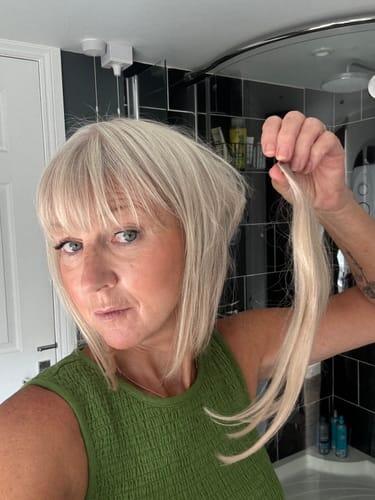
Published September 2026. Based on 301 verified Naturyl customer reviews. Thirty-two of those reviews come from women describing fine or thinning hair; three describe a piece that showed through, and those three are the most useful ones here.
The short answer
An extension hides in thin hair when the hair sitting over it is wider and longer than the piece underneath. That is the whole trick, and in practice it means four things: sit the piece low enough that a full section of your own hair falls over it, choose one light and short enough for your hair to cover, match the shade to your mid-lengths rather than your roots, and end the piece at least an inch shorter than your own hair so there is no line where yours stops.
Get the first one wrong and no amount of styling will save it — which is why the one honest three-star review below is worth more than the rest.
The four ways an extension gives itself away
Across 301 verified reviews only three customers described a piece that was visible on them, and each names a different failure. Together they map the whole problem.
Three of the four are fixed by placement and length, not by buying anything. Only the second costs money, and the cheapest version of that fix is a pair of scissors.
The rule that decides everything: your top layer
Every wire and clip-in piece is hidden by your own hair, not by the product. The honest test before you buy: lift the hair at your crown, let it fall, and see how much of the head beneath it disappears. If a crown section covers the area two to three inches below it, a wire piece will hide. If your scalp shows through when your hair falls, the wire will show through with it, and a topper or a wig is the honest answer instead.
"Please be beware you need lots of hair to go over the extensions. My hair was too thin. So disappointed as it is lovely quality hair and the shade was perfect."sue s., verified buyer
That is a three-star review and we have left it up, because it is the most useful sentence on this page. It is also why small clip-in pieces outsell the one-piece wire on our own store by a wide margin: each clip is about an inch wide instead of a band across the whole head, so there is far less to cover.

Buy lighter and shorter than you think
The most reliable predictor of whether a piece hides is how much hair is in it — and the second is whether it ends before your own hair does. Both point the same way on thin hair: shorter and lighter than instinct suggests.
End it above your own ends — measure from where the wire sits down to the ends of your own hair. That measurement is your maximum. A piece that overshoots is what creates the line people notice.
12 inch, 90g — the right starting point for hair from a lob to shoulder length, and the easiest to cover.
45g Lightweight — half the hair at the same length. If a 90g piece feels like a lot, or your scalp shows when your hair falls, start here instead.
14 inch and beyond — only once your own hair reaches past your collarbone. On thin hair, extra length is extra weight and extra edge to hide.
The aim is a piece your own hair can cover, worn daily rather than twice a year. If a 90g piece feels like a lot, the 45g Lightweight exists for that reason: half the hair, same length, less to hide. One customer solved it herself with scissors.
"I could see the bottom layer of the weft as I do have fine thin hair. I was going to send them back but I decided to keep them. I cut the lower half of the weft off creating much thinner extensions which feel better for me."Jane C., verified buyer

One piece, nothing attached
Invisible Wire Extensions
Sits on a clear wire under your own top layer. A 45g Lightweight version for very fine hair, and 12 inch is the easiest length to hide.
100% Remy human hair · 28 shades · from £89 · Rated 4.7 "Excellent" on Trustpilot · Free UK delivery · Free colour exchanges
Shop invisible wire extensions → Free colour match from a photoHow to hide an extension in thin hair, step by step
- 1Start with day-two hair. Freshly washed fine hair is slippery and lies flat, which is the worst possible cover. A day of texture, or dry shampoo at the roots, gives the top layer body to sit over the piece.
- 2Section from the crown, not the hairline. Use a pin tail comb to take a horizontal section from ear to ear across the crown and clip it up. The section you lift is the section that will hide the piece, so take more than feels necessary.
- 3Place the piece low. A wire roughly level with the tops of your ears, a clip-in an inch below your parting. Placing it high is the most common reason a piece peeks out: there is less hair above it to fall over.
- 4Flatten what's underneath. Brush the hair beneath the wire smooth first. A wire resting on a lump of hair creates the ridge customers describe as a "bump".
- 5Drop the section and shake, don't comb. Combing the top layer down creates a flat sheet with visible gaps; tousling it with your fingers interlaces the two.
- 6Check the back with a second mirror. Front views hide everything; the join shows in profile and from behind, which is where everyone else sees it.
- 7Trim the ends to sit short of yours. The piece should finish an inch or two above your own length. This is the fix for the visible line in straight styles, and worth twenty minutes of a hairdresser's time to point-cut.
- 8Add a bend. A loose wave through the last few inches breaks up the horizontal line where two lengths meet. Dead-straight styles are the hardest to hide.
- 9Secure with two small clips. A wire that slips backward through the day rises up the head and reveals itself; two velcro clips at the sides stop the drift.
Steps two and nine are not extras. The pin tail comb and the pack of velcro clips are two of our three best-selling add-ons — the customers who get the best results are buying tools for placement, not more hair.
What customers with fine hair say
We sell these pieces, so weigh the following accordingly. All are verbatim from verified reviews; the small clip-in pieces average 4.87 across 895 of them.
"Great clip ins that I wash, straighten or curl to suit my mood, no one knows they are there but me and just thicken my fine hair up beautifully!"Steph D., verified buyer
"The clip ins are really discrete and cannot be seen and I have fine hair."Julie G., verified buyer
"My hair is long and this hair piece mixes beautiful with my skinny hair and nobody knows as it's the same length and colour of my own hair."Lorraine G., verified buyer
Lorraine states the rule almost by accident: the same length and colour of my own hair. Both halves matter. A shade right at the roots but wrong at the mid-lengths reads as a stripe in fine hair, because there is less of your own hair to blur it. Match to the length you see in the mirror, and if you are between two shades, take the one closer to your ends.
When it won't hide, and what to do instead
Three situations defeat placement entirely, and it is cheaper to know now.
Not enough hair on top. If your scalp is visible through your own hair when it falls loose, there is nothing to hide a wire under. A topper, which has a parting of its own, or a wig, is the right product. That is also the answer during chemotherapy, when there may be no top layer at all.
Thinning at the parting or crown. Wire pieces sit below the crown and add hair to the lengths, so they do nothing for a widening parting. Small clip-in pieces at the sides, or a scalp-shading powder, address that area directly.
Sudden or patchy loss. If your hair has started shedding noticeably in the last few months, or is coming out in patches, see a GP before buying anything — the NHS hair loss guidance sets out when loss is worth investigating. Extensions cover thinning; they do not treat it.
"A good colour match and easy to fit. I need to disguise the slight 'bump' where it fits on the back of my head, as my hair is quite thin. Overall, a good product which thickens the hair."Moira G., verified buyer
Moira's is the middle case, and the common one: the piece works, the placement needs a centimetre. Most "it shows" problems are that, not a wrong purchase.

Easiest to hide in fine hair
Face-Framing Layers
Two small pieces on inch-wide clips. Far less to cover than a full band, which is why they are our best-selling piece for thin hair.
Front clip-in extensions · 100% Remy · £36 · 4.87 from 895 reviews · Free UK delivery · Free colour exchanges
Shop Face-Framing Layers → Free colour match from a photoHiding extensions in thin hair: your questions
How do you hide hair extensions in thin hair?
Place the piece low — level with the tops of your ears for a wire, an inch below the parting for clips — and pull a deep section of your own hair from the crown over it. Use a lighter, shorter piece than you think you need, match the shade to your mid-lengths, and trim the ends to finish above your own length.
Can you wear hair extensions if your hair is very thin?
Usually yes, but the test is what your own top layer covers, not how thin your hair feels. If your scalp shows through when your hair falls loose, a wire piece will show through with it, and a topper or wig is the better product. Small clip-in pieces need much less hair over them than a full band.
Why can you see my hair extensions?
Almost always one of four things: the piece is sitting too high, the section pulled over it is too shallow, the piece is denser than your own hair so its bottom edge reads as a line, or it is longer than your hair so the join shows. The first two are free to fix.
What length hair extensions are easiest to hide in thin hair?
Short ones. Measure from where the wire sits down to the ends of your own hair and buy at or under that length. Shorter pieces carry less hair, sit flatter and end further from your own ends.
How do I stop my extensions showing when my hair is straight?
Straight styles are the hardest, because the horizontal line where two lengths meet has nothing to break it up. Trim the piece an inch or two shorter than your own hair, have the ends point-cut rather than blunt, and add a loose bend through the last few inches.
Do clip-in extensions show in fine hair?
The clips themselves are the thing to hide, and small pieces with an inch-wide clip are far easier to conceal than a full set with six to eight wefts. Clip an inch below the parting, not at it, and move the position by a centimetre each day so the same strands are not always carrying them.