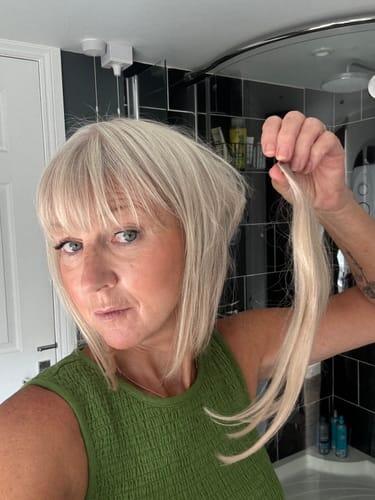
Published September 2026. Written from 395 verified Naturyl customer reviews, including twelve from women wearing extensions in short hair or growing a cut out — and one five-star review from a customer who can no longer wear hers, which is the most useful thing on this page.
The short answer
Extensions work in short hair down to about a collarbone lob, and stop working at a chin-length blunt bob. Two things have to be true: enough of your own hair must fall over the piece to cover it, and your hair must be close enough in length that there is no shelf where yours ends.
If that sounds like your hair, buy the shortest piece made and budget for a hairdresser to cut it in. If it does not, small front clip-in pieces are the only thing that reliably works — and they cost a lot less.
The two-minute test, before you spend anything
Settle this at home before you look at shades or lengths. Let your hair fall naturally.
Find the spot where a band would sit — roughly an inch or two below your crown, level with the tops of your ears. Now check whether a full section of your own hair hangs about four inches below that point.
If it does, you have coverage and a wire piece will hide. If it does not, no amount of styling will save it, and you should be looking at small front clip-in pieces instead.
The test matters more than your total length because it measures the thing that actually does the hiding — the layer falling over the top. It is why two people with hair the same length get opposite results: one has layers, the other a blunt cut.

What works at your exact length
Rather than a yes or no, here is what to expect at each starting point — and what we would actually tell you to buy.
Where it genuinely stops
We would rather tell you before you buy than refund it after. A wire piece needs hair falling over it and hair to blend into; a blunt bob with no layers offers neither. One customer found this out a week after a haircut, and left the review up.
"The hair is fabulous and a great colour match… the only downside, for me, is I’ve had 8 inches cut off my hair last week and now have a blunt LOB so unfortunately now the extensions don’t work! Ah well … maybe I’ll grow my hair again in the future"Helen E., verified buyer
Five stars, from someone who cannot currently wear the product. What changed was not the quality, the colour or the fit — it was the length of her own hair. Above that line the same piece was invisible on her.
How to choose your length — and why shorter is usually right
The instinct is to buy the length you want to have. For short hair that is backwards: a piece that overshoots your own hair is exactly what creates the visible tier. The rule that works is the extension should end at or above where your own hair ends.
Measure in a straight line from where the wire sits down to your own ends. That is your maximum. Our range starts at 12 inches, so if you measure under that, you are buying the 12 inch and having the difference cut off.
12 inch, 90g — the right starting point for anything from a lob to shoulder length. There is also a 45g Lightweight version at the same length for finer hair, which is the least there is to hide.
14 inch, 100g — for hair that already sits at or below the shoulder and you want a little extra length as well as fullness.
16 and 18 inch — genuinely not for short hair. If your own hair does not reach past your collarbone, these will read as a second layer of someone else's hair sitting under yours.
Match to your mid-lengths, not your roots — short hair shows more mid-length tone and less root, so root-matching is a more obvious mistake here than anywhere else. Send a photo and have it checked first.
"I had long hair that needed a restyle but was worried that my new lob would feel too thin. I ordered the 12 inch Beach Wave Remy Human Hair Invisible Wire Extension from Naturyl Extensions… blends as invisibly as the said it would! My stylist still had to cut a lot of the length off which was a bit of a shame, so a 10 inch option would be great"Sarah A., verified buyer
She is right, and it is worth saying plainly: 12 inches is our floor. If your hair sits above the collarbone, some of what you buy will end up on the salon floor.

One piece, nothing attached
Invisible Wire Extensions
Sits on a clear wire under your own top layer, and comes out at night. Start at 12 inch — our shortest piece — and have it cut into your shape.
100% Remy human hair · 12 to 18 inch · from £89 · Rated 4.7 "Excellent" on Trustpilot · Free UK delivery · Free colour exchanges
Shop invisible wire extensions → Free colour match from a photoBudget for the cut, not just the hair
The most repeated advice in our short-hair reviews, and the one nobody expects: for short hair an extension is a raw material, not a finished product. It arrives blunt and one length; your hair is layered and tapered. Left alone they will never match — that is not a fault in the hair, it is a haircut that has not happened yet.
"It was a brilliant match and my hairdresser made it even more so by blending it in and giving it a trim… Will definitely get a spare and get it chopped in again"Emma W., verified buyer
Plenty of people do it themselves and are perfectly happy — take small vertical snips into the ends rather than cutting straight across, while the piece is clipped in and you are wearing it.
"It is a great colour match and the hair is very quick. My hair is quite short currently so I have had to trim the extension, but I might buy another when my hair gets a bit longer."Carolyn C., verified buyer
The part a band cannot fix
A wire piece sits across the back of your head, so it does nothing for the hair around your face — usually the shortest and finest hair you have, and the part you see every time you look in a mirror.
"it’s so well hidden when fitted and I honestly forgot about the wire… The only thing I wished was that it came with a couple of side strands to clip in because my own hair at the front is a lot shorter and thinner."Emma W., verified buyer
That is what the small front pieces are for. Each sits on one inch-wide clip, so there is very little to hide — which is why they still work when your hair is too short for a band, and why they are the sensible place to start if you are unsure.

Works when hair is too short for a band
Face-Framing Layers
Two small pieces on inch-wide clips. Almost nothing to hide, and they fill the shorter, finer hair around your face that a wire piece never reaches.
Front clip-in extensions · 100% Remy · £36 · 29 shades · Free UK delivery · Free colour exchanges
Shop Face-Framing Layers →Making it invisible: four things that decide it
- 1Sit it lower than feels right. Most people place a wire too high the first time. Dropping it a centimetre gives you a deeper section of your own hair to pull over the top, and costs you nothing.
- 2Fit it on day-two hair. Freshly washed short hair is slippery and lies flat — the worst possible cover. A day of texture, or dry shampoo at the roots, gives your top layer body to sit over the piece.
- 3Get it cut in before the first proper wear. Take it to your hairdresser already clipped in and ask them to point-cut it into your existing layers. This is the step that separates "seamless" from "you can see where mine ends".
- 4Never wear it poker straight at first. Straight hair shows a horizontal join the way a flat wall shows a crack. A loose wave through both your hair and the piece breaks the line up completely.
If you are growing a cut out
The most common short-hair story in our reviews is not a style choice. It is someone growing out damage, a bad colour or an awkward length, who wants to look like themselves meanwhile. A temporary piece suits that better than any permanent method: it comes out at night and puts no tension on hair that is trying to recover.
"After going through a blond and back journey, my hair got damaged and I needed to cut my hair so it could grow healthy again. But I struggled with the short length and wasn’t expecting much with the naturyl extension hair, but oh my god - I’m so happy that I ordered it and used the color match tool before hand… My confidence is back up again"D., verified buyer
And once you are back to shoulder length the problem disappears — at that point a wire piece is simply invisible, with no cutting in required.
Common questions
Can you get hair extensions with really short hair?
Yes, down to about a collarbone lob with layers. Below that — a chin-length blunt bob, or a pixie — a wire band has nothing to hide behind and nothing to blend into, and small front clip-in pieces are the only thing that works reliably.
What is the shortest hair extensions will work with?
Test it rather than measure it: you need a full section of your own hair falling roughly four inches below where the wire sits. Layers matter far more than total length, which is why two people with hair the same length get opposite results.
Will hair extensions work with a bob?
A layered, collarbone-length bob, yes, provided the piece is cut down to meet it. A blunt one-length bob, no. The difference is whether there is a soft edge for the extension to disappear into or a hard horizontal line for it to fight.
What length extensions should I buy for short hair?
The shortest one made — ours is 12 inches. Measure from where the wire sits down to your own ends: that is your maximum, and the extension should finish at or above it. Buying longer and trimming works; buying longer and not trimming is what creates a visible second tier.
Do you need to cut in hair extensions?
With short hair, almost always. An extension arrives blunt and one length while your hair is layered, so a hairdresser point-cutting it into your shape is what makes it read as your own hair. Most will do it for the price of a dry trim.
Are clip-ins or a wire piece better for short hair?
Small front clip-in pieces are the safer buy, because each one only has to hide behind a couple of inches of hair and they fill the shorter, finer hair around your face. A wire piece gives fuller all-round volume, but only once your own hair is long enough to cover it.