Updated September 2026. Based on 396 verified Naturyl customer reviews. This is a buying guide, not medical advice. Hair regrowth after chemotherapy varies from person to person, and your oncology team or GP is the right first call about your own scalp and timing.
Hair extensions are a regrowth-stage option, not a during-treatment one. Every wire and clip-in piece needs some of your own hair on top to hide it, so while you have little or no hair a wig, a topper or headwear is the honest answer — with one exception, a wire piece tucked under a headband and scarf, which is covered below. Once your hair has come back far enough to cover a wire at the back of the head, or to hide two small clips near the parting, a piece that attaches to nothing is the gentlest way to add fullness: nothing is glued, clamped or bonded to hair that is still fragile, and it comes off every night. Most people reach that point six to twelve months after their last cycle, but coverage decides it, not the calendar. Below is the headscarf method for during treatment, how to judge when you are ready for a piece on its own, and which lengths and shades suit short regrown hair.
Why a piece on its own doesn't work during treatment
A single-piece extension sits on a clear wire resting on the head, hidden under your own top layer; small clip-in pieces hold with two velcro-lined clips near the parting. Both rely on hair above them to cover the join, and a bare scalp gives a wire nothing to disappear into.
One customer put it more usefully than we could — she bought a piece while unwell, loved the hair, and told us what would have worked better:
"I love this hair. I paid a fortune for a real hair wig and this extension feels so much softer and real for a fraction of the price. If you made these with a very thin cap part instead of the wire for chemo sufferers sick as myself to put under caps and hats, I would buy it in a heartbeat."Susan H., verified buyer
That is the whole issue in one review. During treatment you need something with a cap or a base, or something that borrows one. There is a second reason to be careful even if scalp cooling has left you some hair: the scalp is often tender during and just after chemotherapy, and a wire sized slightly tight is uncomfortable on skin that would be fine months later. The NHS chemotherapy pages cover treatment generally; your own team can say when your scalp is ready for anything resting on it.
The one method that does work during treatment: the headscarf tuck
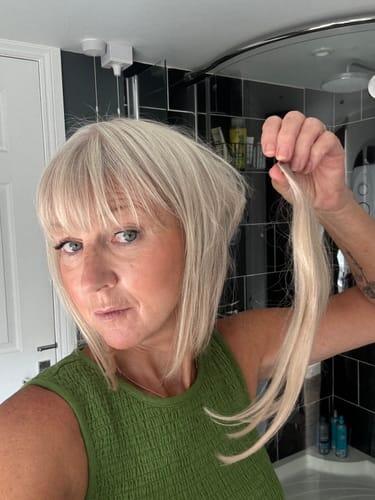
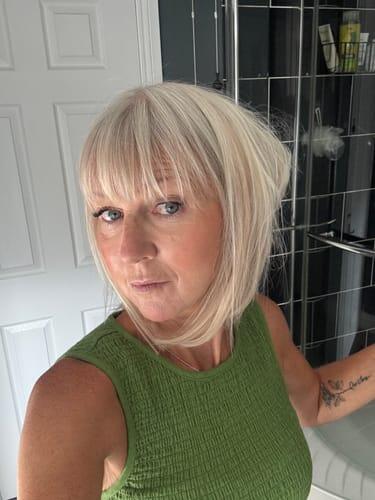
A wire piece cannot hold on its own without hair to hide it, but it can borrow an anchor. Tucked under a soft headband and worn beneath a scarf, it gives you hair around your face rather than a bare edge, and it takes seconds. These are a customer's own photos, taken on a ward.

Before

After
- Put the headband on first. A soft, stretchy band around 3cm wide, from any pharmacy. Sit it slightly forward of where you want the hairline to read.
- Tuck the wire piece under it at the back. The band holds the wire in place and becomes the hidden anchor the piece would normally get from your own hair.
- Tie the scarf over the top, tucking the front edge of the scarf under the band so it cannot slide back.
Two things to get right: go shorter than you think, because a longer piece is a heavier one, and keep the band loose enough that you forget it is there. Nothing on a tender scalp should grip.
When you can start: judge coverage, not the calendar
Regrowth timing is genuinely individual, so rather than a date, here is a test. Look at the back of your head in a mirror, at the level where a headband would sit. If the hair there is long enough to lie flat over your finger, it will cover a wire. If you can hide a hair grip near your parting, you can hide a clip.
| Stage | What the hair is usually like | What tends to work | What to avoid |
|---|---|---|---|
| During treatment and the weeks after | Very sparse to none | Wig, half-wig, or the headscarf tuck above | A wire or clips worn on their own; there is no hair to hide them |
| Early regrowth (soft, short, often a new texture) | Under an inch, covers the scalp but no length | Wig or topper | Wire pieces; clips have nothing to grip and will show |
| Pixie stage | Roughly one to three inches, full coverage | Small fill-in pieces at the sides once hair covers them; a topper if the crown is still thin | Full-length pieces, which will not blend into a pixie |
| Bob or chin length | Enough length to lie over a wire at the back | A 12 inch wire piece for overall fullness; small front clip-in pieces | Long, heavy pieces; the weight fights short hair instead of blending |
| Shoulder length and beyond | Back to a normal cut | Any removable piece, at any length | Bonded, taped and ringed methods while hair is still recovering |
The stage that catches people out is the pixie one. Hair has grown back and it is tempting to add length straight away, but a full-length piece under a two-inch cut has nowhere to hide. Waiting until the back reaches your chin is the difference between a piece that reads as your own hair and one that reads as an extension.

The gentlest place to start
Face-Framing Layers
Two small Remy pieces that clip in beside the parting and hide under your own hair. Nothing bonded, taped or clamped, and off again in seconds. Our most popular piece, in 28 shades including Mature Silver and Grey.
Front clip-in extensions · 100% Remy · £36 · Rated 4.7 "Excellent" on Trustpilot · Free UK delivery · Free colour exchanges
Shop Face-Framing Layers → Free colour match from a photoChoosing for hair that is growing back
Regrowing hair changes month to month, so the piece that works at three months is rarely the one that works at nine. Three things decide it.
Start with the smallest thing that solves the problem. If it is the hair around your face that bothers you, two small front pieces on inch-wide clips will do more than a full band, cost far less, and need almost nothing to hide them. A full wire piece only becomes the better answer once there is enough hair all over your head to cover it.
Buy short. A 12 inch piece sits at the shoulders, which blends with hair grown back to a bob without announcing itself. Anything longer over a short cut has nowhere to disappear into, and it is the single most common reason a piece looks obvious.
Weight matters more than usual. The Lightweight 12 inch is 45g against 90g for the standard — on hair still finer than it used to be, half the weight is the difference between a piece that sits and one that drags.
Check the four inches. Let your hair fall and see whether a section reaches about four inches below where a wire would sit. Until it does, clip-in front pieces and headwear are the honest answer, and there is no rush.
Chemo curls, and hair that grows back a different colour
Regrown hair often comes back a different texture, and frequently greyer or whiter than before. That changes which shade will blend.
It is common enough that we keep four shades specifically for it — Silver Blonde, Ivory, Mature Silver and Grey. Silver Blonde is an ash blonde with silvery lowlights, which is what most people want when grey is coming through blonde or highlighted hair; Mature Silver and Ivory suit hair that has gone mostly white.
Two rules follow. Match your mid-lengths in daylight rather than the roots, because regrowth at the root is often the greyest part and matching to it leaves the piece too light. And if your hair has come back curlier, straighten a section before holding a shade against it: curl makes hair read darker. If you would rather not guess, send a photo through our free colour match; exchanges are free if the shade is wrong.
What customers whose hair is growing back told us
Nine of the 396 reviews we read for this piece are from customers regrowing hair after treatment, surgery, illness or alopecia. We sell these products, so read them with that in mind, but they are verbatim and verified.
"I could not be happier. I used to have very very thick hair but lost a lot of it due to a surgery. Whilst my hair is growing back, I've been miserable with how thin it is. Since getting the invisible wire extension I've felt so confident. It's so easy to fit, comes with everything you need, no one can tell I'm wearing it."Abigail B., verified buyer
"Gorgeous hair in exactly the right colour. My hair is already long but is very thin after illness, the invisible wire hair extensions has given me my confidence back!"Tara C., verified buyer
"It also allows protection of her regrowth as it doesn't pull on the new hair at all. Very happy. Her confidence just got a huge boost."Nadine A., verified buyer
Wearing a piece on regrowing hair, safely
- Ask your team first if you are still in treatment or your scalp is tender.
- Do the coverage test above before you buy anything.
- Size the wire loose. It should rest, not grip. A wire that leaves a pressure line is too tight; swap it for a longer one.
- Start light — a 45g Lightweight piece, or a pair of small front pieces, before anything heavier.
- Skip the optional clips unless you need them; most people find the wire alone holds.
- Take it off at night, every night. Overnight friction does more harm than a full day of wear.
- Keep heat off your own roots. Style the piece separately, under 180°C.
And the honest caveat: a piece covers thinning, it does not treat it. If your hair is not coming back as you expected, that is a question for your GP or oncology team, not a hair shop.

For once your hair reaches your chin
Invisible Wire Extensions
One piece on a clear wire, nothing attached to your own hair. The 12 inch is our shortest length, and the 45g Lightweight is made for hair that is finer than it used to be.
100% Remy human hair · 28 shades · from £89 · Rated 4.7 "Excellent" on Trustpilot · Free UK delivery · Free colour exchanges
Shop invisible wire extensions → Free colour match from a photoQuestions we're asked about extensions after chemotherapy
Can you get hair extensions after chemo?
Yes, once there is enough hair to cover the piece: every wire or clip-in extension hides under your own top layer, so coverage decides it, not a date. Check with your team first if your scalp is still tender.
How long after chemo can you get hair extensions?
It varies a great deal, and we would not put a number on your own regrowth. Most people are ready once the hair at the back of the head is long enough to lie flat over a wire, often six to twelve months after the last cycle. Small front pieces sometimes become possible earlier.
Can you wear hair extensions during chemotherapy?
Not on their own: extensions need existing hair to hide the wire or clips. The exception is the headscarf tuck, where a wire piece sits under a soft headband and the scarf is tied over it, so the band does the holding. A wig or half-wig is the other option at that stage.
Will extensions damage hair that is growing back?
Pieces that attach to nothing put no tension on the follicle: a clear wire rests on the head, small clips hold near the parting, and both come off at night. Methods that bond, tape, clamp or sew into your own strands hang weight on them for weeks — the last thing recovering hair needs.
What length extensions suit short hair after chemo?
The shortest you can get. The 12 inch is our shortest wire length and sits at the shoulders, which blends with hair grown back to a bob. A long piece over a short cut has nowhere to disappear into.
My hair has come back grey and curly. What shade do I match to?
Match the mid-lengths in daylight, not the roots, since regrowth at the root is usually the greyest part, and straighten a section first because curl makes hair read darker. Grey blended with blonde suits Silver Blonde, mostly white hair Mature Silver or Ivory, salt-and-pepper brown Grey under Cool Brown.